
 Yield.ly
On this page7 sections
- The Short Answer on Stablecoin Yield Rules
- How the CLARITY Draft Separates Passive and Activity Rewards
- Enacted GENIUS Rules Versus Draft CLARITY Text
- Treasury Triggers and the 18-Month Sunset
- How Yield Sources Could Shift for DeFi Users
- Worked Example of Net Yield After Costs
- A Six-Step Checklist Before Trusting a Stablecoin Yield
“Stablecoin yield is banned, so all DeFi yield must disappear” is the wrong starting point. An issuer paying a holder for keeping a token, a borrower paying interest, and a trader paying a liquidity-pool fee are different economic arrangements. The useful question is who pays the return, for what action, and under which legal provision?
The CLARITY Act stablecoin yield debate concerns those distinctions, not a single interchangeable category of APY. For holders comparing stablecoins, ETH, BTC or SOL, a policy headline isn't enough to establish either eligibility or investment risk.
The Short Answer on Stablecoin Yield Rules
The GENIUS issuer prohibition and the reported CLARITY draft target holding-based payments, not every mechanism through which a stablecoin position might generate a return. That doesn't establish that any particular lending pool, vault or reward program is legally permitted.
The first task is to label the income source before comparing rates.
Stablecoin yield sources and their treatment in the cited materials
| Yield source | Who pays the return | Treatment in cited materials | What to check |
|---|---|---|---|
| Issuer-paid interest on a payment stablecoin | Stablecoin issuer | GENIUS issuer prohibition is described as enacted | Whether payment is made solely for holding |
| Activity-based reward, including payments, liquidity, collateral and governance | Platform or protocol | Reported CLARITY draft preserves bona fide activity rewards | What action earns the payment |
| Intermediary or exchange reward | Platform, sometimes funded by issuer revenue | GENIUS doesn't expressly prohibit exchange rewards; draft anti-circumvention language could matter | Funding arrangements and resemblance to deposit interest |
| Protocol lending interest | Borrowers | A different payer doesn't establish legal clearance | Borrow demand, withdrawal liquidity and contract risk |
| Liquidity-pool trading fees | Traders | Economically activity-based; draft interpretation remains open | Trading volume and impermanent loss |
| Token incentives | Protocol treasury or emissions schedule | No universal classification is established | Reward share, payment conditions and campaign expiry |
The Congressional Research Service discussion of stablecoin legislation describes the GENIUS framework and the absence of an express prohibition on exchanges paying stablecoin rewards. That distinction supports identifying the intermediary separately from the issuer, not assuming an intermediary arrangement is unrestricted.
Status qualification for 25 November 2026: the White House and CRS materials used here describe the GENIUS issuer prohibition as law. The CLARITY stablecoin-yield provisions discussed here are draft or negotiated language, and their enactment as settled law isn't independently confirmed here.
A holder should verify the latest bill status and controlling text on Congress.gov before acting. An official summary can explain a provision, but it isn't a substitute for the enacted statute, effective-date provisions or implementing rules.
Practical rule: Two matching APYs aren't comparable until their payer, qualifying action and underlying exposure are identified.
A stablecoin yield ban at the issuer level therefore answers a narrower question than whether a particular on-chain position can continue generating borrower interest or trading revenue.
How the CLARITY Draft Separates Passive and Activity Rewards
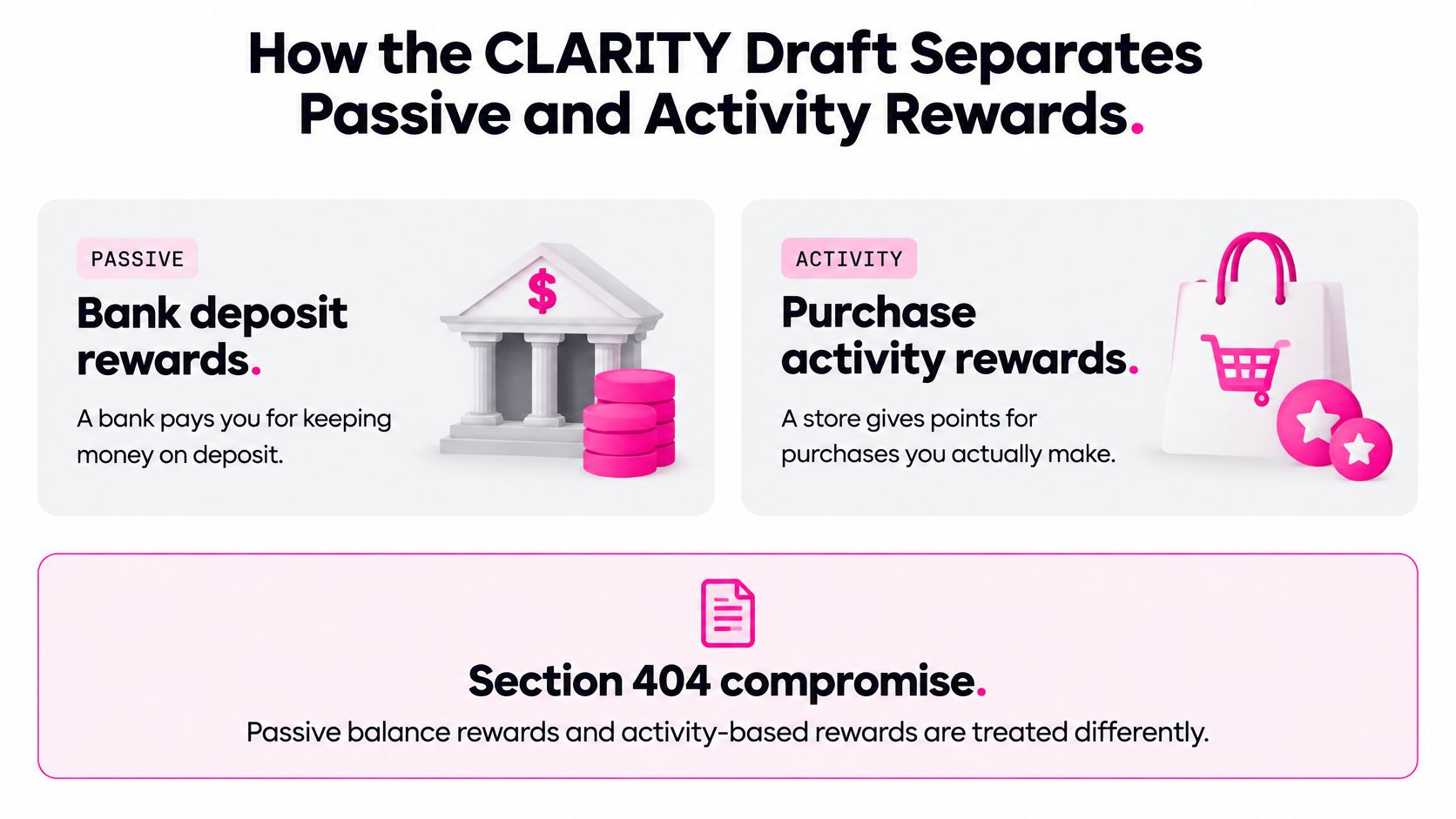
A bank pays interest for keeping money on deposit. A store gives points for purchases made. The distinction is useful because one payment rewards a balance, while the other rewards an action.
The analogy has limits. A platform can't necessarily convert deposit-like interest into an activity reward by requiring a nominal click or calling the payment a loyalty benefit.
The conceptual distinction is illustrated below.
Economic substance matters more than the label
Galaxy's account of the Section 404 compromise and subsequent draft describes a prohibition on service-provider payments made solely because a customer holds a payment stablecoin or maintains a balance, while preserving bona fide activity and transaction rewards that aren't economically or functionally equivalent to bank-deposit interest. This is a secondary account of negotiated language, not independent verification of current statutory text.
That account also describes an anti-circumvention test. Calling a payment a rebate, incentive or loyalty benefit wouldn't resolve its treatment if the payment's mechanics reproduce deposit interest.
Consider these illustrative arrangements, without assuming either has received legal approval.
| Question | USDC supplied to a lending market | Idle USDC receiving a custodial reward |
|---|---|---|
| Economic source | Interest paid by borrowers | Platform-funded payment |
| Customer action | Supplies assets to a lending arrangement | Maintains an eligible balance |
| Exposure accepted | Protocol, borrower and withdrawal-liquidity exposure | Platform and reward-program exposure |
| Classification question | How lending activity and provider roles are treated | Whether the payment is holding-based or deposit-equivalent |
A lending position involves more than ownership of the stablecoin. The holder supplies capital under a separate arrangement, accepts its withdrawal conditions and bears its risks. That economic distinction matters, but it doesn't settle how legislators or regulators classify a specific interface or provider.
Record separate fields, not a blended promise
A comparison worksheet should distinguish:
- Passive balance APY: Compensation received because an eligible balance remains in place.
- Activity-qualified rewards: Compensation requiring a genuine payment, transfer, liquidity contribution or other qualifying action.
- Underlying strategy yield: Income generated by lending, trading fees or another deployed strategy.
These are classification fields, not necessarily additive components. A platform's displayed total may already include several components, so adding them again would double-count income.
The explanation of base APY versus reward APY addresses another necessary separation: income from the underlying strategy versus additional token rewards. A legal classification worksheet and a yield-composition worksheet answer different questions.
Four facts deserve particular attention: who pays, the action required, sensitivity to balance size or holding duration, and economic equivalence to deposit interest. Final classification remains a question for controlling bill text, implementing rules and qualified counsel, not an APY label or this article.
Enacted GENIUS Rules Versus Draft CLARITY Text
The assumption that an issuer restriction covers every subsequent use of a token confuses the asset with the arrangement generating income. The GENIUS rule described by the White House targets a specified payment by a specified payer.
The White House Council of Economic Advisers analysis describes Section 4(a)(11) as prohibiting permitted payment-stablecoin issuers and foreign payment-stablecoin issuers from paying interest or yield, including cash, tokens or other consideration, solely because a holder keeps, uses or retains the stablecoin. That prohibition is enacted text. The CLARITY provisions addressing stablecoin rewards remain draft proposals, and readers should treat them as such until enactment is confirmed.
Illustrative example: an issuer advertising 5% for holding 1,000 tokens would fit the issuer-paid holding-return scenario described in that analysis. Moving the tokens into another arrangement changes the facts requiring examination, not automatically the legal answer.
The intermediary gap requires a funding map
The same White House analysis notes that the statute doesn't explicitly prohibit affiliates or third parties from offering interest-bearing products. Its discussion includes Coinbase USDC Rewards and funding connected in part to Circle's revenue-sharing agreement with Coinbase. An issuer-level ban narrows one payer. It doesn't eliminate every mechanism by which a holder can still earn a return.
The resulting diligence questions are concrete:
- Payment obligation: Which legal entity owes the holder the reward?
- Funding chain: Does the intermediary receive issuer revenue that supports the payment?
- Contract terms: Is the payment discretionary, promotional or contractually specified?
- Eligibility: Does the holder need to perform an activity beyond maintaining a balance?
For a separate jurisdictional perspective, Glentorion on systemic stablecoin oversight provides context on UK oversight. It isn't authority for interpreting US issuer restrictions.
Keep a dated authority record
A dated record keeps enacted text and draft text from blurring together. For each authority a holder relies on, the record should capture what that document is:
| Authority | Status to record |
|---|---|
| Congress.gov enacted text | Enacted law, with effective dates checked separately |
| Congress.gov proposed or amended text | Proposal unless enactment is confirmed |
| Official committee release | Explanation of the version it describes |
| Regulator statement or rule | Interpretation, proposal or final rule, explicitly identified |
A summary shouldn't be stored as though it were statutory text. Statutory silence about one arrangement also doesn't establish that arrangement's legality under other applicable rules.
Treasury Triggers and the 18-Month Sunset
The reported emergency mechanism is narrower than its name implies. Activation runs through a governmental finding about deposit flight from community banks, not through any move in a stablecoin rate.
The official Senate explanation of the reported CLARITY text describes a written determination by the Treasury Secretary that deposit flight is occurring from community banks on a substantial scale, followed by required rules restricting payment-stablecoin rewards, with the authority expiring 18 months after enactment. That sequence describes the reported proposal, not a confirmed operative restriction.
An illustrative timeline
The sunset works as a fixed window measured from enactment, not as a named calendar deadline. Adding the proposed 18-month period to any signing date produces an expiration exactly 18 months later, so a bill enacted near the start of one year would see the authority lapse midway through the following one.
The operational sequence would run:
- Enactment: The statutory clock begins.
- Written determination: Treasury identifies the specified deposit-flight condition.
- Rulemaking: Treasury issues restrictions under the relevant authority.
- Sunset: The authority expires on the statutory schedule.
The duration of any resulting restriction is a separate question. Reading the final statute and rule, including transition or survival provisions, would be required before treating the lapse of rulemaking authority as the end of every legal effect created under it.
Apply the trigger to components
An illustrative 6% quoted annual return bundling borrower interest, liquidity fees and temporary rewards shows why the trigger analysis happens at component level. A restriction on payment-stablecoin rewards would not automatically erase the entire quoted figure.
The relevant question is which component, which payer and which token fall within the restriction's actual scope. Borrower interest or trading-fee income could sit outside a particular reward restriction, but that conclusion follows only from the rule's text, not from the yield's label.
A position log should retain three items:
- Token classification: Payment stablecoin or another instrument.
- Reward payer: Issuer, intermediary, protocol or another entity.
- Activation event: The determination and rule that would affect the payment.
The USYC explainer gives useful background when comparing instruments whose legal and economic structure may differ from a payment stablecoin. A dollar-denominated asset should not be assigned a payment-stablecoin rule merely because its displayed price resembles a dollar.
How Yield Sources Could Shift for DeFi Users
A holder comparing opportunities needs an income map, not a prediction about where capital will move. An issuer-level restriction doesn't itself establish whether borrowers will demand more credit, traders will generate more fees or a protocol will continue distributing incentives.
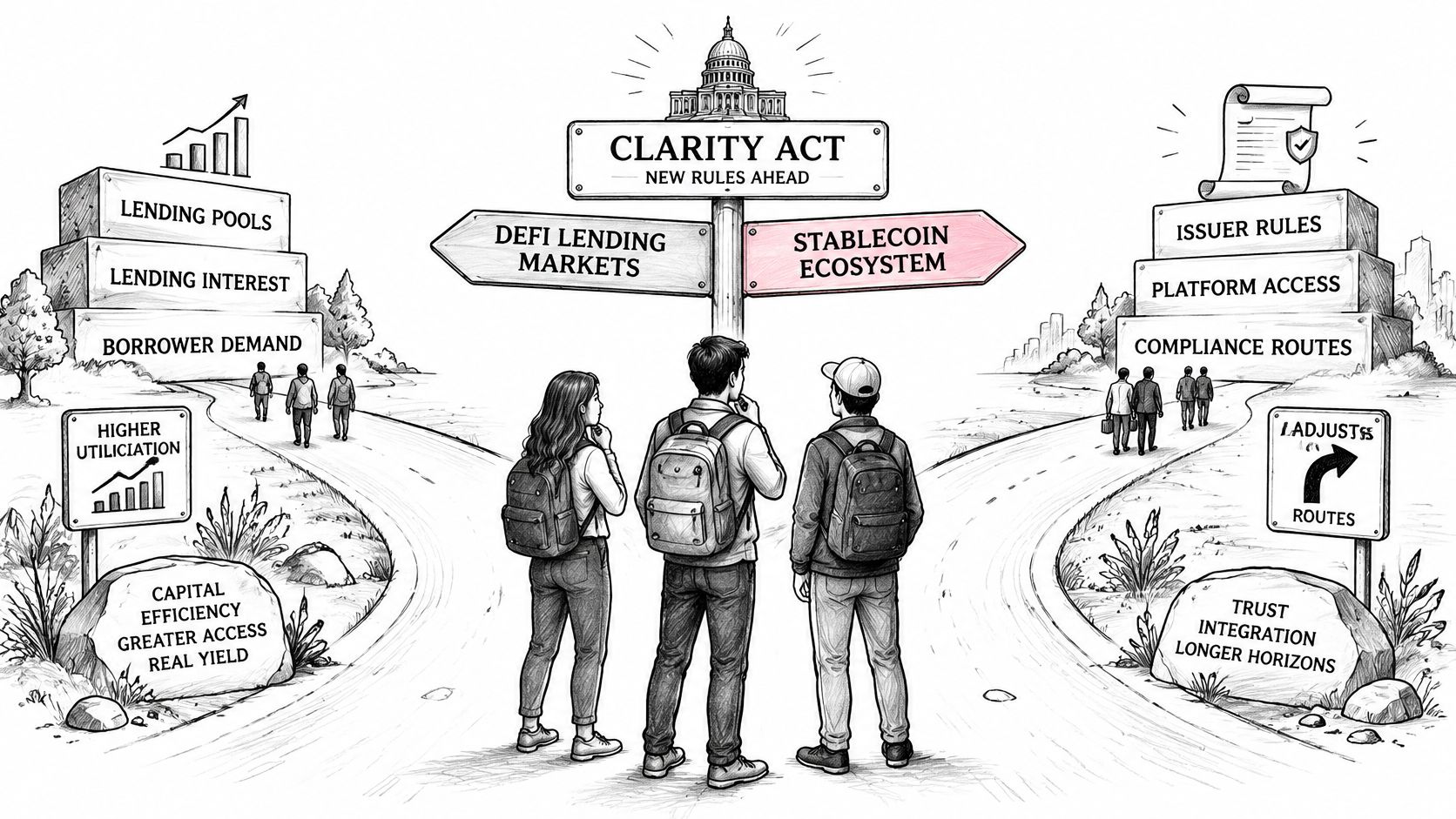
The distinction between lending and stablecoin issuance is illustrated below.
Follow each economic mechanism
Lending interest comes from borrowers. Examine borrowing demand, collateral requirements, utilization and available withdrawal liquidity rather than assuming the stablecoin issuer supplies the return.
Liquidity fees come from trading activity. Lower volume can reduce fee income, while price divergence between pooled assets can create impermanent loss that offsets or exceeds fees. A pool containing stablecoins still needs depeg analysis.
Token incentives are separate compensation. Their value can decline because emissions end, eligibility changes or the reward token loses value. The reward share of total displayed APY therefore indicates how much of the quoted return relies on something other than the underlying activity.
Vaults add another layer. A vault can allocate funds among strategies, compound rewards or use borrowing, so the holder must inspect both the underlying positions and the vault's own contracts and withdrawal terms.
The BIS analysis of stablecoin-related yields identifies consumer-protection, financial-stability and conflict-of-interest concerns, including greater runnability when promised yields fail to materialize and stress spreads across issuers and service providers. The practical implication is that reward sustainability and redemption liquidity belong in the same assessment.
A supplementary video is embedded below; it isn't a substitute for the cited legal authorities.
Risks that survive a change in reward rules
- Smart-contract failure: Examine audit scope, upgrade permissions, incident history and whether the deployed contracts match the reviewed version.
- Depeg risk: Check reserve reports where applicable, redemption access and the assets supporting the token.
- Liquidation: A holder borrowing against ETH, BTC, SOL or stablecoins should inspect collateral ratios and liquidation conditions, not just the income on the supplied asset.
- Impermanent loss: Compare the pool position with holding its constituent assets, including a scenario where one stablecoin loses its peg.
- Oracle failure: Identify price feeds, fallback behavior and how stale prices affect collateral valuation.
- Bridge failure: Check the bridge's custody or verification model, contract status and any withdrawal restrictions.
- Issuer or counterparty failure: Identify legal redemption rights, custodians and dependencies on intermediaries.
- Incentive decay: Read the emissions schedule and calculate the position without rewards.
The guide to where stablecoin yield comes from provides mechanism-level background. Protocol, smart-contract, asset, liquidity, market and platform risks still apply to yields displayed on Yield.ly; a favorable regulatory classification wouldn't remove them.
Worked Example of Net Yield After Costs
A quoted annual rate says little about whether a short switch pays for itself. Costs can absorb a meaningful part of the income, especially when the deposit is small or the holding period is brief. The useful test is the net result over the actual holding period, with the payer and mechanism separated from the headline rate.
Every number below is hypothetical and illustrative, not a current market quote. The calculation uses a $10,000 deposit, a 30-day holding period, and simple pro-rata interest rather than compounded APY. That last choice matters: Yield Alpha calculates earnings as simple pro-rata APY over the user's horizon, with no compounding in v1.
Calculate income before adding assumptions
The illustrative formula is:
Gross period income = principal × annual rate × days ÷ 365
For the hypothetical base return:
$10,000 × 5% × 30 ÷ 365 = approximately $41.10
For an additional hypothetical average token incentive:
$10,000 × 2% × 30 ÷ 365 = approximately $16.44
After illustrative entry and exit swap costs:
$41.095890… + $16.438356… − $25 = approximately $32.53
If the distributed incentive tokens lose 40% of their assumed value before realization, with all other hypothetical inputs unchanged:
$16.438356… × 60% = approximately $9.86
$41.095890… + $9.863013… − $25 = approximately $25.96
The cut from $32.53 to $25.96 comes from reward quality, not from a change in the stated APY. That is the point of separating base income from token compensation. A return funded by borrowers, trading activity, emissions, or another mechanism should not be treated as interchangeable merely because each appears as a percentage.
Illustrative 30-day net result on a hypothetical $10,000 deposit
| Scenario | Incentive (30 days) | Costs (illustrative) |
|---|---|---|
| 5% base APY only | $0 | $0; base income and net result approximately $41.10 |
| 5% base plus 2% average token incentive | Approximately $16.44 | $25 in swaps; net result approximately $32.53 |
| Same base and incentive, reward token value falls 40% | Approximately $9.86 | $25 in swaps; net result approximately $25.96 |
Calculations use unrounded values, so re-adding rounded figures can differ by a cent. These examples exclude gas, bridge and separate withdrawal costs unless added explicitly.
A switching decision should compare the destination's net income with the income forgone by leaving the existing position, not with zero.
That comparison is stricter than a fresh-deposit calculation. An existing position already has an income stream, and leaving it creates an opportunity cost. Yield Alpha gives a MOVE, STAY, or WATCH decision based on dollar thresholds plus durability checks, so an insufficient edge can remain under observation instead of being recast as a worthwhile switch.
Complete the cost ledger
The illustrative swap charge isn't an all-inclusive cost estimate. A reproducible calculation also needs:
- Gas: Approvals, deposits, reward claims and withdrawals.
- Trading friction: Swap fees, price impact and slippage.
- Bridge costs: Transfer charges and costs associated with moving back.
- Exit conditions: Withdrawal fees, lockups, queues and early-exit penalties.
- Reward realization: The token price when rewards are sold, not merely when displayed.
The explanation of DeFi yield after gas fees provides additional cost context. A locked position also cannot be treated as freely available cash throughout the comparison period.
Yield.ly is a public crypto yield intelligence dashboard for comparing qualified opportunities by asset, return, liquidity, and observed risk, with no wallet required. Its opportunity tables show current APY, 30-day average APY, stability score, and reward share, which helps readers rebuild the calculation with current inputs and inspect yield composition instead of relying on headline APY. Rankings consider yield quality, liquidity, observed risk and data confidence rather than headline APY alone, and the methodology explanation provides comparison context.
The Yield Stability Score runs from 0 to 100 and combines alignment with 30-day history, reward share, observed rate durability, and recent TVL trend. It is a research aid, not a guarantee of future rates. Dashboard APY is a point-in-time reading, not a promise about what a user will average over the next month. Yields are variable and never guaranteed. Yield.ly and Yield Alpha are research tools, not financial advice, and observed risk isn't a safety guarantee.
A Six-Step Checklist Before Trusting a Stablecoin Yield
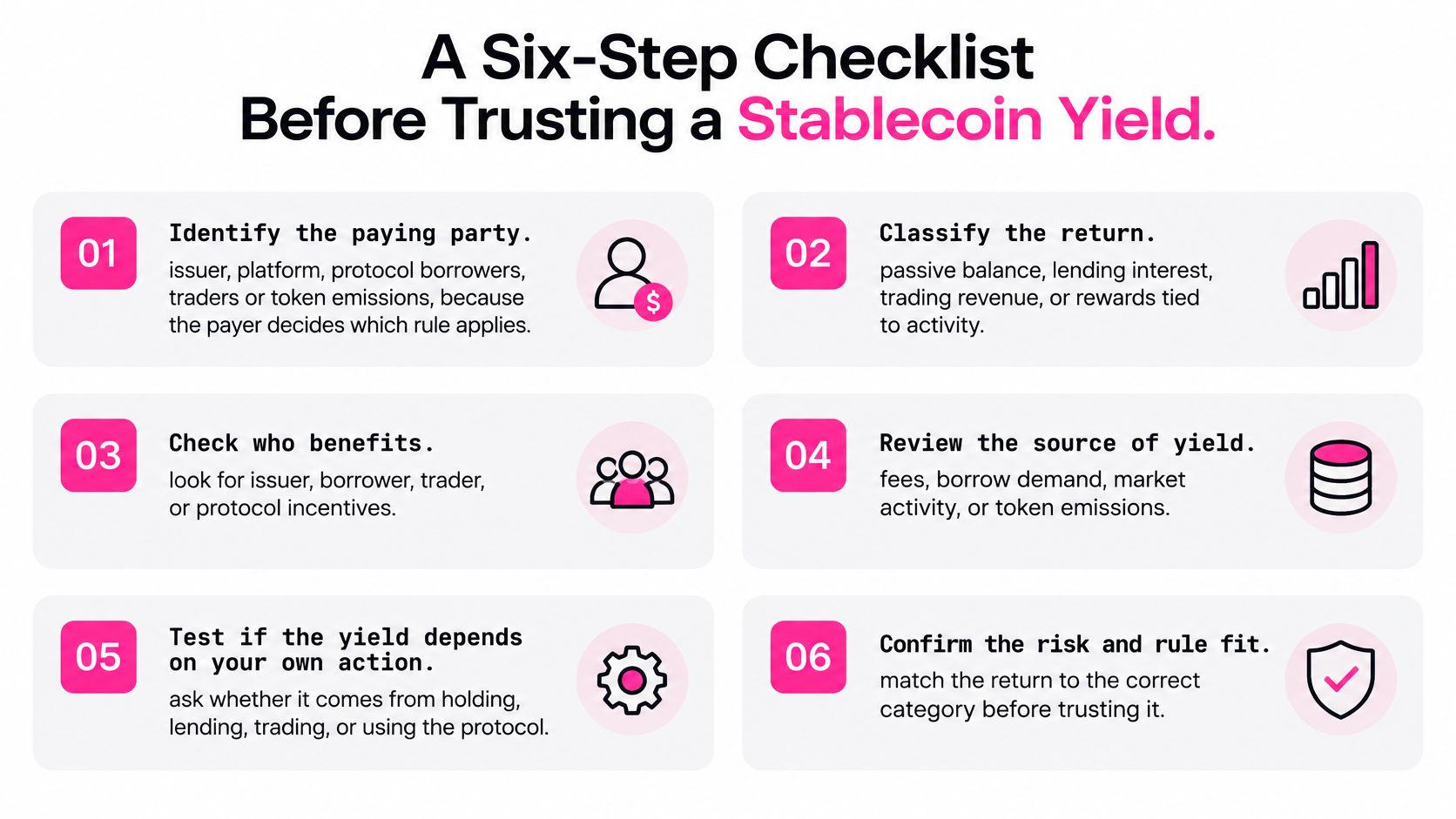
A stablecoin APY is only useful once the reader knows who pays it, what produces it and what conditions could break it. That matters because banning stablecoin yield at the issuer level does not remove every yield source. Borrowers, traders, platforms and token emissions can still sit behind the quoted return, so each payment should be sorted by payer and mechanism before legal exposure or risk is judged.
The checklist below summarizes the classification process.
Build a position record
Identify the paying party. Record the issuer, platform, borrowers, traders or token-emissions source, including any intermediary funding chain. The payer helps identify the relevant rule, although it does not alone determine legal treatment.
Classify each return. Mark passive balance compensation, activity-qualified rewards and underlying strategy income separately. If a nominal activity merely disguises a holding-based payment, retain that uncertainty rather than assigning an approved label.
Separate base income and incentives. Calculate the reward share and record when eligibility or emissions can end. Recalculate without the incentive to expose dependence on temporary compensation.
Check liquidity and evidence freshness. Use the stablecoin yield listings as a starting point for a dated worksheet containing TVL, recent liquidity movement and the timestamp of the rate observation. A fresh rate does not establish that every depositor could exit simultaneously.
Record the legal trigger. Save the token classification, payer and specific event or provision that could restrict the payment. Keep enacted restrictions separate from draft provisions and unresolved interpretation.
Calculate net income and set a recheck date. Include gas, swaps, bridge costs, withdrawal charges and the income forgone in the existing position. Recheck when the holding horizon, reward schedule, liquidity or applicable rules change.
Keep education separate from authorization
The distinction between a token and its income arrangement also matters for a yield-bearing stablecoin. A product name does not establish whether the instrument is a payment stablecoin, another legal category or a separate claim layered onto a token. The same label can cover different payment chains, and each chain changes what the holder is underwriting.
Background explanations are available in the Learn library and the plain-English guide to stablecoin yield sources. Those resources help separate yield mechanics from the legal status of the token itself. They do not turn research into authorization, and they do not make a variable rate predictable.
Yield.ly is a public crypto yield intelligence dashboard for comparing qualified opportunities by asset, return, liquidity and observed risk. It is not a wallet, exchange or paywalled terminal. It does not hold funds, connect to wallets on a user's behalf or execute transactions, so reviewing information does not itself establish or change a position.
For education only, not financial or investment advice. Rates move and yield is never guaranteed; DeFi deposits can lose value.
Yield.ly offers free crypto yield intelligence with no account or wallet connection needed, helping holders compare the composition and liquidity of returns rather than treating every stablecoin APY alike. Find My Yield Alpha to assess possible MOVE, STAY or WATCH decisions ranked in dollars after estimated switching costs, with dollar thresholds and durability checks rather than a promise of future yield.
Yield.ly
Check today's rates before you move
Yield.ly ranks live DeFi yields with base and reward APY split out, TVL, and data freshness on every row. Free, no wallet needed.
Open the yield boardKeep reading
What Is APY in Crypto and How Is It Calculated Nov 24, 2026 · 15 min read
What Is APY in Crypto and How Is It Calculated
Learn what is APY in crypto, how compounding turns APR into APY, why DeFi rates change, and how to sanity check any quoted yield with worked examples.
Yield Bearing Stablecoin Guide: Sources, Models and Risks Nov 24, 2026 · 13 min read
Yield Bearing Stablecoin Guide: Sources, Models and Risks
Yield Bearing Stablecoin explained: where the return comes from, how savings, delta-neutral and Treasury models differ, and the risks to check first.

Base APY vs Reward APY: The Difference That Changes How You Read DeFi Yield Aug 25, 2026 · 18 min read
Base APY vs Reward APY: The Difference That Changes How You Read DeFi Yield
Base APY comes from a protocol's underlying activity. Reward APY comes from additional token incentives. Learn how to separate durable yield from temporary rewards.
Informational disclaimer
This guide is for research and education. Yield rates change, smart-contract risk is real, and nothing here is investment advice. Rates shown on Yield.ly are observed readings, not guarantees.
About the blog
Blog articles explain DeFi yield concepts. For live rates, qualification, and risk readings, use the Yield.ly dashboard and the methodology. Sponsored placements never change qualification or ranking logic. See commercial independence.