
On this page
USYC is a tokenized share of a Cayman-registered fund that holds short-term U.S. Treasury bills and repo backed by government securities, so its value grows as income accrues rather than staying pinned to one dollar. That makes it different from a stablecoin before eligibility, redemption, or fees even enter the calculation.
For a crypto holder, the surprising part is that government-backed assets don't automatically create a cash-like exit. The useful question isn't just what USYC earns, but whether a particular holder can legally own it, redeem it when needed, and retain enough proceeds after costs and taxes.
Table of Contents
- What USYC Is and What It Holds
- Who Can Buy and Hold USYC
- How USYC Yield Accrues Through Its Price
- How to Redeem USYC Step by Step
- Risks to Check Before Holding USYC
- Comparing USYC With Stablecoin Lending Yields
What USYC Is and What It Holds
USYC's price can drift above one dollar, and that is the point. Each token represents a fund share whose net asset value (NAV), the value attributable to each share, can increase as income accumulates rather than paying out a fixed cash coupon.
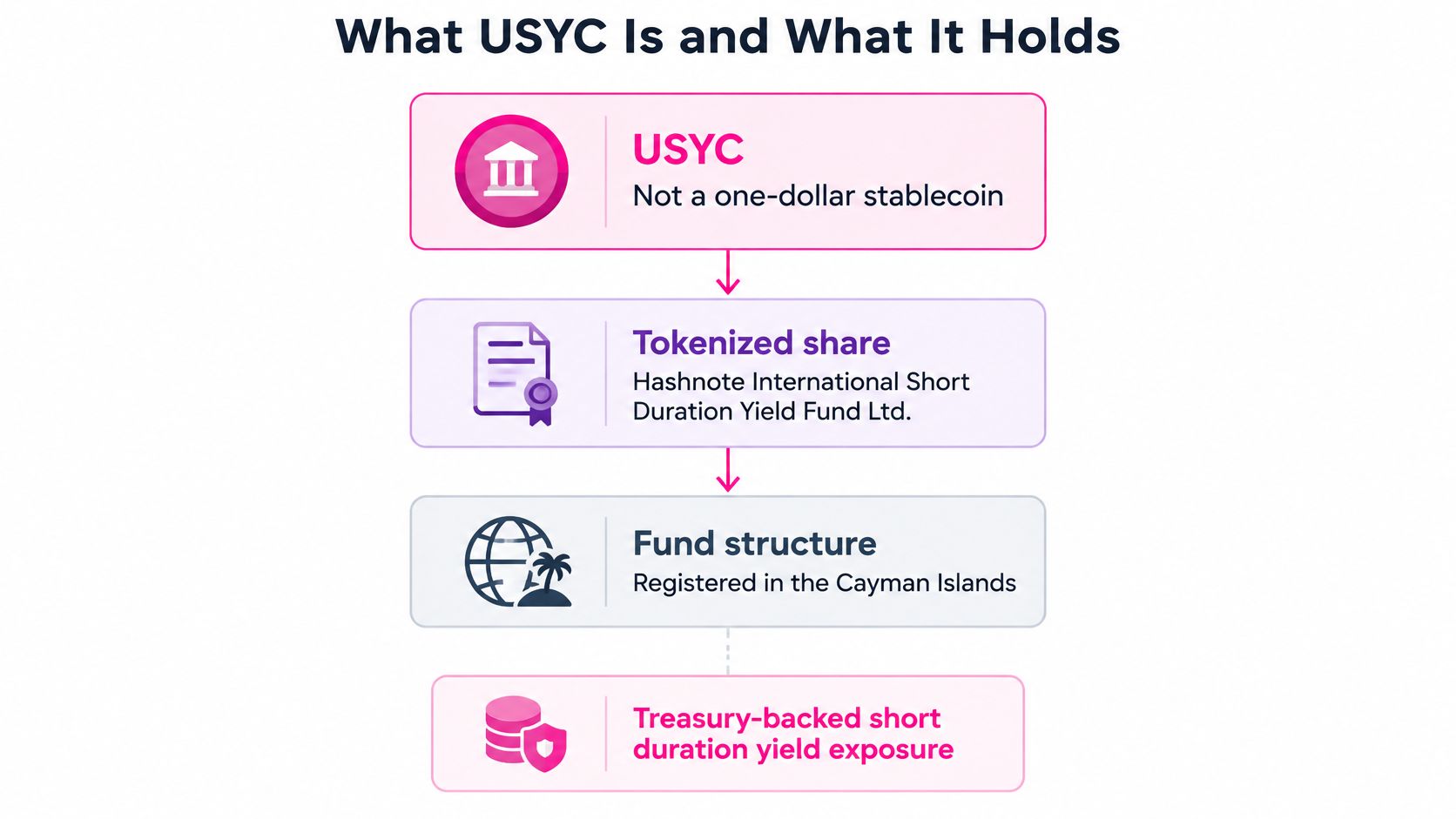
Circle's USYC product page identifies the product as a tokenized share of Hashnote International Short Duration Yield Fund Ltd., a Cayman Islands-registered mutual fund holding primarily short-term U.S. Treasury bills and government-security-backed repurchase or reverse-repurchase agreements. Circle became its operator and token administrator after acquiring Hashnote, and USYC was originally known as Hashnote US Yield Coin.
The assets, the fund, and the token
The structure is easier to grasp as three stacked layers, each answering a different question:
- Underlying assets: Treasury bills provide short-duration government debt exposure. Repo transactions are short-term financing arrangements involving securities, with reverse repo describing the cash-provider's side. These holdings generate the income.
- Legal fund: The Cayman fund owns the portfolio and defines investors' rights through its governing documents.
- Blockchain token: USYC digitally represents a share in that fund. The blockchain records who holds the token, while the fund documents decide what that holding entitles the holder to do.
A holder therefore doesn't receive Treasury bills directly into a wallet. Owning the token means holding a claim on fund economics, and exercising that claim still runs through fund terms, not through the blockchain alone.
What a wallet balance actually represents
Take an eligible investor who swaps part of a stablecoin balance into USYC. The wallet shows a token count, but the return depends on how each token's valuation moves over time, so the investor tracks both figures rather than expecting a fixed dollar price.
That distinction matters when comparing tokenized funds. A reference page for BlackRock's BUIDL fund offers another starting point for product-specific research, but shared Treasury exposure doesn't mean identical ownership, distribution, or redemption terms.
Fund assets, market capitalization, and token supply each measure something different. Fund assets describe the portfolio's size, market capitalization multiplies token price by outstanding supply, and token supply only counts units. Comparing two tokenized funds on size requires the same measure taken at the same date.
Practical rule: A token's appearance in a wallet doesn't establish the holder's legal rights or exit options.
The balance is the easy part to see. What the balance can be turned into, on what schedule, and at what cost is decided by the fund's terms, and that is where a holding either pays off or stalls.
Who Can Buy and Hold USYC
USYC access is permissioned, not open to every wallet. The Hashnote USYC documentation describes an interest in a Cayman fund issued by Circle International Bermuda Limited and offered to eligible non-U.S. persons under Regulation S.
Regulation S is the offering framework identified in the documentation, not a universal permission slip for anyone outside the United States. Investor category, residence, entity structure, and issuer approval still need separate verification.
That distinction is the genuine yield question in disguise. A Treasury-backed token only pays a holder who is allowed to hold it, so eligibility comes before any return calculation.
USYC access requirements
| Requirement | What it means | Where to verify |
|---|---|---|
| Identity verification (KYC) | Required before buying or holding; obtain the issuer's current identity-verification requirements | Issuer onboarding documents |
| Qualified-investor screening | Investor qualification must be established under the applicable subscription terms | Subscription documents |
| Regulation S eligibility | Offering framed for eligible non-U.S. persons | Fund offering documents |
| Minimum investment | Set by the issuer's current onboarding terms | Issuer onboarding page |
| Jurisdictional restrictions | Country restrictions and sanctions status can prevent access | Local counsel and issuer terms |
Know your customer (KYC) means verifying the identity of the investor and, where relevant, the people controlling an entity. The exact qualified-investor test and required evidence should come from the current subscription documents, not an assumption based on wallet size.
U.S. persons should not assume a purchase route exists. The supported blockchains and the exact onboarding steps must be confirmed directly with the issuer, and neither should be inferred from a token appearing in a wallet interface.
Three checks before any transfer
- Investor category: Establish whether the individual, company, trust, or fund meets the issuer's requirements. Entity approval shouldn't be treated as approval for an unrelated personal wallet.
- Jurisdiction: Confirm that the offering is permitted for the investor's location and status. A non-U.S. address alone doesn't settle the question.
- Wallet approval: Confirm the correct network, official contract address, and any address-approval requirements before sending assets.
Blockchain settlement and legal transferability are different. A transaction being technically possible doesn't prove that the recipient can validly hold, transfer, or redeem the interest.
A permissioned-token scenario illustrates the problem: tokens reach a receiving address, but an issuer control or missing approval prevents the next transfer or redemption. That scenario isn't a statement about a particular USYC transaction; it explains why a small test transfer cannot substitute for written eligibility confirmation.
The same diligence applies when investigating Ondo yield assets. Product categories don't share a single eligibility policy.
Users remain solely responsible for verifying destination details, smart contract addresses, terms of use, eligibility, tax treatment, and counterparty risk before acting on information from Yield.ly.
How USYC Yield Accrues Through Its Price
USYC can pay through price without paying out tokens. The balance may stay flat while the value represented by each token rises as fund income accumulates.
For USYC, the economic chain runs from short-duration portfolio income through fund expenses into the value attributable to each token. That accrued value becomes spendable proceeds only when the holder can use an available sale or redemption route, then keep the amount left after costs and taxes.
Components of a USYC return
| Component | What it means | How to check it |
|---|---|---|
| Underlying Treasury and repo income | Short-term U.S. government-backed income earned by the fund | Issuer fund reports and dated yield disclosures |
| Fund fees and operating costs | Reduce the net income that reaches NAV | Offering documents and the current fee schedule |
| NAV growth | Token value reflects accrued fund income | Circle or Hashnote NAV with an as-of date |
| Reported seven-day annualized yield | A short observation period expressed as an annual rate | Issuer page with date stamp |
| Realized return at exit | Redemption or sale proceeds minus cost basis and applicable costs | Transaction records and settlement statements |
Short-term funding conditions matter because the portfolio's income does not stay fixed indefinitely. The federal funds rate and repo-market conditions influence the short-duration cash-market exposure described in the official documentation.
An annualized rate extrapolates a shorter observation period. It does not secure that rate for a full year, and two products should be compared only after checking how each figure was calculated.
A hypothetical NAV example
Illustrative only: Assume an eligible investor buys a $10,000 position at a NAV of $1.00 per token. The position contains 10,000 tokens.
If redemption occurs at a hypothetical NAV of $1.02, the calculation is:
- Gross redemption value: 10,000 × $1.02 = $10,200.
- Gain before costs and taxes: $10,200 − $10,000 = $200.
- Net realized gain: $200 minus actual transaction expenses, any applicable redemption charges, and taxes.
The round figures show the mechanism: a higher exit price can carry the return even though the token count never changed. The investor's actual result depends on the exit value available at the time, the fees charged on the route used, and the tax treatment that applies.
A reported yield describes the investment's income behavior. A realized return describes what the holder actually keeps.
Tax treatment requires separate attention. Holding-period rules can change the after-tax result, and guidance on timing asset sales to lower taxes explains why sale timing belongs in the calculation.
The same distinction between a quoted rate and a contractual commitment appears in fixed versus variable DeFi yield. Yields are variable and never guaranteed. Current NAV and reported yield should be checked on issuer pages with their valuation dates; a cached quote is not an executable exit price.
How to Redeem USYC Step by Step
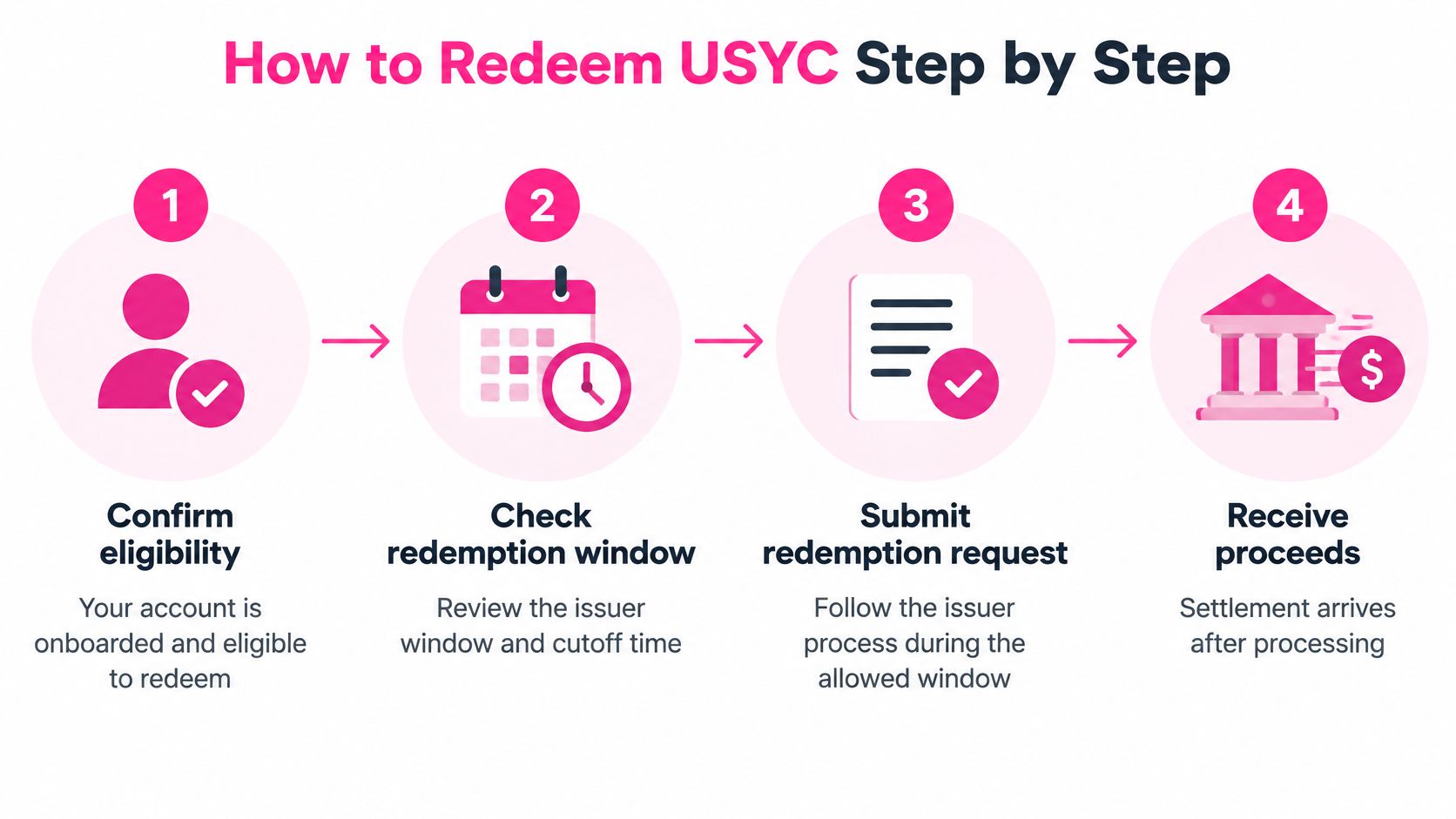
A USYC position only turns back into cash through the issuer's own redemption process. A fund token has no universal withdraw button. The issuer sets who may redeem, the cutoff times, the settlement asset, and the pricing rule for each route, and those details live in its current terms rather than in the token itself. Redemption is where a quoted yield becomes a realized return.
That makes exiting a scheduling question before it becomes a market question. A holder who confirms the window and the settlement route beforehand knows when proceeds should arrive and in what form. A holder who assumes instant withdrawal can discover a processing delay only after the request is already in.
The redemption checklist
Confirm account eligibility. Establish that onboarding is complete and that both the redeeming account and the destination are approved. Account status with the issuer matters here, not merely whether tokens sit in a wallet.
Establish the applicable window. Obtain the redemption availability, any cutoff time and its time zone, and how holidays are handled. Check whether the chosen route operates continuously or follows a processing schedule.
Identify the settlement asset. Confirm how proceeds will be delivered. Depending on the route the issuer supports for the account, settlement may arrive as a supported digital asset or through a banking channel; the issuer's current terms state which applies.
Verify the pricing rule. Determine which valuation applies and whether fees or adjustments reduce proceeds. Neither a previously displayed NAV nor a particular cutoff NAV should be treated as guaranteed.
Submit through the official process. Use the authenticated issuer workflow and retain the request identifier and, where applicable, the transaction hash. A request counts once it is accepted, not merely broadcast.
Reconcile net proceeds. Compare the amount received with the quoted gross redemption value. Account for every separate gas, swap, bridge, withdrawal, and currency-conversion charge incurred along the way.
Preserve the tax record. Retain acquisition cost, disposal date, proceeds, fees, and any local-currency conversion evidence. Realization rules of the holder's jurisdiction determine how the gain is reported.
A hypothetical delayed-window example
Hypothetical delayed-window example (not USYC's actual schedule): Assume a $10,000 request arrives just after a Friday cutoff, the next permitted settlement is the following business day, no holiday intervenes, and NAV does not change across the intervening two days.
Under those assumptions the position is still worth $10,000, but the money is unavailable during the wait. The cost of a missed window shows up as lost flexibility: the holder can neither spend nor redeploy the proceeds until settlement completes.
A reconciliation should show each deduction separately:
- Gross proceeds: the amount determined under the applicable valuation rule.
- Swap cost: any spread, price impact, and exchange charge.
- Other costs: gas, bridging, withdrawal, and fiat conversion where used.
- Net proceeds: gross proceeds less the actual deductions.
If a window is missed, the holder needs written confirmation of the next available processing opportunity. A secondary-market sale is a different exit entirely: the available buyers and the pool depth, the amount of liquidity available at quoted prices, can produce proceeds below NAV, and no redemption schedule governs what a buyer will pay.
Risks to Check Before Holding USYC
Treasury-backed doesn't mean identical to cash. The underlying investments, the fund wrapper, the issuer's operations, and any added blockchain strategy create different kinds of exposure.
A Treasury security can be only one component of a much longer ownership chain. Assessing the token requires inspecting that chain rather than stopping at the portfolio label.

USYC risks and what to check
The following are diligence categories, not claims that a particular failure has occurred.
| Risk | What it looks like | What to check |
|---|---|---|
| Issuer and administrator | Operational or governance failure at Circle, Hashnote, or the fund manager | Issuer disclosures and fund reports |
| Reverse-repo counterparty | A counterparty fails to meet its cash or collateral obligations | Collateral terms in fund documents |
| Cayman fund wrapper | Legal rights differ from owning Treasury bills directly | Fund offering documents |
| Smart contract | A bug or upgrade changes token behavior | Official token contract page and audit disclosures |
| Address freeze or whitelisting | A wallet is blocked from transferring | Issuer terms and eligibility status |
| Redemption timing | Processing conditions delay an exit | Issuer schedule and the redemption checks above |
| Rate decline | Income falls as short-term rates decline | Dated yield snapshots over time |
| Tax realization | Sale or redemption creates a taxable event | Local tax guidance |
Issuer risk resembles relying on a broker's administrative systems: valuable underlying assets don't prevent access problems if records or processing fail. Counterparty risk is different, resembling a secured borrower failing to perform; collateral helps define recovery options but doesn't remove the need to examine them.
The Cayman wrapper determines the legal claim. Owning a fund interest isn't the same as holding Treasury bills directly, just as owning a warehouse company isn't identical to owning each item inside its warehouse.
Smart contracts add an execution layer. An audit can inform diligence, but it doesn't guarantee that software, upgrade permissions, or external integrations cannot fail.
Risks added by a DeFi strategy
Decentralized finance (DeFi) means financial activity executed through blockchain applications and smart contracts. Using USYC inside such an application can add exposures that aren't inherent to holding the fund token.
- Bridge risk: Moving across chains can introduce another contract system or custodian. A bridged or wrapped representation may have different redemption rights from the issuer's native token.
- Oracle risk: An oracle supplies price information to an application. A stale or incorrect valuation can affect collateral limits and trading.
- Liquidation risk: Borrowing against a holding can trigger a forced sale when collateral requirements aren't met.
- Liquidity-pool risk: Providing assets to an automated trading pool can create impermanent loss, a shortfall relative to holding those assets as their relative prices change.
- Depeg risk: USYC doesn't target a fixed dollar peg, but stablecoins used to enter, exit, borrow, or pair with it may trade away from theirs.
A plain holding doesn't create amplified exposure or liquidity-pool exposure by itself. Adding either changes the analysis, including potential lockups and withdrawal restrictions.
Risk boundary: Government-backed portfolio assets don't guarantee the performance of every contract, counterparty, or exit route around them.
A risk-methodology explanation can help interpret evidence labels. A low observed-risk label is never a guarantee.
Comparing USYC With Stablecoin Lending Yields
A higher headline rate settles nothing by itself. The quoted number works like a menu price: it counts only if you can get a seat and settle the bill. How yield arrives, who may hold the position, and what exiting costs decide the comparison.
| Feature | USYC | Stablecoin lending supply | Cash-distribution fund |
|---|---|---|---|
| How yield arrives | NAV reflects accrued income | Supply return accrues through the protocol's balance or share accounting | Cash paid on the fund's schedule |
| Who can access | Eligible investors after required verification and screening | Supported wallets, subject to protocol restrictions and local law | Investors permitted by the fund terms |
| Main yield source | Treasury bills and repo | Borrower interest, sometimes supplemented by incentives | Fund income |
| Exit path | Issuer redemption or an available secondary sale | Pool withdrawal, subject to liquidity and restrictions | Redemption under fund terms |
| Main risk | Issuer, counterparty, and access restrictions | Smart contracts, bad debt, and utilization | Fund structure and redemption terms |
| Where to check the rate | Dated issuer disclosure | Dated protocol data | Dated fund reports |
The table compares mechanisms rather than equivalent products. A lending pool's utilization, the proportion of supplied assets currently borrowed, affects both its interest rate and the liquidity available for withdrawal.
The access and exit rows carry the most weight. A Treasury-backed rate reaches only an investor who clears the issuer's eligibility checks and can redeem on the issuer's schedule; a pool rate reaches a supported wallet, and withdrawal still depends on liquidity sitting in the pool at that moment. Comparing APYs before these gates compares numbers you may never collect.
For ETH, BTC, or SOL holders, moving into dollar-denominated exposure also changes the asset being held. A dollar yield calculation doesn't capture the gain or loss from selling the original asset, hedging it, or buying it back later.
A hypothetical net-return worksheet
All figures below are illustrative, not current USYC or lending rates. Assume simple annualized accrual, a constant rate, unchanged principal value apart from the modeled income, and no additional market-price movement.
- Starting amount: $10,000.
- Illustrative reported rate and period: 3% over 30 days produces $10,000 × 0.03 × 30 ÷ 365 ≈ $24.66 gross.
- Hypothetical costs: Entry $2 + swap $3 + bridge $4 + gas $2 + withdrawal $2 + fiat conversion $2 = $15. The modeled return becomes $24.66 − $15 = $9.66 before tax.
- Tax adjustment: Subtract the applicable liability. No universal tax amount is assumed.
- Alternative calculation: At an illustrative 5% lending supply rate, $10,000 × 0.05 × 30 ÷ 365 ≈ $41.10 gross, before that route's own costs and taxes.
For a NAV-accruing fund, the modeled income is already the assumed NAV appreciation. It mustn't be added again as a separate price gain. Any departure from the assumed valuation, including a secondary-sale discount, changes the result.
The higher gross figure doesn't establish the better outcome. Fixed costs weigh hardest on small balances and short holding periods, and different transaction costs, available liquidity, lockups, contract exposures, and borrowing demand can flip the ranking.
Token reward APY deserves separate treatment. APY means annual percentage yield, generally incorporating compounding assumptions; an incentive can shrink or disappear, and its market price can fall. Multiplying an annual rate by a fraction of a year is a simplified comparison, not an exact compounded APY calculation.
Compare the evidence before the rate
Yield.ly's free stablecoin yield listings and USDC opportunities separate base APY from token rewards and display total value locked, seven-day liquidity changes, and data freshness. Rankings weigh yield quality, liquidity, observed risk, and data confidence rather than headline APY alone.
The ranking methodology explains the qualification gates that control default visibility. Observed-risk scoring is incomplete and isn't a safety guarantee, and the Learn library, including its explanation of why DeFi APY changes, helps distinguish a temporary quote from a durable assumption. Watchlist and Alerts can track whether a rate or listing moves between reviews. A displayed ranking never replaces confirming eligibility with the issuer, since access terms sit outside any comparison table.
If a required input lacks dated evidence, pausing the comparison is more defensible than filling the gap with an assumed redemption promise.
For education only, not financial or investment advice. Rates move and yield is never guaranteed; DeFi deposits can lose value.
Yield.ly is free, requires no account or wallet connection, and doesn't hold funds or execute trades. For a USYC comparison that accounts for the expense of changing positions, Find My Yield Alpha: Yield Alpha ranks MOVE, STAY or WATCH moves in dollars after estimated switching costs.