
On this page
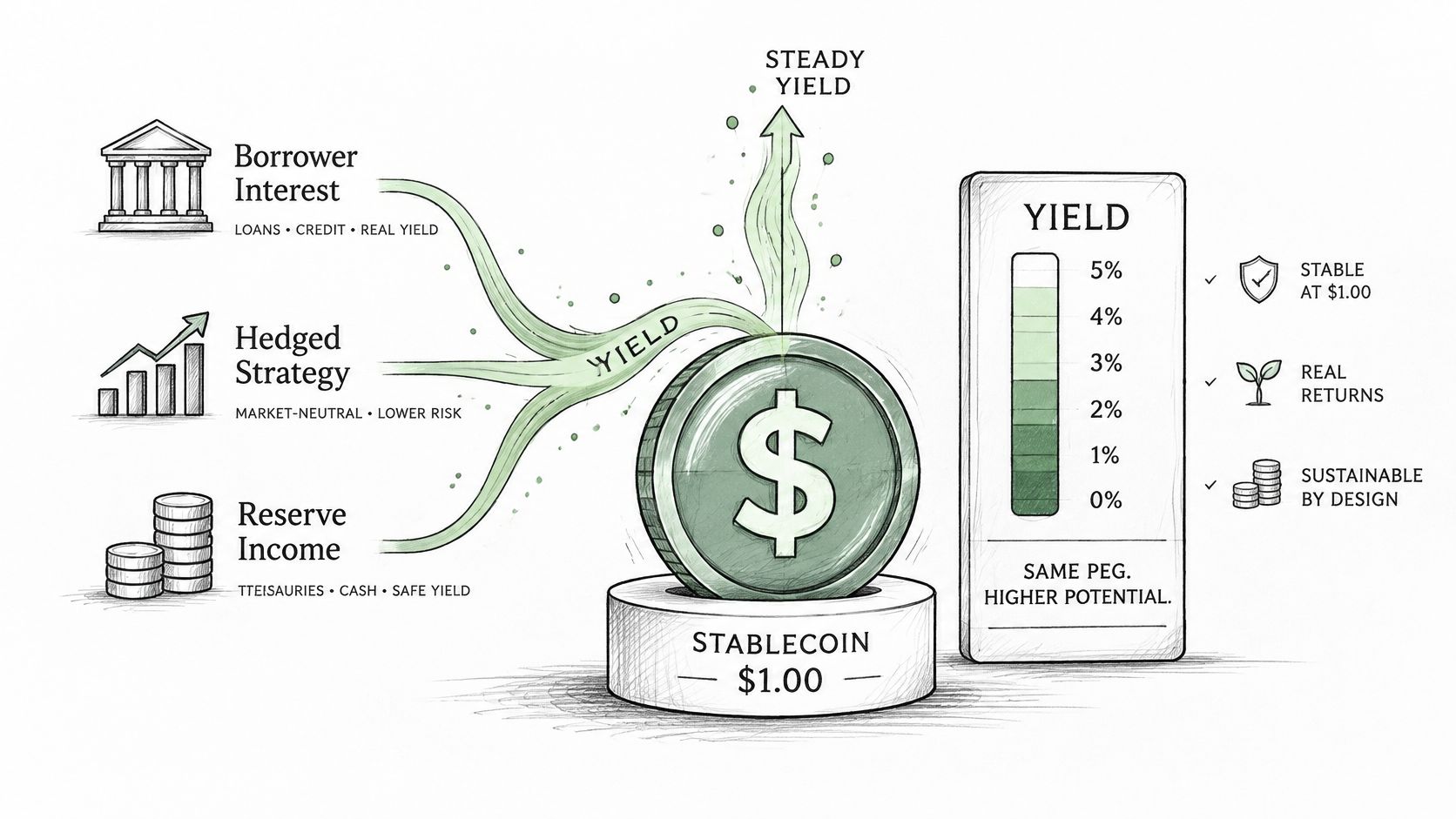
A yield-bearing stablecoin pays a return from a named source on top of its dollar peg, and the peg itself earns nothing. The token holds close to $1 because of reserves, collateral or a hedge, while the income arrives separately from borrower interest, a hedged derivatives position, Treasury bills or token incentives.
Sort the table by APY, take the top row, move the money. That is the advice most yield screens imply, and it's the quickest way to buy risk you haven't priced. Two listings can show the same headline number while one is paid by borrowers and the other by an emission schedule that ends in six weeks.
A stablecoin label is the least informative part of the decision. The payer matters more: who it is, what it pays with, and how it behaves when borrowing demand drops, funding rates flip negative or a market maker pulls liquidity. Judging a rate by its payer rather than its size is the habit that keeps a position intact.
Table of Contents
- What Makes a Stablecoin Pay Yield
- Three Models Behind Yield-Bearing Stablecoins
- Why the Quoted Rate Moves With Borrowing and Incentives
- Yield-Bearing Versus Ordinary Stablecoins Compared
- Risks That Can Break the Peg or the Payout
- How to Check Composition, Liquidity and Redemption
- Run These Checks Before You Move Any Stablecoin
What Makes a Stablecoin Pay Yield
A savings account pays interest because the bank doesn't leave your deposit in a drawer. It lends most of the balance and invests the rest, then hands back a slice of what those assets earn. A yield-bearing stablecoin runs the same logic on a public blockchain, with an issuer, protocol or vault deploying the dollars behind the token, or the tokens you deposit, into a named activity.
Keep two questions apart. The peg asks whether the token is worth roughly a dollar. The yield asks who pays you, from what money, and for how long. A token can hold $1 perfectly and pay nothing, and it can pay well while carrying risks that never appear in the price on your screen.
Scale came fast from a small base
Yield-bearing stablecoins grew from roughly $666 million in August 2023 to $8.98 billion in May 2025, a gain of about 13.5 times, according to CoinGecko's State of Stablecoins report. The category peaked at an estimated $10.8 billion in February 2025 before easing, and it still represented only about 3.7% of a stablecoin market above $244 billion in May 2025. Those products had paid out nearly $600 million in yield across the category, averaging roughly $1.5 million a day at the time of reporting.
DeFiLlama's tally put the group at about $9.5 billion at the start of 2025 and above $20 billion later that year, with reported yields from 2% to 10% and an average near 5%, in its State of DeFi 2025 report. Stablewatch data cited in RedStone's 2025 report put market capitalization near $22 billion in November 2025. Treat every one of those figures as a moving total that says nothing about the token in front of you.
The test that survives a changing rate
Ask three things of any listing. Who pays: an issuer from reserve income, a lending pool from borrower interest, a hedging strategy from funding payments, or a rewards program from token issuance. How durable that payer is: a Treasury ladder behaves differently from an emission schedule with an end date. What breaks: redemption terms, collateral quality, liquidity at the exit.
Splitting a quoted rate into base and reward parts is the first habit worth building, and Yield.ly's explainer on base APY versus reward APY covers how the two are reported. The Yield.ly dashboard shows that split for each listed opportunity and needs no account or wallet connection.
Three Models Behind Yield-Bearing Stablecoins
Three structures cover most of the tokens a stablecoin holder will meet, and the table below lines them up by where the return comes from and what to read first.
| Model | Example tokens | Where the return comes from | Main risk to check | Primary document to read |
|---|---|---|---|---|
| Savings wrapper | sUSDS, sDAI | Savings rate set by the issuing protocol, funded from its collateral income | Smart contract, governance rate changes, collateral quality | The issuer's documentation for the savings token |
| Delta-neutral | sUSDe | Funding and staking income from hedged positions | Funding rate reversal, hedge counterparty, reserve level | The issuer's documentation covering the hedge and reserves |
| Tokenized Treasury | USDY, USYC | Interest from short-term US Treasuries and cash held for the token | Issuer and custody risk, redemption terms, limited DeFi liquidity | The issuer's documentation covering reserves and redemption |
The table describes structure, not current rates. None of the three is a government-insured deposit, and none of the rates is fixed.
Savings wrappers with a governance-set rate
sUSDS and its predecessor sDAI are wrappers: the token you hold carries a claim on a savings mechanism, and the rate is set by protocol governance rather than by a single borrower pool. The Sky Savings Rate is variable and funded from aggregate protocol surplus, so a governance vote can change it. Sky's documentation sets out the current mechanism and the redemption path back to the underlying stablecoin.
Delta-neutral positions that depend on funding
sUSDe holds spot assets alongside an offsetting hedge, so the position is designed not to care which way the market moves. Return comes from funding payments on the short leg plus staking income on the spot leg. When funding runs positive the strategy collects; when it flips, the position can pay instead of earning. Hedge counterparty, custody and reserve levels are what to check, and Ethena's documentation describes the structure.
Tokenized Treasuries with issuer exposure
USDY and USYC hold short-term U.S. Treasuries and cash, so interest accrues from the bills themselves. That return tracks short-term policy rates more closely than a lending pool does, but the exposure shifts to the issuer: custody arrangements, attestations, redemption terms and secondary liquidity. Ondo's documentation sets out USDY's reserve and redemption model.
Balance growth versus price growth
Payout mechanics differ too. Some wrappers increase the number of tokens in your wallet, while others keep the token count fixed and let each token redeem for more of the underlying over time. In a hypothetical case, a wrapper priced at $1.00 per token that accrues 5% over a year would redeem near $1.05 while your wallet still showed the same count. Check which design applies before estimating anything, because "10,000 tokens" tells you nothing about dollar value on its own.
For the fuller list of yield sources, including trading fees and liquidity provision, the Yield.ly guide to where stablecoin yield comes from maps each one to the risk it adds.
Why the Quoted Rate Moves With Borrowing and Incentives
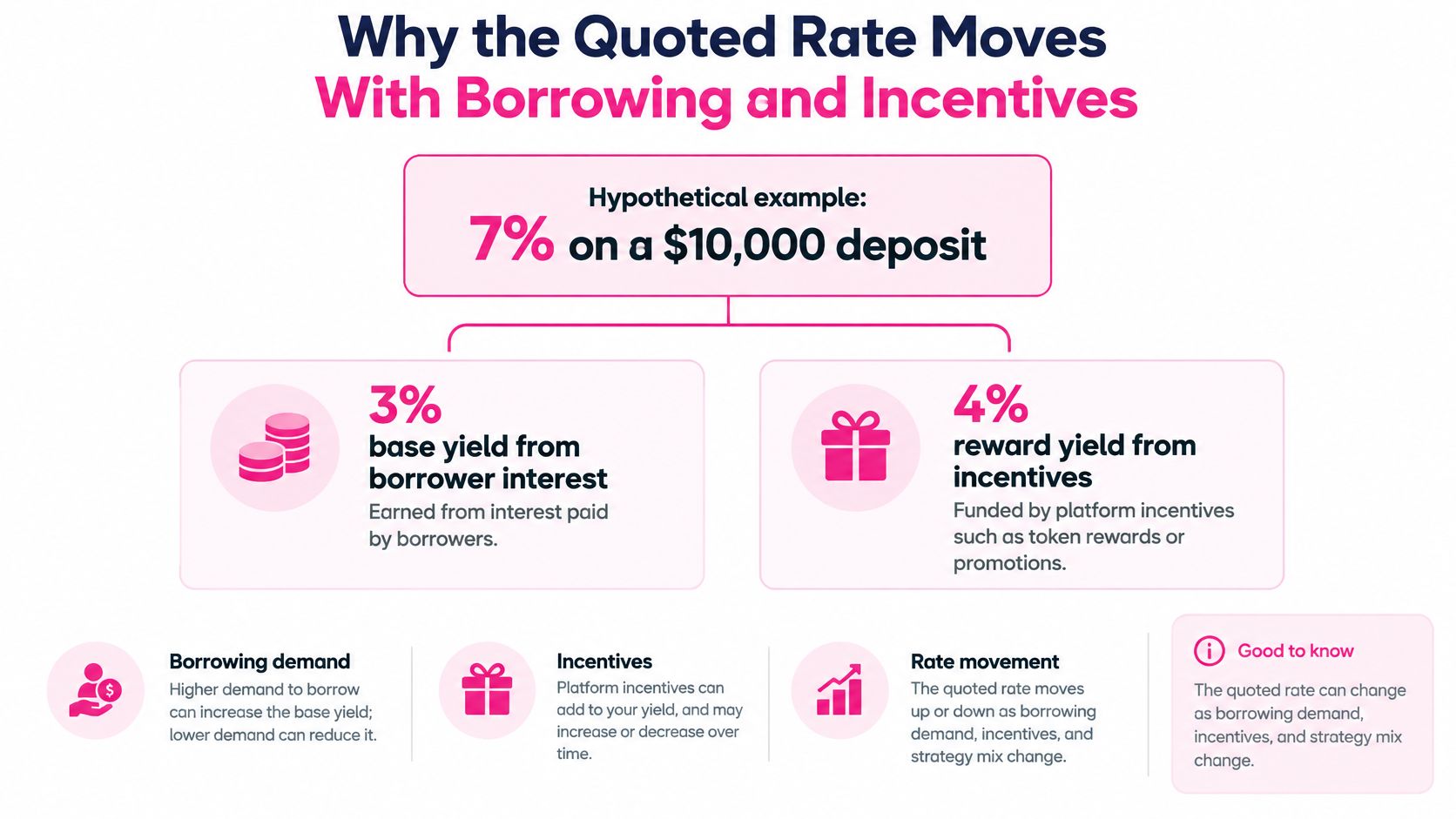
A quoted APY is a photograph, not a contract. Take a hypothetical $10,000 position quoted at 7%. That headline might be 3% base yield from borrower interest plus 4% from token incentives, which is $300 of lending income and $400 of rewards across a year. Base means the organic yield component before token incentives, and the split decides how the position behaves when conditions change.
Utilization drives the base rate
Lending markets price borrowing with a curve tied to utilization, the share of supplied funds that borrowers have taken out. Say a hypothetical pool holds 10 million USDC and borrowers have drawn 8 million: utilization is 80%. If new borrowing pushes that to 9.5 million, utilization hits 95% and the pool typically moves onto a steeper segment of its rate curve, where supplier yield can jump. Repayments do the reverse, and supplier yield can fall within days. Aave's documentation explains how interest rate models and utilization interact.
Here's a short walkthrough of the same mechanism in video form.
Incentives fade, and the token price decides what you keep
The reward half is less durable than the base half. If the program behind those hypothetical 4 points ends, the same position drops back toward 3%, or $300 a year before fees. A falling reward-token price cuts realized return even while the advertised reward rate holds steady, because 4% paid in a token that halved in value is closer to 2% in dollars.
| Component | Rate | Durability |
|---|---|---|
| Base lending yield | 3% | Moves with pool utilization |
| Token incentive | 4% | Ends with the program or falls with token price |
| Headline quoted rate | 7% | Before fees and before any price loss |
| Base only after incentives end | 3% | Before fees |
Three checks settle most of the question: how much of the quoted rate is base, how much is reward, and when the incentive program ends. Yield.ly lists base and reward APY separately for each opportunity, and the guide to why DeFi APY changes goes further into the mechanics. Every figure in this section is a hypothetical illustration, not a current rate.
Yield-Bearing Versus Ordinary Stablecoins Compared
A payment stablecoin works like a checking balance: it sits at $1 and returns nothing. A yield-bearing one works like a savings product, where the same $1 label hides a strategy underneath that produces the return. Five criteria line up the difference before either token goes into a portfolio.
| Criterion | Ordinary payment stablecoin | Yield-bearing stablecoin |
|---|---|---|
| Return to holder | Usually none from holding | Variable return from reserves, lending, hedging or rewards |
| Peg pressure | Mainly reserve confidence and redemption | Adds pressure from strategy losses and synchronized exits |
| Extra technical exposure | Issuer and chain risk | Adds smart contract, oracle, bridge and liquidation risk where DeFi is used |
| Exit path | Redeem with issuer or sell on a market | Redemption terms plus pool liquidity, withdrawal delays and gas |
| Benchmark to compare | Cash or short-term government debt | Return after expected losses, costs and peg risk |
Checking the quoted rate answers only the first row. The other four decide whether the extra return compensates for what the holder takes on. Moving reserves or collateral into a strategy also changes where peg pressure comes from: reserve confidence still matters, and strategy losses plus synchronized exits now share the load.
What the GENIUS Act does and doesn't settle
Recent U.S. stablecoin rules require issuers to hold one-to-one reserves and prohibit them from paying interest or yield directly to holders, while stopping short of an explicit ban on affiliate or third-party arrangements, a gap examined in a White House analysis of stablecoin yield prohibition. The label tells you little. The source of the return tells you almost everything.
Say a product advertises 5%. The money could come from reserve income on Treasury bills, from lending markets, from market making, from token incentives, or from an intermediary's balance sheet. Each answer carries different risks, different legal treatment and a different lifespan. A reserve-income model adds issuer, custody and redemption exposure. A DeFi route adds smart contract, oracle, liquidation and depeg exposure. An incentive-heavy one can fall the moment emissions change.
The benchmark most comparisons skip
Start with short-term government debt as the yardstick. The figure that matters is the return left over after expected losses, withdrawal costs and a reasonable allowance for a temporary depeg. Yield.ly's comparison of USDC and USDT yield shows how two tokens that both target $1 can carry very different return profiles, which is why the stablecoin label alone never settles the risk question.
Risks That Can Break the Peg or the Payout
Picture a token that has traded within a cent of $1 for eighteen months. On a Monday morning it prints $0.972, redemption requests queue, and the displayed yield still reads 7.8%. Nothing about the quoted rate changed; the exit did.
| Risk | What can happen | What to verify |
|---|---|---|
| Depeg | Token trades below $1 when redemption or confidence fails | Redemption mechanism, reserve composition, buffer size |
| Smart contract | Bug or exploit drains pooled funds | Audit history, upgrade controls, incident record |
| Oracle | Wrong price triggers liquidations or misvalues collateral | Price source and update frequency |
| Bridge | Tokens on another chain depend on a bridge that fails | Which bridge, its security model, and whether exit is possible |
| Liquidation | Borrowed collateral is sold at a poor price when value falls | Collateral factor, liquidation penalty, market depth |
| Emissions decay | Rewards end or the reward token falls in value | Reward share, program end date, token liquidity |
| Issuer or counterparty | Reserve holder fails or restricts redemptions | Custody arrangement, disclosures, redemption terms |
Why yield makes a run more likely
Yield-seeking capital is fast capital. Holders react within hours to a falling rate, a credit worry or a better offer elsewhere, and synchronized withdrawals force the issuer or protocol to sell reserves into a market that has already moved. An analysis from the Federal Reserve Bank of Philadelphia makes the point that return generation can increase run and depeg sensitivity relative to a non-yielding payment token. In DeFi the same pressure can arrive through an oracle failure, a bridge problem, a smart contract exploit or a liquidation cascade.
The BIS brief on stablecoin-related yields adds a second warning. An issuer that earns income from reserves while paying holders little has an incentive to reach for higher returns through riskier or less liquid assets, or by lending the reserves out.
A labeled example of realized versus quoted
Take a hypothetical 10,000 stablecoins quoted at 8% for one year. Gross income is $800. Now charge a $20 withdrawal fee, $30 of slippage on the exit and a 1% depeg loss of $100 on the way out. What's left is $650, or 6.5%, before any reward cut. Realized return can sit well under the quote without anything dramatic happening.
The practical rule: a high APY with thin exit liquidity is usually payment for risk, not a better deal.
What an observed-risk label does and doesn't mean
Observed risk on a listing is evidence-based: it reflects what the data shows about a market, not a verdict that the market is safe. The risk methodology page explains the categories that feed a label, and the wider Yield.ly methodology covers how opportunities qualify for listing at all. Protocol, smart contract, asset, liquidity, market and platform risks still apply to every yield shown, and no label removes them.
How to Check Composition, Liquidity and Redemption
Seven checks cover the decision, and the sequence takes about twenty minutes per candidate.
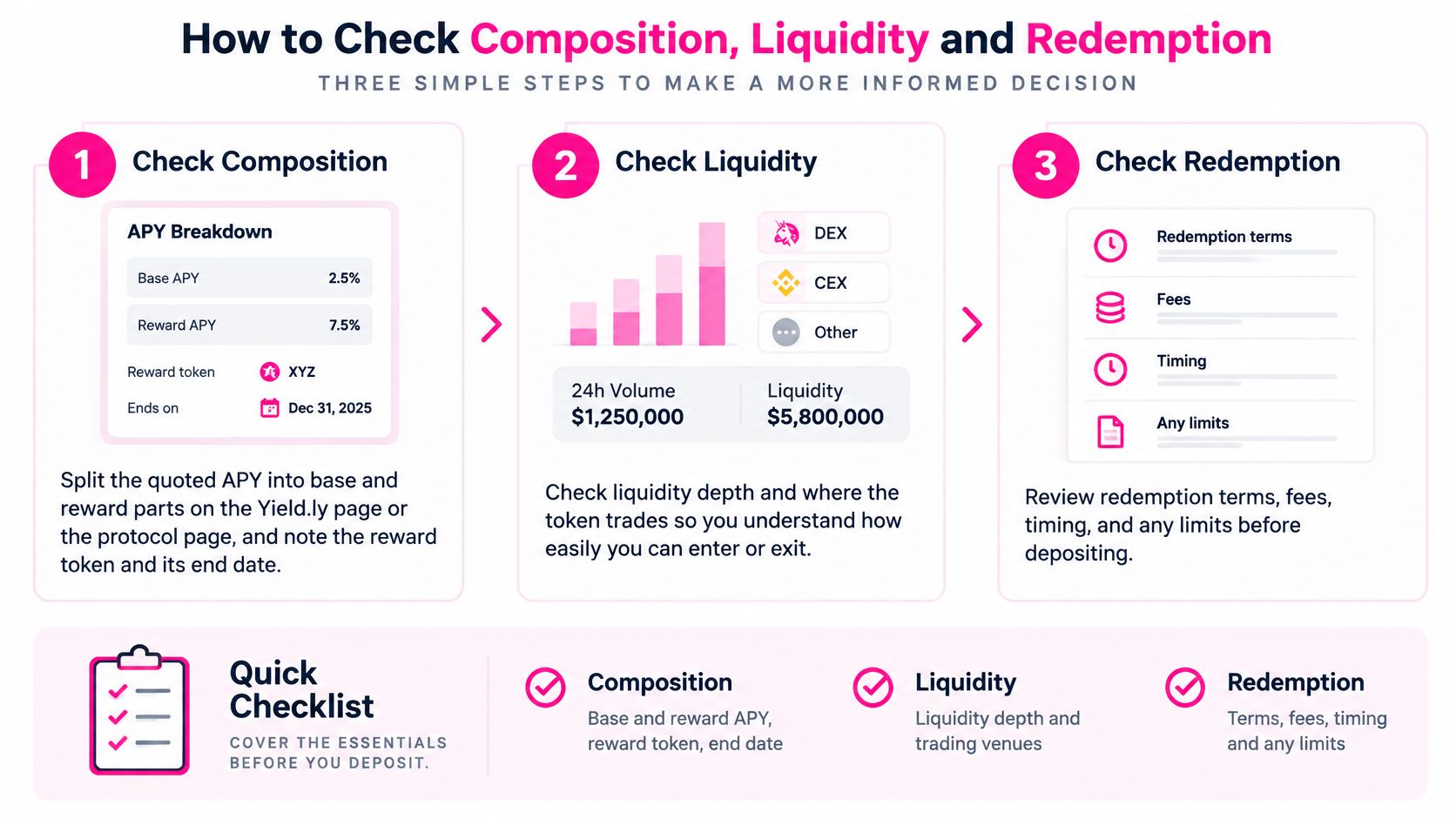
- Split the rate. Break the quoted APY into base and reward on the listing or the protocol page, note the reward token, and find the program's end date. A rate that is three quarters incentive is a different product from one that is three quarters lending interest.
- Name the payer. Decide whether the yield comes from an issuer, a lending market, a hedging strategy or a Treasury portfolio, then read that party's own documentation instead of a summary.
- Check the backing. For an overcollateralized design, stated collateral is the ratio multiplied by tokens issued: a 150% ratio on 100 million tokens implies about $150 million of stated collateral before price moves, liquidation timing and sale depth. Galaxy's state of onchain yield research compares materially different structures, from roughly 270% overcollateralization for USDS to a delta-neutral hedge plus a 1% reserve for USDe, and those percentages aren't interchangeable safety scores.
- Check the exit, not just the entry. Confirm redemption terms, any withdrawal queue, and whether pool depth can absorb your size. Where the tokens sit between trades matters too, and a NexaPay guide to custodial versus non-custodial wallets covers who controls keys at each step.
- Check history. Use the 7-day TVL change and data freshness alongside the rate, and compare listings on the stablecoin yields page instead of judging one product in isolation.
- Run the net return. On a hypothetical $10,000 held 90 days at 5% APY, gross interest is $123.29 (10,000 × 5% × 90 ÷ 365). Subtract a $15 entry swap, a $15 exit swap and $10 of gas, and $83.29 remains, or 0.83% on the position. Swap in a 1% exit depeg costing $100 and the same position ends at about negative $16.71.
- Write exit conditions first. Set the depeg level, rate drop or reward end date that triggers a withdrawal, and note it before depositing. Decisions made in advance beat decisions made during a queue.
Tokenized Treasury products deserve their own read on redemption, and Yield.ly's breakdown of USYC walks through how that token's structure and exit path work.
Run These Checks Before You Move Any Stablecoin
Nothing above is an instruction to deposit anywhere. The checks are research inputs, and the choice, the size and the timing stay with the holder.
A comparison tool earns its place once those checks are done, and Yield.ly is free with no account and no wallet connection. It does not hold funds, execute transactions or connect to a wallet on your behalf, and it ranks qualified opportunities by yield quality, liquidity, observed risk and data confidence rather than headline APY. Its tables also separate base yield from reward incentives, so a rate built mostly on token emissions reads differently from one paid by borrowers.
If the same dollars will be spent or sent rather than parked, Africhange's walkthrough of how to pay with crypto covers the spending side, which changes the liquidity question entirely.
For education only, not financial or investment advice. Rates move and yield is never guaranteed; DeFi deposits can lose value.
The Yield.ly Learn section goes deeper on definitions, rate mechanics and why a quoted APY moves. When a position survives your own checks, Find My Yield Alpha ranks the next move as MOVE, STAY or WATCH in dollars after estimated switching costs, so a rate gain that costs more to capture than it pays back shows up as a stay.
Yield.ly is a free crypto yield dashboard that puts base yield, reward yield, liquidity, observed risk and data freshness side by side for qualified opportunities, with no account and no wallet required. Used alongside the source checks above, it lets you compare a savings wrapper, a hedged position and a Treasury token on the same terms instead of on the size of a headline. Visit Yield.ly to see how the listings are ranked and what each label measures.