
 Yield.ly
Which Hyperliquid vault has the highest APR? That's the question most vault pages are built to answer, and it's the one that gets depositors into trouble. An APR on a vault page is an annualized reading of a trading record that might be three weeks long, might lean on one very good week, and says nothing about what happens to your USDC if the account gets liquidated.
A Hyperliquid vault is a pooled USDC trading account run by a leader, and your deposit buys a slice of that account's equity. Nobody is paying you interest. You're funding a trader's positions and sharing the wins and losses in proportion to what you put in.
What a Hyperliquid Vault Actually Is
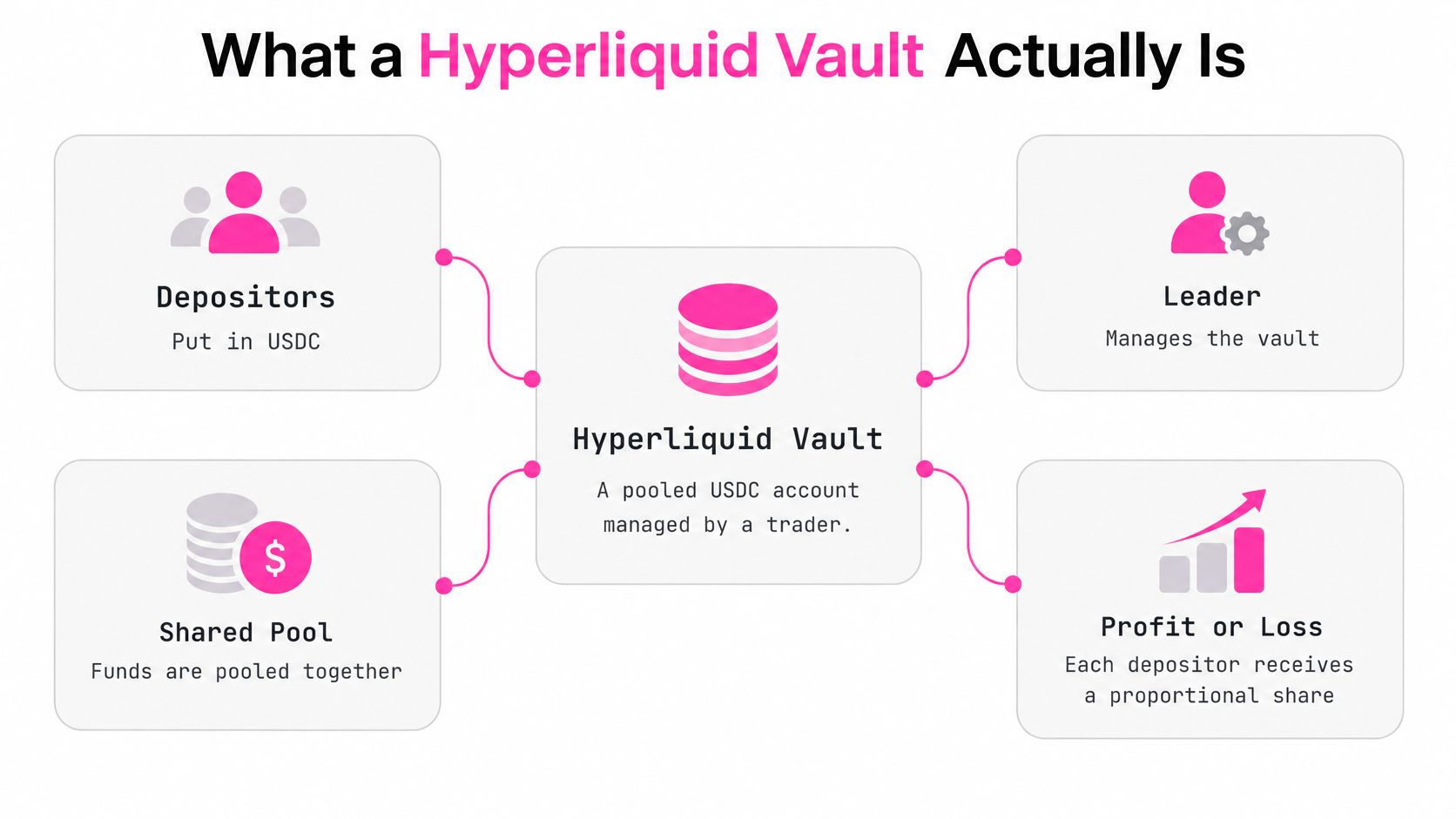
Start with the plain definition. A Hyperliquid vault is a single trading account that many people fund and one leader trades. Depositors hold proportional shares of the account's equity, so every gain and every loss is divided across those shares.
Hyperliquid's vault depositor documentation describes the system as a copy-trading structure: depositors allocate USDC to a vault managed by a trader, the leader trades the pooled account, and depositors receive a proportional share of profits or losses after the leader's commission. The same page works through the ownership arithmetic directly. Deposit 100 USDC into a vault holding 900 USDC of total deposits, and you own 10% of the deposited capital.
Sit with that example, because it explains everything downstream. Your balance doesn't tick upward by a quoted rate. It moves with the value of an account you now partly own.
Two vault families, one shared mechanic
The interface lists two kinds of vault, and confusing them is the most common early mistake.
User vaults (legacy copy-trading vaults) are run by an individual trader or team. The leader picks the strategy, and depositors are backing that person's judgment.
Protocol vaults, with HLP (the Hyperliquidity Provider) as the main example, are operated as part of Hyperliquid itself rather than by an outside manager. HLP supplies liquidity and takes part in selected market-making and liquidation functions, which is a different job from running a directional book.
Both share the same core mechanic: one pooled account, many depositors, proportional shares. Neither is a savings account, and neither behaves like a lending market where a borrower's loss stays the borrower's problem.
Who absorbs the loss
Here's the part that gets glossed over in most explainers. A vault is a single cross-margined trading account. If that account is liquidated, the loss lands on every depositor's share proportionally, and no conventional depositor-protection layer is identified in the documentation.
Compare that with a lending market. When a borrower there gets liquidated, the lender's principal is meant to be protected by collateral and a liquidation penalty. In a vault, you sit closer to the equity holder: the account's equity is your position.
Because returns depend on the manager's trading results, the timing of deposits and withdrawals, fees, and the vault's risk exposure, a single yield figure can't describe the product. Hyperliquid's public interface exposes the statistics that can, including annual percentage yield, total deposits or total value locked, profit and loss, maximum drawdown, trading volume, open positions and trade history. Those seven fields are the raw material for every check below.
Practical rule: if you can't explain where a vault's return comes from in one sentence, you don't have enough information to deposit.
If the gap between backing a trader and lending into a pool still feels abstract, this comparison of DeFi vaults and lending pools shows where the risk sits in each structure.
Profit Share, Lockups and Getting Your USDC Out
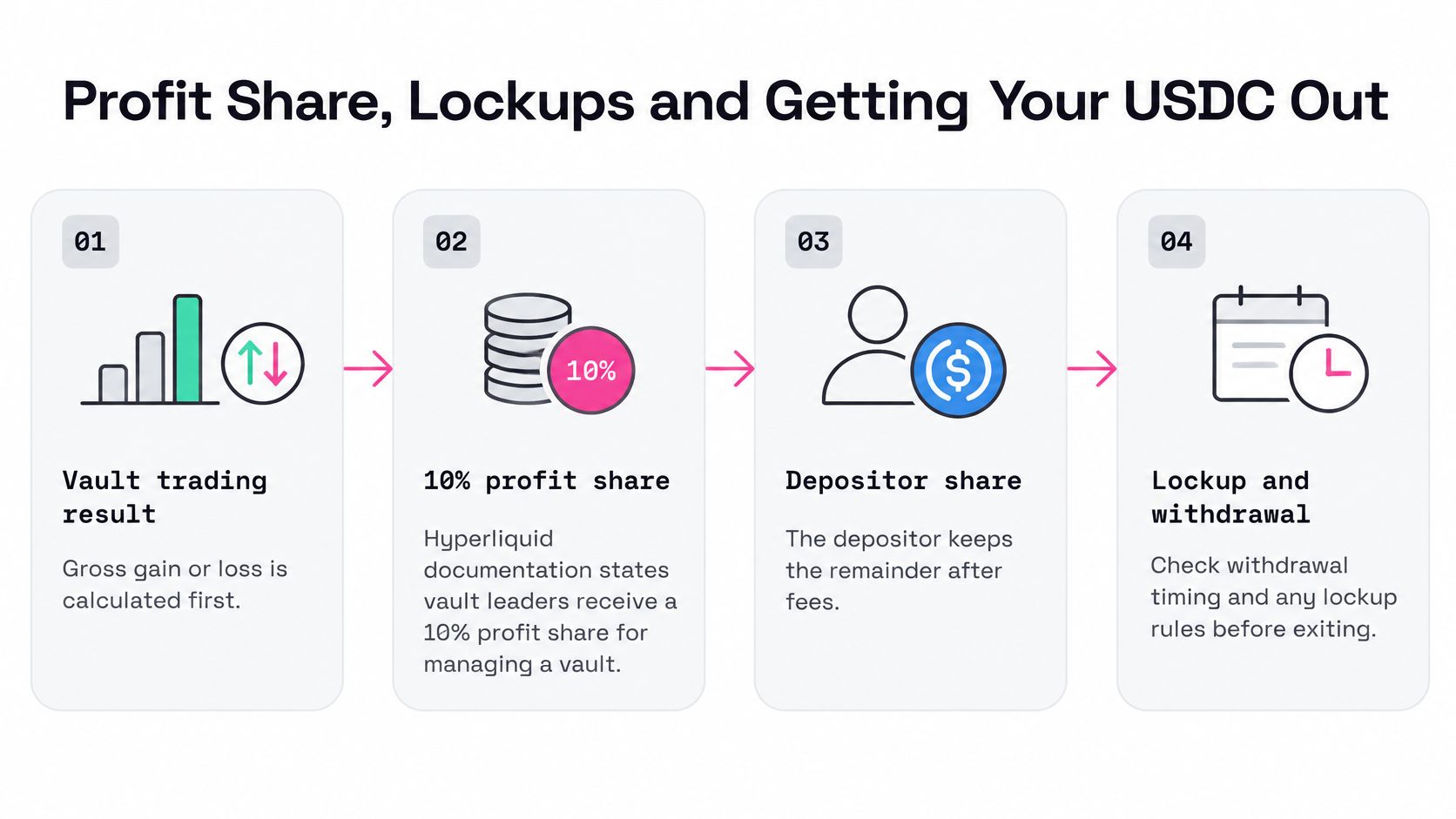
Fees first, because they change what a "good" vault even means. Hyperliquid's documentation for vault leaders states that vault leaders receive a 10% profit share for managing a vault. A gross trading gain is therefore not what a depositor keeps. The leader earns on profit, not on losses, so a vault that gains 10% then loses 10% still paid a commission on the way up. Run that sequence twice and the asymmetry compounds: the account can end flat or worse while the leader has already taken a cut of every winning leg.
The same documentation separates two costs that are easy to conflate with a yield figure: creating a user vault requires a 100 USDC minimum deposit plus a 10,000 USDC gas fee, distributed to the protocol in the same manner as trading fees. Neither number is an APY, and neither is a deposit fee for someone joining an existing vault. They matter only if you're evaluating whether to run a vault yourself, where a large fixed creation charge can swamp a small pool.
Withdrawals allowed is not cash available
The exit side is where most write-ups stop short. HLP is described as having a four-day lockup, and withdrawals after that window may still depend on the vault reducing positions when free margin is insufficient, according to this review of Hyperliquid vault mechanics. The lockup is only the first gate. Because the vault's capital sits inside open trades, the second gate is whether the account holds enough free margin to pay you out without unwinding anything.
That produces a distinction worth writing on a sticky note: "withdrawals allowed" is not "cash available immediately." If the vault is fully deployed and margin is tight, your exit is a trading decision the leader has to make, not a button you press.
Public flow data doesn't clear this up either. Deposits and withdrawals appear on-chain without saying whether a flow was ordinary rebalancing, profit-taking, an emergency exit or forced deleveraging. A spike of withdrawals can read as panic and turn out to be routine, or read as routine and turn out to be a leader pulling capital ahead of a loss.
| Term | Documented value | What it means for you |
|---|---|---|
| Leader profit share | 10% of vault profits | A gross trading gain is not what you keep; the leader earns on profit, not on your losses |
| User vault creation fee | 10,000 USDC | One-time cost for running a vault, not an APY and not a deposit fee |
| User vault minimum deposit | 100 USDC | Separate from the capital needed to support the leader's strategy |
| HLP lockup | Four days as described | Principal is not withdrawable during the lockup |
| Withdrawal after lockup | May depend on reducing positions when free margin is short | "Withdrawals allowed" is not "cash available immediately" |
| Loss sharing | Losses fall on all depositors through the shared account | A single liquidation of the vault account reaches every depositor proportionally |
| TVL versus liquidity | TVL is total deposits, not redeemable cash | A large deposit base does not mean you can exit at once |
Vault activity also creates a trail of deposits, withdrawals and profit-share events that has to be reconstructed at filing time, and crypto tax support for self-employed traders from Blue Sage Tax & Accounting Inc. can save a messy reconciliation.
For the comparison that matters, Yield.ly's opportunity tables include Hyperliquid L1 alongside Ethereum, Base and Arbitrum One opportunities from protocols such as Morpho Blue, Pendle, Aave V3 and Uniswap V3, and they show liquidity, base versus reward composition, and rate durability flags for opportunities with thin or volatile history. That's the context a vault page won't give you: how the vault's terms stack up against a lending market you already understand. Terms and rates move, so confirm the current lockup and fee on the live vault page rather than trusting any table, including this one.
Reading Vault History Like a Risk Analyst
A vault's APR is annualized from a trading record. The first question is therefore not "how high," but how long is the record, and does it include a bad week?
| Stat | What it tells you | Warning sign |
|---|---|---|
| APR | Annualized return from the vault's trading record | Computed from a short window or one strong month |
| Total deposits / TVL | Capital in the vault | Read as safety when it is really just size |
| PnL | Profit and loss on the pooled account | Reported profit while account value falls |
| Maximum drawdown | Worst peak-to-trough decline | Deep or repeated drawdowns in the window |
| Trading volume | How actively the leader trades | High volume with flat or negative PnL |
| Open positions | Markets and exposure the vault holds | Heavy concentration in one volatile market |
| Trade history | How the leader acted over time | History too short or gaps around bad periods |
Walk the rows in order
APR comes first only because it's printed first. Ask what window it annualizes. A vault that gained modestly over a few weeks can display an annualized number that looks like a career, and the methodology behind a yield stability score is a useful reminder that rate durability is measured separately from rate level.
Total deposits tell you size, not safety. A nine-figure TVL can sit in a book with one concentrated position, and TVL is never the same as redeemable cash. Trading volume tells you the leader is active, which is not the same as skilled. Open positions tell you what the account is exposed to right now, and whether that exposure is a single volatile market.
The two rows that matter most
Maximum drawdown is your realistic bad-case pain. If a vault shows a return of 20% and a maximum drawdown of 25%, an early depositor could have been down a quarter of their capital before the recovery. Drawdown larger than the annual return deserves an explanation, not a shrug.
PnL needs splitting into realized and unrealized. Independent analysis of Hyperliquid vaults makes this concrete: one snapshot reported HLP at roughly $152 million in TVL and a 13.23% APR, while another showed HLP's account value falling 12.6% over 30 days despite $2.24 million in trading profit, as documented in this Hyperliquid vault analysis. Gross trading profit and depositor return can diverge for entirely ordinary reasons: annualization effects, unrealized losses on inventory, and positions marked against a moving price.
What HLP's return is actually made of
HLP isn't a conventional copy-trading vault. Hyperliquid's protocol vault documentation lists its functions as providing liquidity to Hyperliquid, executing multiple market-making strategies, performing liquidations, supplying USDC through Earn, and accruing part of trading fees.
Those are separate return channels with separate risks. Market-making inventory can lose value during directional moves. Liquidation activity generates fee-related income while exposing the vault to stressed-market execution. Deploying USDC introduces utilization and counterparty dependencies. Ranking HLP against a plain lending APY without separating fee income, trading PnL, liquidation economics, asset exposure and liquidity terms compares two different things.
A lower-APR vault with steady equity and a shallow drawdown usually tells you more than a high-APR vault whose number was annualized from a brief winning streak.
One structural caveat applies to every dashboard: platform-wide vault totals are dominated by the protocol vault, so an aggregate figure isn't a summary of the independent trader vaults. When you compare histories, compare vault to vault, and treat a short record as an unknown rather than a good one. The notes on how DeFi APY history behaves over time are worth reading before you weight any annualized number heavily.
A Worked Example of a Vault Position
Everything in this section is hypothetical and illustrative. Rates and costs move, and none of these figures is a forecast or a recommendation.
Say a reader moves 5,000 USDC into a trader vault with a reported 12% annualized return, and holds for 30 days.
The cost of getting in and out
Four costs sit around the trade itself. Bridging USDC to the right chain, swapping if the reader holds a different stablecoin, the deposit transaction, and later the withdrawal transaction. These are roughly fixed: they don't shrink because the deposit is small, which is why position size changes the arithmetic more than many expect.
The gain, step by step
Gross return for 30 days is 5,000 × 0.12 × (30 ÷ 365), which is about 49 USDC. The leader's 10% profit share takes roughly 5 USDC of that, leaving about 44 USDC for the depositor. Subtract an illustrative 8 USDC of round-trip costs and the net lands near 36 USDC.
Now shrink the deposit. On a much smaller balance, the same month produces a gain smaller than the illustrative round-trip costs, so the costs swallow the entire return. Fixed costs, not yield, decide the outcome at small sizes.
The same month, with a drawdown
In that same 30 days, the vault's equity could fall 10% before recovering. A 10% dip takes the account to 4,500 USDC on a 5,000 USDC position, and the depositor carries that decline proportionally. Notice the asymmetry: the profit share applies only to gains, while the drawdown is borne in full.
The annualization trap
A vault that made 1.5% in a quiet fortnight gets annualized by scaling that short window up to a full year, which lands in the range of a spectacular headline. If that fortnight is the only profitable stretch in an otherwise flat quarter, the headline describes two weeks and hides the rest.
Run the arithmetic before the deposit, not after. Gross return, minus profit share, minus round-trip costs, compared against the disclosed drawdown.
Break-even sits closer than it looks, which is why how much APY is too high is a better question than which number is biggest, and why the effect of gas and fees on net DeFi yield deserves a look before any move. If the terminology is still new, the DeFi yield explainers cover the vocabulary in plain English.
Risks a Vault APR Does Not Price In
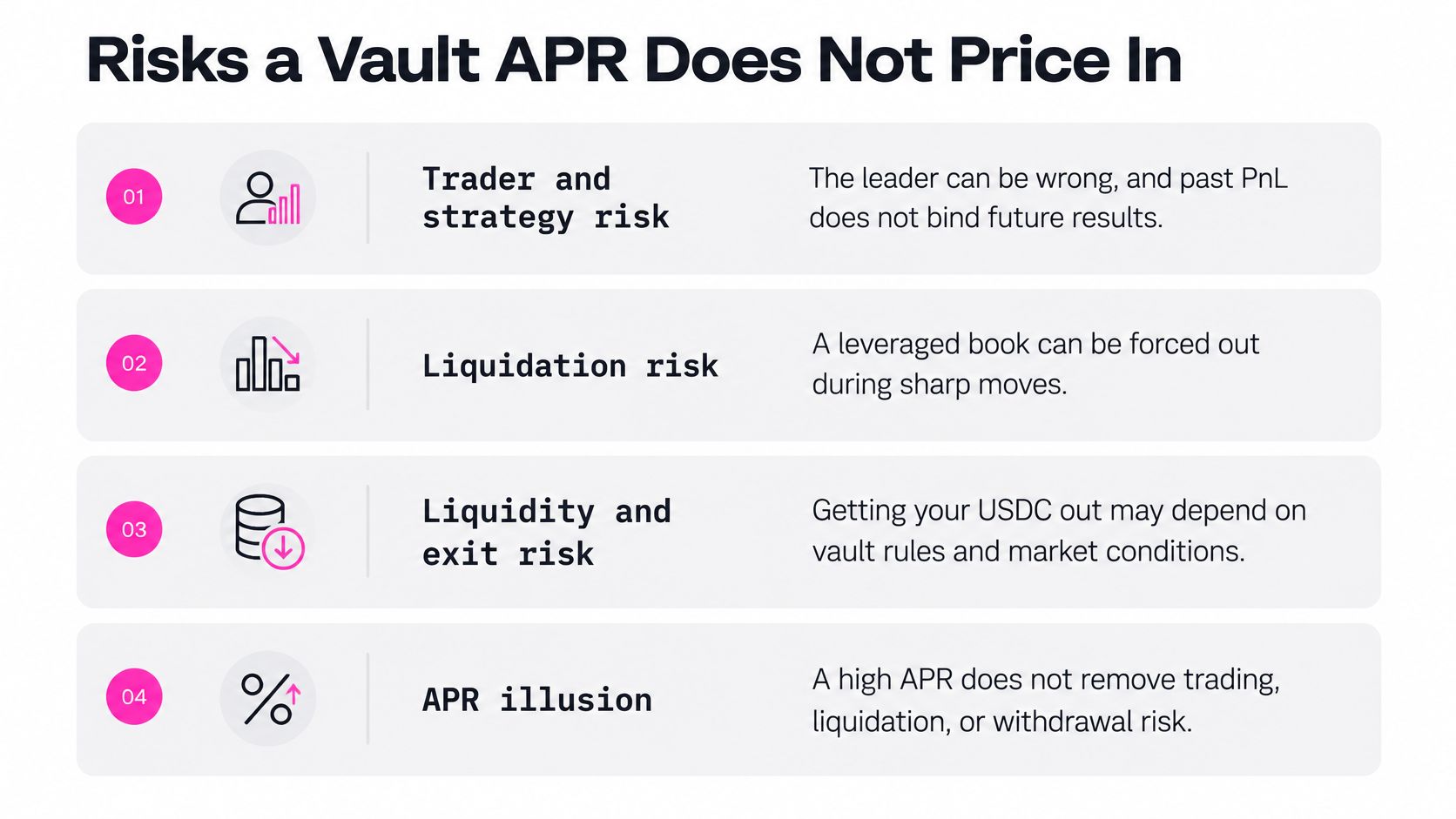
Trader and strategy risk. The leader can be wrong, and a strong PnL history doesn't bind future decisions. Strategy drift is real: nothing forces a leader to keep running the approach that produced the record.
Liquidation and cross-margin contagion. Because the account is cross-margined, one stressed market can cascade through collateral that supports every depositor's share.
Open-position risk. Perpetual positions can be concentrated in a single volatile market, and an APR computed before a liquidation event doesn't price that event.
Liquidity and exit risk. Lockup plus free-margin constraints mean your exit can take longer than the stated window.
Smart contract and protocol risk. The vault contracts and the exchange infrastructure beneath them both matter, and newer vault architectures widen that surface compared with legacy vaults.
Oracle and mark-price risk. Liquidations and PnL depend on prices the protocol reads, so a bad print can move an account before anyone trades.
Bridge and chain risk if USDC arrives over a bridge, stablecoin issuer and depeg risk because USDC is the unit of account across these vaults, incentive decay wherever a headline blends base yield with token rewards, and counterparty risk on any USDC deployed through Earn.
Losses are shared, not isolated
The deposit-level consequence is the one to internalize. In a cross-margined vault, a stressed market can liquidate collateral that backs every depositor's share, so the loss is divided across the pool rather than confined to whoever was "wrong." An APR printed before that event never included it.
Scale concentrates the problem. A late-November 2026 snapshot on the Hyperliquid vaults page reported roughly 219.65 million dollars in total value locked across Hyperliquid vaults, with HLP holding about 151.53 million dollars and displaying a reported APR of 14.62%. HLP accounted for roughly 69% of platform-wide vault TVL (151.53 divided by 219.65). That's a time-specific observation, not a forecast, and the same snapshot shows wide dispersion among individual vaults, including negative APRs alongside very high reported ones. Platform averages hide exactly the differences a depositor needs to see.
The structure itself isn't unique to crypto, and how real estate debt funds work at LendingXpress raises the same questions to ask a manager. The difference here is that the book is marked to market continuously and can be liquidated on a bad afternoon. Risk observations are evidence-based, never a safety guarantee, and crypto and DeFi carry substantial risk of loss. For a sanity check on where a headline number sits against its own history, see why a very high APY deserves scrutiny.
How to Vet a Vault Before You Deposit
Work through these in order. Each one has a pass or fail signal, and any hard fail is a reason to stop.
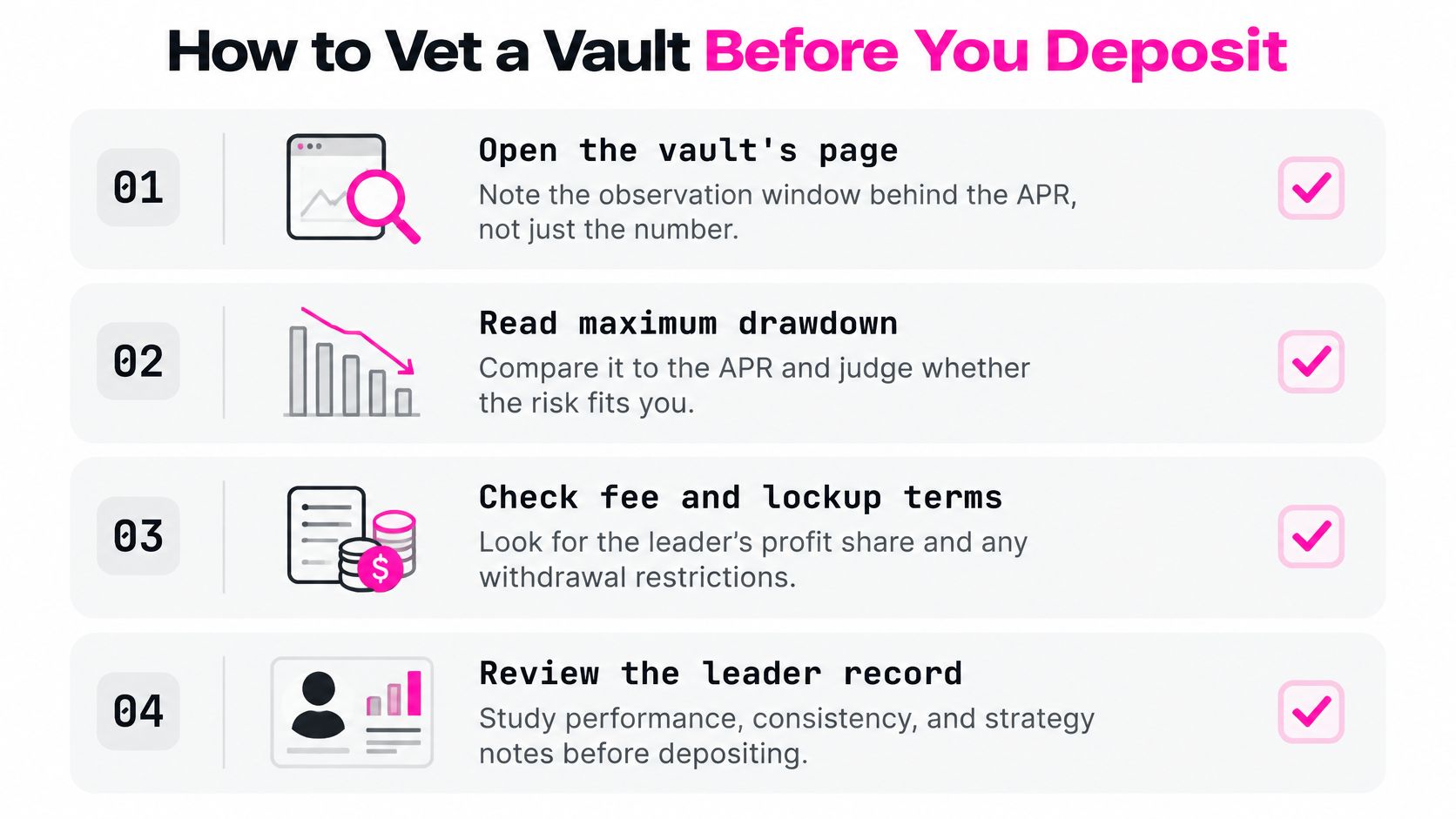
- Open the vault page and find the observation window behind the APR. A number annualized from a few weeks is a description of a few weeks. Fail if the window isn't visible anywhere.
- Read maximum drawdown next to the return. If drawdown exceeds the annual return, ask what produced it. Fail if drawdown isn't disclosed.
- Open the trade history and locate a losing stretch. Note whether the leader cut risk or doubled down. Fail if the history starts after a drawdown.
- Check open positions and list the markets. Decide whether that concentration fits your tolerance. Fail if you can't tell what the vault holds.
- Confirm the lockup and withdrawal conditions. Assume an exit takes longer than the lockup if positions need unwinding. Fail if the lockup is longer than your holding horizon.
- Split base yield from reward components. Where part of a headline comes from incentives, that part can fade. Fail if the entire return is incentives.
- Size the position so a full drawdown is survivable, then run the worked-example math with your own deposit and expected hold.
- Write down your exit conditions before depositing. A pre-committed rule beats a decision made during a drawdown.
- Compare the vault against alternatives on liquidity and observed risk, not only APY. A side-by-side comparison view and a glossary of yield definitions help normalize terms that protocols use differently.
When to walk away
Walk if the history is short, if drawdown isn't disclosed, if the lockup runs past your horizon, or if you can't attribute the return to trading PnL, fees or liquidation income. The risk methodology notes explain why an observed-risk label is evidence rather than assurance.
If you also hold crypto in a self-custody wallet, the same custody questions come up when you spend it, and choosing non-custodial spending cards from NomadCards covers that trade-off.
Education note: for education only, not financial or investment advice. Rates move and yield is never guaranteed; DeFi deposits can lose value.
Decide Whether to Deposit or Stay Out
A Hyperliquid vault is a bet on a trader or on the protocol's market-making engine, wrapped in a lockup and cross-margin rules. It behaves nothing like a yield product with a fixed rate, and treating it like one is how depositors end up surprised by a drawdown they never priced.
The decision rule fits in three questions. Can you name where the return comes from, whether trading PnL, fee income, or liquidation economics? Can you survive the disclosed maximum drawdown without changing your plans? Can you accept the exit terms, including the possibility that cash isn't immediately available? Three yeses make a vault one possible piece of a portfolio. Any no, and a lending market you already understand is the better comparison.
Each question has a concrete failure mode behind it. If you can't attribute the return, you're trusting a black box with a leaderboard position. If the drawdown would force you to sell something else or miss a payment, the position is oversized no matter how attractive the APR looks. If the lockup outlasts your horizon, the exit terms have already decided the outcome for you.
Every figure worth checking lives on the live vault page and on a live yield board, not in an article snapshot. Terms change, and a table in a guide is a starting point, not a source of truth.
For education only, not financial or investment advice. Rates move and yield is never guaranteed; DeFi deposits can lose value.
Yield.ly is free, needs no account and no wallet, and doesn't hold funds or place trades. Its Yield Alpha view ranks a possible move as MOVE, STAY or WATCH in dollars after switching costs, so the vault you're weighing gets compared on net outcome rather than on the number at the top of a leaderboard. Run your own numbers at Find My Yield Alpha, or start from the main Yield.ly board.
Yield.ly
Check today's rates before you move
Yield.ly ranks live DeFi yields with base and reward APY split out, TVL, and data freshness on every row. Free, no wallet needed.
Open the yield boardKeep reading
Tokenized Treasury Explained: Structure, Access and Risks Nov 28, 2026 · 15 min read
Tokenized Treasury Explained: Structure, Access and Risks
Learn how tokenized Treasury products work, how they differ from T-bills and stablecoins, and what to check on access, liquidity and issuer risk.
Maple Finance Crypto: How Its Lending Pools Earn Yield Nov 27, 2026 · 19 min read
Maple Finance Crypto: How Its Lending Pools Earn Yield
Maple Finance crypto explained: how institutional lending pools work, where yield comes from, and the credit and withdrawal risks to check.

Base APY vs Reward APY: The Difference That Changes How You Read DeFi Yield Aug 25, 2026 · 18 min read
Base APY vs Reward APY: The Difference That Changes How You Read DeFi Yield
Base APY comes from a protocol's underlying activity. Reward APY comes from additional token incentives. Learn how to separate durable yield from temporary rewards.
Informational disclaimer
This guide is for research and education. Yield rates change, smart-contract risk is real, and nothing here is investment advice. Rates shown on Yield.ly are observed readings, not guarantees.
About the blog
Blog articles explain DeFi yield concepts. For live rates, qualification, and risk readings, use the Yield.ly dashboard and the methodology. Sponsored placements never change qualification or ranking logic. See commercial independence.