
 Yield.ly
On this page7 sections
What do you own when a token says it holds U.S. Treasury bills?
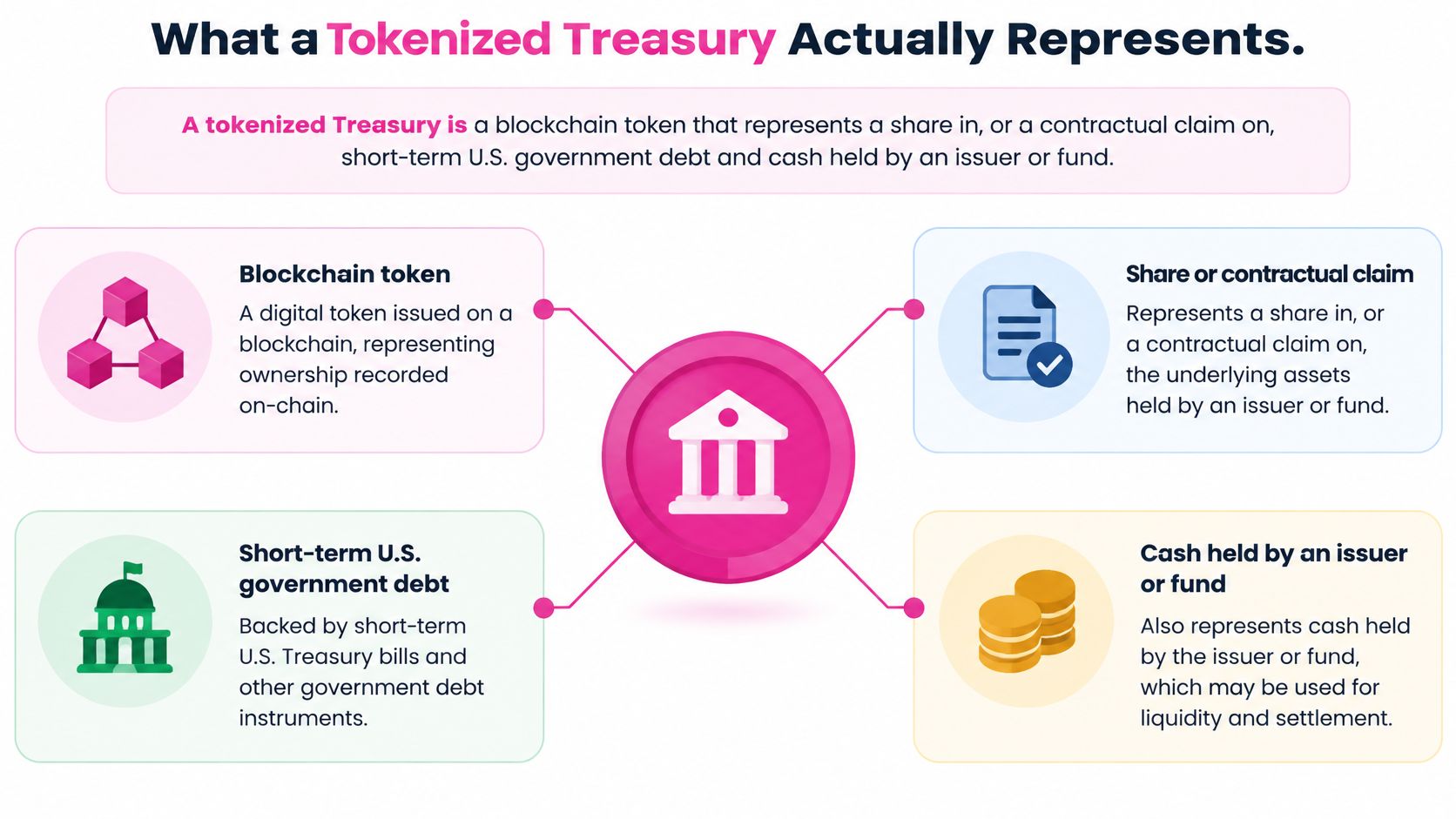
A tokenized Treasury is a blockchain token that represents a share in, or a contractual claim on, short-term U.S. government debt and cash held by an issuer or fund. The category has grown quickly in a short time, and every dollar of its yield comes from the underlying portfolio rather than from the blockchain that records ownership.
Two products can carry the same label and hand you completely different rights. One may be a fund share with a pro rata claim on a basket of Treasury bills. Another may be a note issued by an intermediary, paying on a schedule that issuer controls. A third may be a tokenized money market fund unit wrapped inside a lending market.
Same label, three different legal positions.
That difference is where most confusion starts. A holder who compares only the headline yield never sees the parts that decide whether the position can be exited or what happens if the issuer fails. A token can transfer freely between wallets and still be impossible to redeem, because transferability is a property of the ledger while exit is a property of the issuer's rules. The question worth asking isn't "what does it pay" but "what do I hold, who lets me in, and who pays me out."
The order that matters: follow the money to the underlying portfolio, then the access rules, then the legal claim. Yield comparison comes last, because the first three decide whether the yield is collectable at all.
What a Tokenized Treasury Actually Represents
Think of a cloakroom. The coat is a portfolio of Treasury bills sitting with a custodian. The claim check is the token in your wallet. The printed rules behind the counter decide who may collect the coat, on which days, and what happens if the cloakroom changes owners. The token is never the coat. It is the claim check, and its worth depends on the desk honoring it.
Every tokenized Treasury product has three layers under that analogy, and you can find all three in the issuer's documents.
- Underlying assets. Treasury bills, short-dated notes, repo and government money market fund shares. This layer produces the income.
- Legal wrapper. A fund share, an intermediary note, or a contractual claim backed by assets held off chain. This layer decides what you own and what you can recover.
- Token. The ledger record, its transfer rules, and any allowlist that controls which wallets may receive it. This layer decides how the position moves.
BlackRock and Securitize's BUIDL, Circle's USYC, Ondo's USDY and OUSG are examples of the category, not recommendations. Each one's structure and access terms live in its own documents, and each fact you rely on should be recorded with the as-of date printed on that document.
The category grew quickly because Treasuries were the easiest asset to start with. Figures compiled by CoinGecko and cited in the BIS Bulletin 107 on tokenisation of government bonds put the market at an all-time high of about $5.6 billion in April 2025, up $4.7 billion, or 544.8%, from the start of 2024, with BUIDL holding roughly 45% of it.
That same bulletin makes the structural point clearly: compared with equities, corporate bonds or private assets, short-term government securities offer deep underlying liquidity, transparent pricing and relatively standardized settlement, which is why they became the entry point for institutional tokenization.
Where the yield actually sits
Of the three layers, only the first generates income. The token adds near-continuous transferability, programmable compliance and faster settlement, but it adds no interest of its own. A holder who can name the portfolio, the wrapper and the token can also say which one pays them, and that answer rarely changes while the quoted rate does.
Tokenized Treasury vs Bills, Funds and Stablecoins
The fastest way to see what changes between holdings is to put them side by side. Read across each row, not down a single column.
| Holding | What You Hold | Where the Income Comes From | Access Rule |
|---|---|---|---|
| Direct Treasury bill | Government debt held book-entry through a broker | Discount to face value at maturity | Brokerage or direct purchase account |
| Government money market fund share | Pro rata claim on fund assets | Interest accrued in fund net asset value or dividends | Fund distribution rules |
| Tokenized fund share (BUIDL-type) | Token recording a fund share or claim on the fund | Treasury income passed through the fund | Issuer eligibility checks and redemption terms |
| Tokenized note or bond token | Contractual claim issued by an intermediary | Payments set by the note terms | Issuer and custodian terms set who may hold it |
| Plain stablecoin in a wallet | Dollar-pegged token | None by itself | Any compatible wallet |
| Stablecoin lent into DeFi | Claim on a lending pool position | Borrower interest and any token incentives | Protocol smart contract access |
Three columns carry the decision.
Legal ownership is the first. A fund share is a pro rata claim on a pool of assets. A note is a promise from an intermediary, and its strength depends on that intermediary's balance sheet and the custodian behind it. Same yield headline, different counterparty.
Income route is the second. Fund income accrues inside net asset value or arrives as a distribution, while a note pays what its terms say. RedStone's real-world asset report makes the practical version of this point: the underlying return generally comes from short-term U.S. government debt or Treasury-focused funds, and a holder comparing it with a stablecoin lending position should separate the Treasury yield from any added DeFi incentive, check whether yield is paid through token price appreciation or rebasing, and confirm the redemption process (RedStone RWA report).
Access is the third, and it's the one people skip. Brokerage accounts, fund distribution rules and issuer allowlists are three different gates. A product you can't legally hold isn't a yield opportunity, it's a research note.
The stablecoin confusion, stated plainly
A plain stablecoin sitting in a wallet earns nothing by itself. When a stablecoin appears to pay, the money is coming from somewhere else: a lending pool where borrowers pay interest, a fund whose Treasury income is passed through, or a reward program paying in a token. Each source has a different failure mode, so the question "where does this yield come from" beats "what's the APY." A yield-bearing stablecoin is one that has been wired to one of those sources, and the Yield.ly guide to yield-bearing stablecoins shows how each wiring changes the risk.
The Yield.ly guide to where stablecoin yield comes from walks through those sources, and the stablecoin yield page lists live opportunities with rates that move.
First risk to check, by row: a bill depends on your broker, a fund share on the fund's rules, a tokenized fund on the issuer's eligibility checks, a note on the issuer's credit, a stablecoin on its peg, and a lending position on the protocol's code.
How the Yield Reaches Your Wallet
A tokenized Treasury pays its return through one of three routes: accrual in the fund net asset value, a rebasing token balance, or a separate distribution in cash or another token. Knowing which route applies tells you where to look when the number on screen changes.
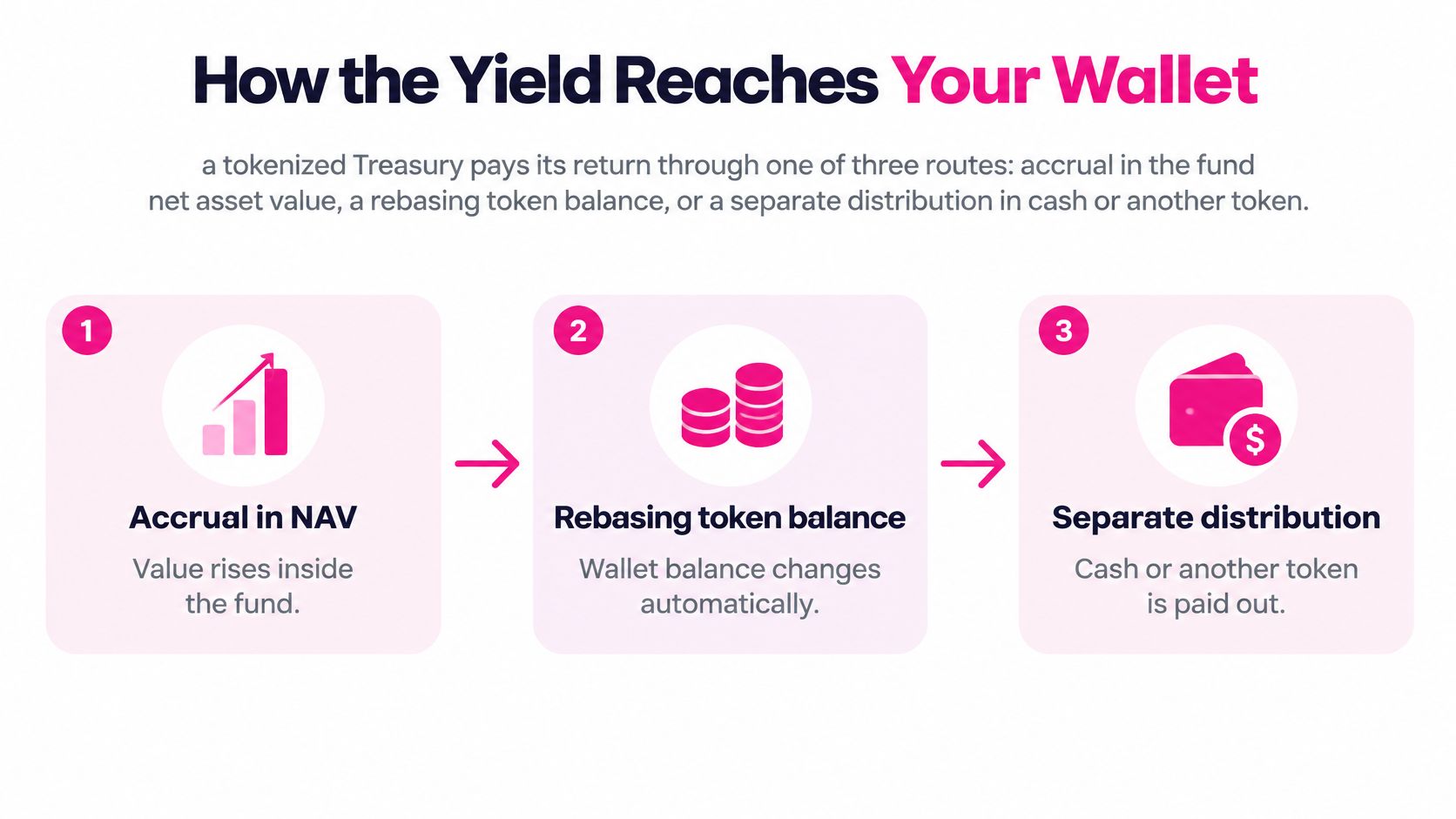
Accrual in NAV means the token's redeemable value rises while your balance stays fixed. Rebasing means your wallet balance grows and the per-token price holds steady. Separate distribution means you receive a payment, sometimes in a different token, which you then have to manage. A token can also trade above or below its net asset value on a secondary market, and that price move is not yield.
Here is the part that decides whether a small position is worth holding. The example below is hypothetical and illustrative, not a quoted rate.
- Gross income. A $10,000 position at an illustrative 4.0% gross annual yield, held 30 days: $10,000 × 4.0% × 30/365 = $32.88.
- Product fee. An illustrative 0.20% annual fee, assumed not already inside the quoted yield: $10,000 × 0.20% × 30/365 = $1.64.
- Entry and exit spreads. An illustrative 0.10% each way: $10 in, $10 out, $20.00 total.
- Gas. Buying and later redeeming: an illustrative $3.00.
- Net result. $32.88 minus $1.64 minus $20.00 minus $3.00 = $8.24, about 0.08% on the position before any price drift.
Spreads dominate a short hold. Stretch the same position to a year and the spread cost stays fixed while the income compounds, which is why hold period matters as much as rate.
Why published market sizes disagree
Growth figures for this category are large but not interchangeable. The AFME DLT report recorded global tokenized Treasuries expanding from $3.9 billion in 2024 to $9 billion in 2025, a 130% increase, while other trackers using different inclusion rules and cutoff dates reported lower totals for overlapping periods. A dashboard that doesn't state its valuation date, chain coverage and whether it counts fund shares, direct bond tokens or wrapped duplicates can't be compared with one that does.
That matters for yield comparison because displayed APY should be separated from secondary-market price changes, management fees, distribution mechanics and any protocol incentives. A high nominal yield isn't the same as realized return once subscription, redemption, transfer restrictions, gas and stablecoin conversion spreads are subtracted.
Base yield is the organic component before token incentives. Split the two apart, then compare net figures, because incentives can fade while Treasury income stays steady.
The Yield.ly breakdown of where stablecoin yield comes from applies the same split to lending positions, which is the right comparison set for anyone deciding between a Treasury product and a DeFi pool.
Who Can Buy and How Fast You Can Exit
A tokenized Treasury can move on chain at any hour while the exit still depends on the issuer's calendar, its eligibility checks and whether a buyer exists at your size. Those are separate systems, and only one of them runs on weekends.
Access comes first. Issuers commonly restrict holders by jurisdiction, investor status and wallet allowlist, and minimum sizes differ by product. Confirm all three in the product documents before calculating anything, because an ineligible holder has no position to optimize.
Liquidity comes second, and it's thinner than the marketing implies. The IMF Global Financial Stability Report notes that fragmented blockchain networks can trap liquidity and reduce secondary-market depth, which is a structural problem rather than a temporary one.
| Exit Route | How It Settles | What Drives Cost | What to Verify |
|---|---|---|---|
| Primary redemption with issuer | Issuer or fund processes redemption under its terms | Redemption fees, cut-off timing, banking settlement | Cut-off time, minimum size, settlement days |
| Peer-to-peer transfer to an eligible buyer | Direct transfer between approved wallets | Negotiated price, buyer eligibility checks | Whether the recipient needs issuer approval |
| Exchange or DEX trade | Trade against a market maker or liquidity pool | Spread, price impact, stablecoin conversion | Pool depth and two-sided quotes at your size |
| DeFi pool withdrawal | Withdrawal from a lending or trading pool | Pool utilization, swap fees, gas | Available liquidity right now, not historically |
A worked exit, with the discount shown
Suppose a holder needs to sell $100,000 of a token. This example is illustrative. A quote shows $20,000 available at 0.30% below net asset value and the remaining $80,000 only at 0.80% below.
- First tranche: $20,000 × 0.30% = $60.
- Second tranche: $80,000 × 0.80% = $640.
- Total cost: $700, a blended discount of 0.70%.
Add an illustrative $25 in gas, plus a stablecoin conversion spread if the proceeds leave as a stablecoin rather than cash. The visible quote told you the price. The depth told you the truth.
Timing adds a second cost that never shows in a quote. A redemption placed after the issuer's cut-off settles on a later processing day, so the wait can be longer than the on-chain transfer that preceded it. Confirm the schedule in the issuer's published terms, with the document's date noted.
What a large TVL does not tell you
TVL is the total value represented in an opportunity. It describes size, not exit capacity. A pool can hold nine figures and still quote a punishing price for a six-figure sale, and market capitalization plus holder count won't close that gap.
The test that matters: check the quote depth you can actually see, at your own size, on the day you plan to sell. Everything else is a proxy.
Where secondary trading exists, execution can be cheaper. The AFME DLT report cites a 2025 BIS assessment that found tokenized bonds had reached approximately $8 billion in cumulative issuance and generally showed lower bid-ask spreads than comparable conventional bonds, with similar issuance costs. That's an encouraging data point about market structure, not a promise about your specific token on your specific chain.
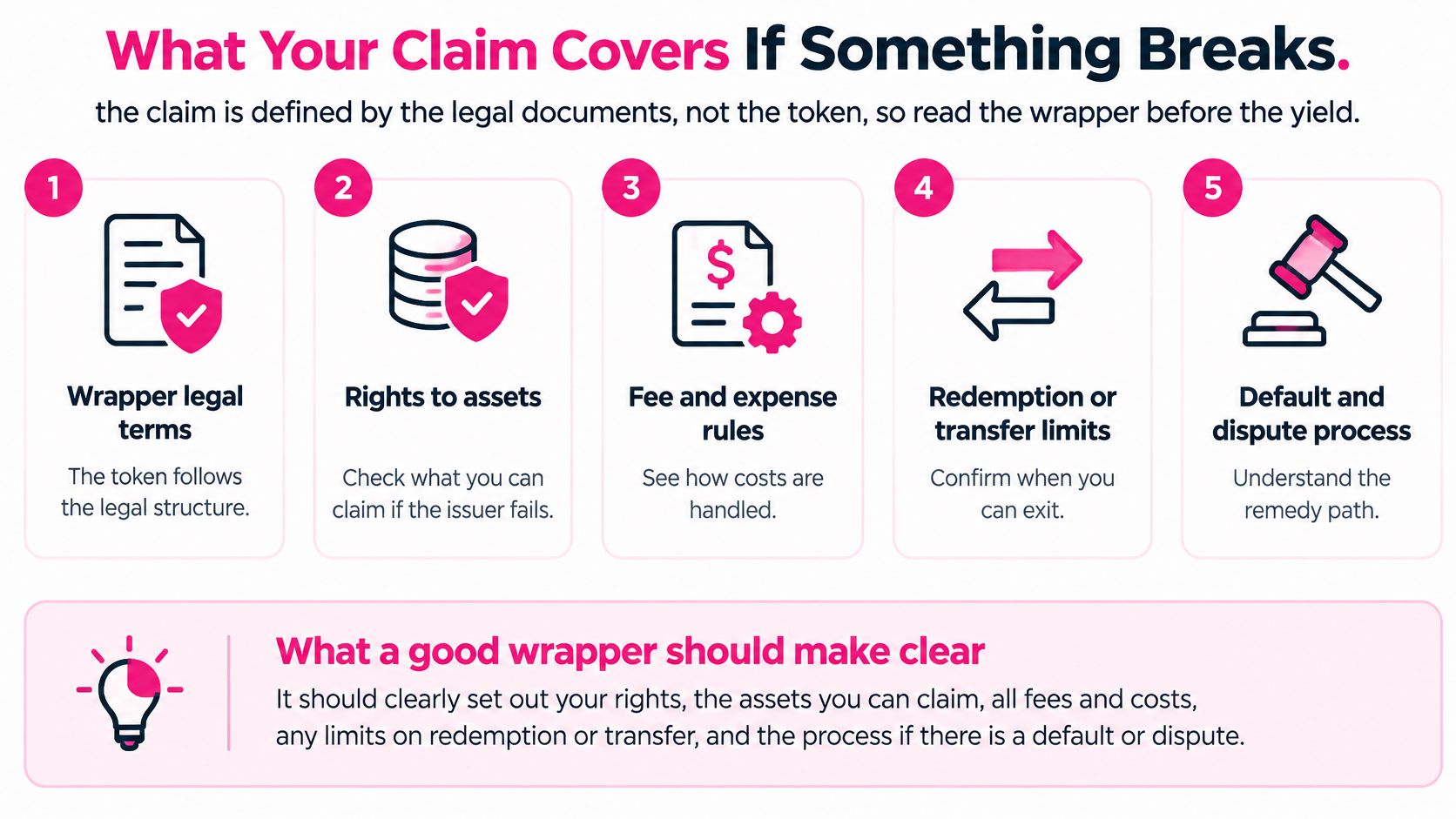
What Your Claim Covers If Something Breaks
The claim is defined by the legal documents, not the token, so read the wrapper before the yield. Six questions cover the ground, and each one has a recognizable good answer.
- Who is the recorded owner, and what does the token entitle you to? A satisfactory answer names the beneficial owner, the entity holding legal title, and the mechanism that connects the two.
- Who pays on redemption, on what schedule, and in which currency? Look for a named obligor, a stated settlement window, and whether redemption happens in cash, a stablecoin or another token.
- What happens to assets held for token holders if the issuer or intermediary fails? A good answer addresses segregation, the priority of claims, and whether the assets sit outside the issuer's estate.
- Who is the custodian, where are the assets held, and are they segregated? The custodian's name, jurisdiction and account structure should be stated, not implied.
- Can the issuer freeze, block or change transfer rules through a contract upgrade? Most can. What matters is whether the conditions are written down and bounded.
- What tax reporting will you receive? Tokenized fund shares generally follow the underlying fund's tax regime rather than the blockchain wrapper, so ask which form arrives and when.
The Astraea analysis of tokenized Treasury fund compliance makes two points worth carrying into any comparison. Tokenized fund shares remain securities even when recorded on chain, and the tax treatment follows the fund regime rather than the token. It also flags custody, operational, smart-contract and counterparty exposures that plain book-entry Treasury ownership doesn't create.
Why structure beats paperwork
Two products can hold identical collateral and offer different recoveries, because the wrapper decides who stands where in a queue. A note holder's claim runs through an intermediary. A fund shareholder holds a share of the pool. Those are not equivalent positions when something goes wrong, even if the yield is identical on a Tuesday.
One boundary worth stating plainly: Yield.ly does not execute transactions, custody digital assets, connect to wallets on a user's behalf, or provide brokerage services. Every answer above has to come from the issuer's own documents, saved with the date of the version that stated it. A worked example of how a lending protocol's legal wrapper shapes recovery shows the same reading discipline applied to a different product type.
Onchain Risks When the Token Moves Into DeFi
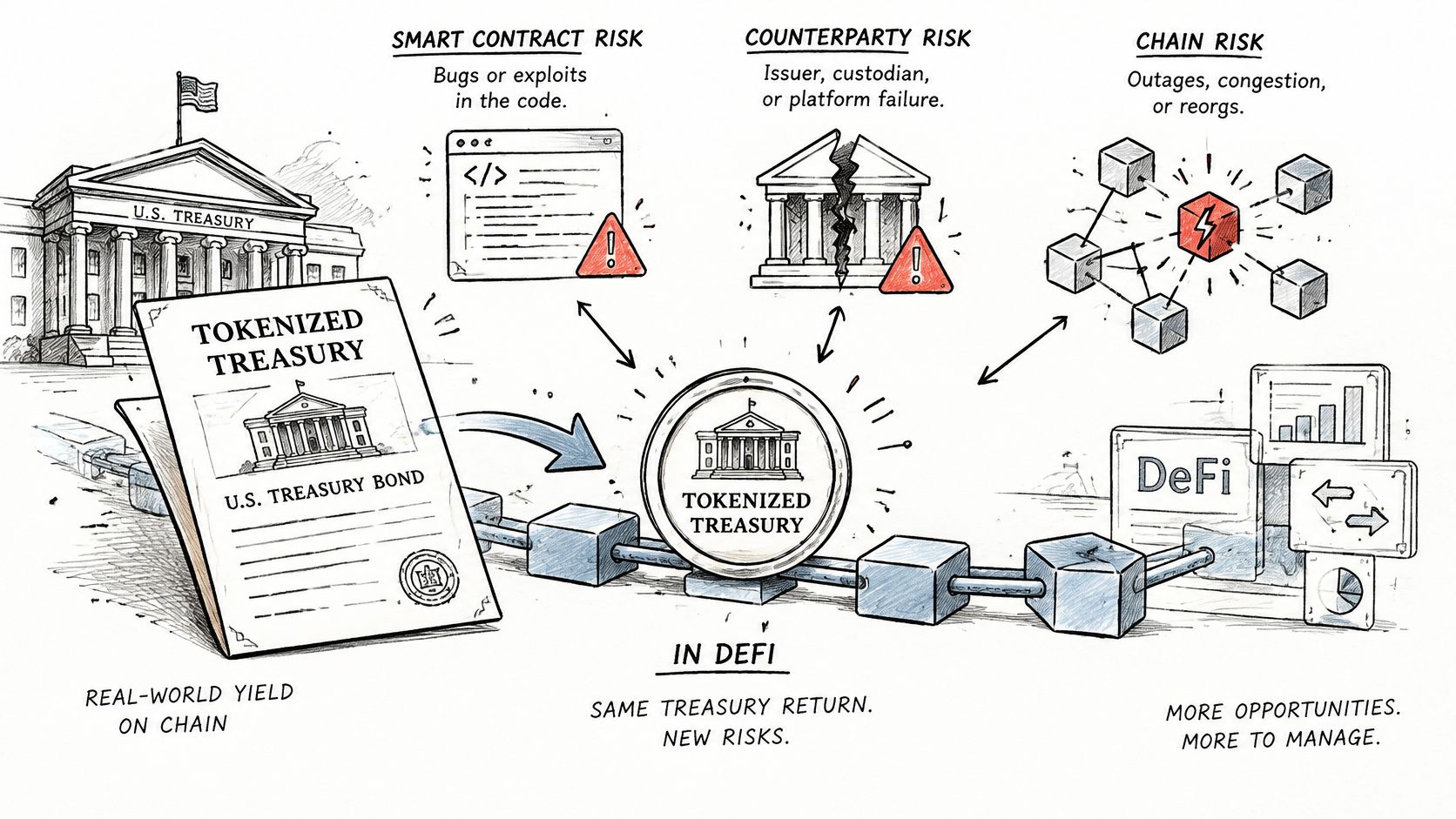
Once a tokenized Treasury enters DeFi, its Treasury return is joined by risks from the protocol and the chain, and those risks don't appear in the yield figure.
Smart contract risk. Audits reduce the chance of code failure; they don't remove it. Upgrades introduce new code paths after the audit.
Stablecoin depeg risk. Converting in or out through a stablecoin puts its price between you and your exit. A momentary depeg can turn a planned round trip into a loss.
Bridge and oracle risk. Cross-chain transfers and price feeds add failure points that a custodied fund share doesn't have. Oracle timing can move a collateral valuation without the Treasury portfolio changing at all.
Permission risk. Many tokens are accepted only by allowlisted pools, so a deposit can be impossible for ordinary wallets. Check this before building a strategy around it.
Incentive decay. Token rewards can fall while Treasury income holds steady, which changes the blended return without any change in the underlying assets.
The liquidation math, shown
Collateral and borrowing introduce a threshold that has nothing to do with Treasury yields. This example is hypothetical. Say a holder deposits $10,000 of tokenized Treasury collateral and borrows $7,000 against it, with liquidation triggered at an 85% loan-to-value ratio.
- Liquidation happens when debt divided by collateral value reaches 85%.
- Collateral value at that point: $7,000 ÷ 0.85 = about $8,235.
- Required fall from $10,000: about 17.6%.
A 17.6% move in a Treasury-backed token sounds implausible until you remember that the price feeding the calculation comes from an oracle, not from the fund's net asset value. Thin secondary liquidity plus an oracle update can produce that gap without any Treasury defaulting.
Protocol, smart-contract, asset, liquidity, market and platform risks apply to yields shown on Yield.ly. Its observed risk grades explain how each listing is assessed, and observed risk is an evidence-based assessment rather than a safety guarantee. The Yield.ly Learn hub covers the mechanics behind those grades for readers who want the underlying reasoning, and this comparison of DeFi vaults and lending pools sets out why the wrapper around a position changes which of those risks reaches you.
Count the layers: the token, the issuer, the custodian, the protocol, the oracle and the chain. Each one is a separate way to lose money, and none of them is covered by another.
Check Net Yield and Exit Terms Before You Move
Can you send the token today, and can you turn it back into cash on the day you need it? Those are different tests. A transfer works like handing over a claim check: the paper moves, but you get the coat back only if the desk is open, you are allowed to collect, and the fee does not swallow the errand. On-chain transfer proves the token can move. It does not prove the issuer will redeem, or that a secondary quote will hold at your size.
Write each check down before any money moves. Follow the money, then the access, then the claim. That sequence keeps a rate comparison from becoming an unplanned position.
- Name the three layers. Record the underlying assets, the legal wrapper, and the token, plus the issuer and custodian behind them. The legal claim is what a holder can try to recover if something breaks. The token is only how that claim travels.
- Confirm eligibility. Check that your jurisdiction and investor status are permitted and that you meet the minimum size, using the issuer's documents rather than a summary.
- Read the redemption terms. Note the cut-off time, the settlement days, and any fee, then set those next to the date you might need the money. A token you can send on a weekend can still be stuck until the next settlement window.
- Calculate net yield for your size and hold period. Start from gross yield. Subtract product fees, entry and exit spreads, gas, and any lockup cost, using the same subtraction method shown earlier. Time spent in transit is forgone yield during the transfer window you assume, not a free pause.
- Test exit depth at your size. Check quotes on the day you plan to sell, not the depth a dashboard showed last month. A quote that clears $1,000 can fail at $50,000.
- Confirm the DeFi use is permitted for your wallet. Then count each layer's risk separately instead of averaging it into one number.
- Compare like with like. Put your net figure beside a stablecoin alternative on the same terms: same size, same hold period, same exit. The Yield.ly opportunity board sorts by yield quality, liquidity, and observed risk rather than headline APY, and Yield Alpha labels a possible move MOVE, STAY, or WATCH after estimated costs.
Yield Alpha's switching-cost lines are labeled estimates unless you override them with protocol terms you verified yourself, and its gas figures come from chain-family default tables. Treat a MOVE label as a prompt to check the arithmetic, not as an instruction. A worked example of the gas side of that arithmetic is in this guide to DeFi yield after gas fees, the right mental model when a five-figure position moves between venues.
For education only, not financial or investment advice. Rates move and yield is never guaranteed; DeFi deposits can lose value.
Using Yield.ly requires no wallet, and the platform does not execute transactions, custody assets, or tell you where to deposit. You are solely responsible for verifying destination details, smart contract addresses, terms of use, eligibility, tax treatment, and counterparty risk before acting on anything you read.
Find My Yield Alpha ranks MOVE, STAY, or WATCH moves in dollars after switching costs.
Yield.ly
Check today's rates before you move
Yield.ly ranks live DeFi yields with base and reward APY split out, TVL, and data freshness on every row. Free, no wallet needed.
Open the yield boardKeep reading
Maple Finance Crypto: How Its Lending Pools Earn Yield Nov 27, 2026 · 19 min read
Maple Finance Crypto: How Its Lending Pools Earn Yield
Maple Finance crypto explained: how institutional lending pools work, where yield comes from, and the credit and withdrawal risks to check.
Best Crypto Liquidity Pools in 2026: 7 Options Compared Nov 26, 2026 · 12 min read
Best Crypto Liquidity Pools in 2026: 7 Options Compared
Compare the best crypto liquidity pools by fee yield, reward yield, TVL, volume and impermanent loss exposure, with a step-by-step checklist.

Base APY vs Reward APY: The Difference That Changes How You Read DeFi Yield Aug 25, 2026 · 18 min read
Base APY vs Reward APY: The Difference That Changes How You Read DeFi Yield
Base APY comes from a protocol's underlying activity. Reward APY comes from additional token incentives. Learn how to separate durable yield from temporary rewards.
Informational disclaimer
This guide is for research and education. Yield rates change, smart-contract risk is real, and nothing here is investment advice. Rates shown on Yield.ly are observed readings, not guarantees.
About the blog
Blog articles explain DeFi yield concepts. For live rates, qualification, and risk readings, use the Yield.ly dashboard and the methodology. Sponsored placements never change qualification or ranking logic. See commercial independence.