
 Yield.ly
On this page8 sections
- What Maple Finance Lends Out and Who Borrows
- How a Maple Pool Turns a Deposit Into a Loan
- Where Maple Yield Comes From and Why It Varies
- Calculating Net Return on a Hypothetical Maple Deposit
- Credit Losses, Borrower Concentration and Collateral Limits
- Smart Contract, Depeg and Issuer Risks
- Withdrawal Queues, Liquidity and Exit Costs
- Comparing Maple Yields and Checking Before You Move Funds
Maple Finance pools stablecoin deposits that professional Pool Delegates lend to institutional borrowers, so the yield is borrower interest and depends on repayment. Treating a Maple pool like a standard money market misses the institutional loan book sitting behind every receipt token.
When a stablecoin vault displays an appealing annual percentage yield, why do so many DeFi depositors look at the headline percentage and stop before asking who pays that interest or how quickly their cash can leave? Most automated lending markets rely on instant collateral liquidation and algorithmic interest curves, which trains crypto holders to expect effortless entry and exit. Evaluating Maple Finance crypto pools requires a different mental model, because each deposit funds a curated credit portfolio rather than a liquid money-market reserve.
Walking through Maple as a loan book makes the trade-offs clear. Every dollar of return traces back to a specific payer, whether that's an institutional borrower, a U.S. Treasury bill, or a temporary token campaign. From there, running the net dollar math after fees and exit costs, then testing how withdrawal queues behave under stress, gives a lender the facts needed before moving stablecoins.
What Maple Finance Lends Out and Who Borrows
The borrower behind a Maple loan is an institution seeking credit. Depositors supply a liquidity asset such as USDC or USDT, while professional Pool Delegates select borrowers and set loan terms. Borrowers pay interest for using that capital, and their ability to repay affects what lenders ultimately receive.
A Maple pool works like a commercial lending desk: the delegate reviews corporate applicants, approves loans and manages the shared credit portfolio. The depositor holds exposure to that portfolio rather than a direct loan to a chosen business. When borrowers pay on schedule, interest supports the pool's returns. When a borrower defaults, lenders can lose money.
The loan book matters more than the headline rate.
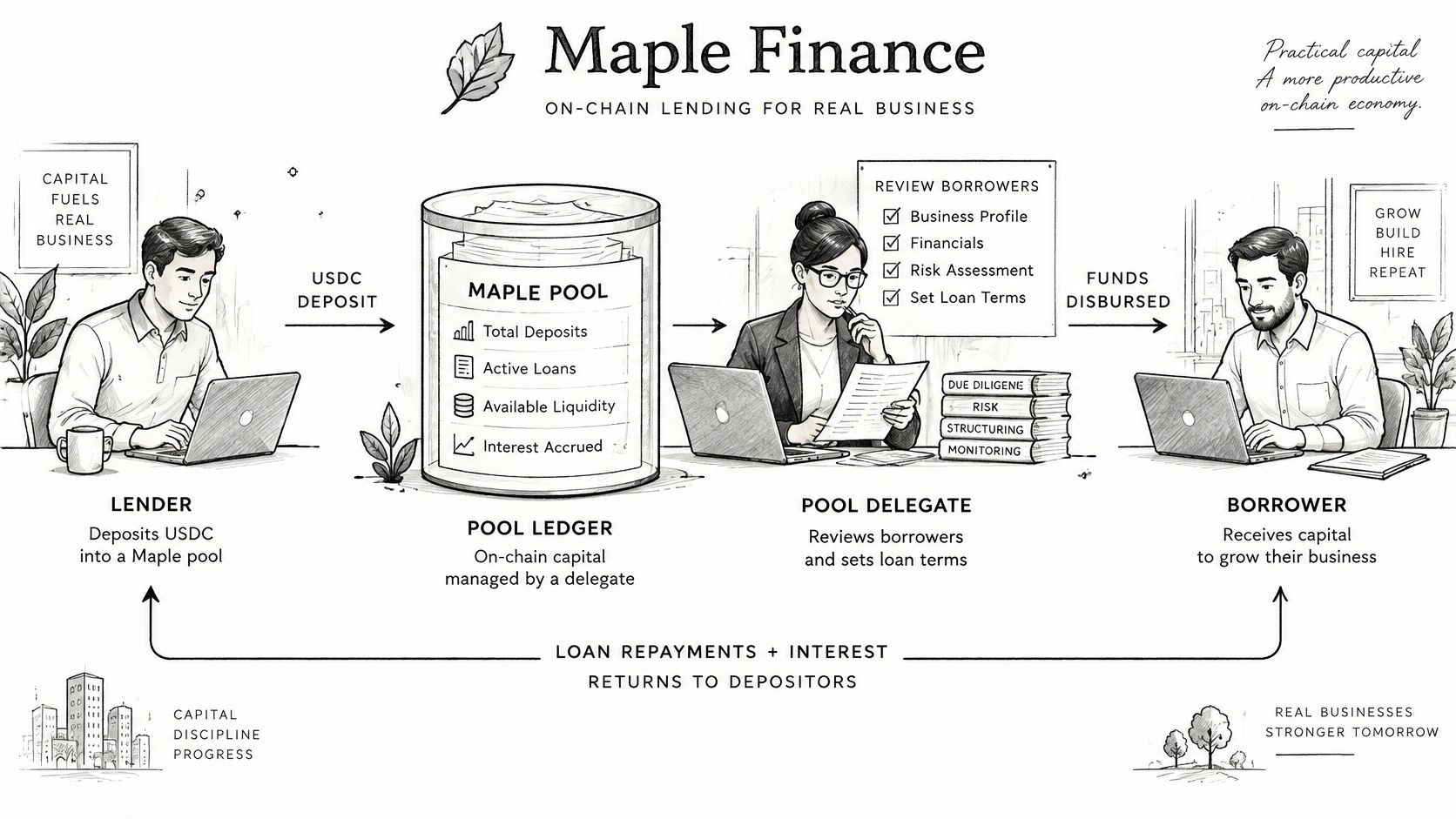
According to Maple Finance's official documentation, Pool Delegates handle pool-level credit decisions, lenders earn interest denominated in the pool's deposit asset, and participation does not require holding the protocol token. The documentation also describes syrupUSDC and syrupUSDT as ERC-4626 yield-bearing vaults, with returns derived primarily from institutional lending alongside additional yield strategies. That distinction matters: identifying the deposit token tells you what you supply, but understanding the underlying strategies tells you what generates the return.
Maple's history also shows why borrower exposure deserves attention. Past undercollateralized-loan defaults were followed by a shift toward overcollateralized institutional lending. Collateral gives a lender another potential source of repayment, but tighter collateral requirements do not eliminate credit risk. A lending strategy can change without making its yield fixed or its principal protected.
Products and Assets at a Glance
Maple's product names describe different claims and access requirements. A lending-pool receipt represents a pool position; a governance token serves a different purpose. Match the product, deposit asset and eligibility requirements before deciding what exposure you would hold.
| Product | What it represents | Deposit asset | Access and checks |
|---|---|---|---|
| syrupUSDC | Yield-bearing ERC-4626 receipt for a USDC lending pool | USDC in, syrupUSDC out | Access can differ by pool, check the pool page and Maple docs |
| syrupUSDT | Yield-bearing ERC-4626 receipt for a USDT lending pool | USDT in, syrupUSDT out | Access can differ by pool, check the pool page and Maple docs |
| Cash Management Pool | Treasury-linked pool with a SOFR-based variable APY | USDC | Permissioned, requires accredited-investor status and AML checks |
| SYRUP | Governance token, not a lending-pool share | Not a deposit asset for lenders | Confirm you hold syrupUSDC or syrupUSDT, not SYRUP |
Read the table as a map of exposures, not a list of interchangeable yield products. Institutional lending ties returns to borrower interest and repayment; the Treasury-linked product has a different underlying source of yield. Holding SYRUP alone does not represent the same claim as holding a lending-pool receipt.
Before comparing returns, identify which pool receives the funds, which asset enters it and what activity pays the yield. Those answers establish whose repayment matters and where a loss could reach the depositor.
How a Maple Pool Turns a Deposit Into a Loan
Depositing into a Maple pool doesn't work like opening a custodial savings account or supplying capital to a permissionless lending market. As detailed in Maple's institutional lender documentation, lenders interact directly with pool smart contracts that follow the ERC-4626 tokenized-vault standard, and access requirements can be permissioned depending on the specific pool.
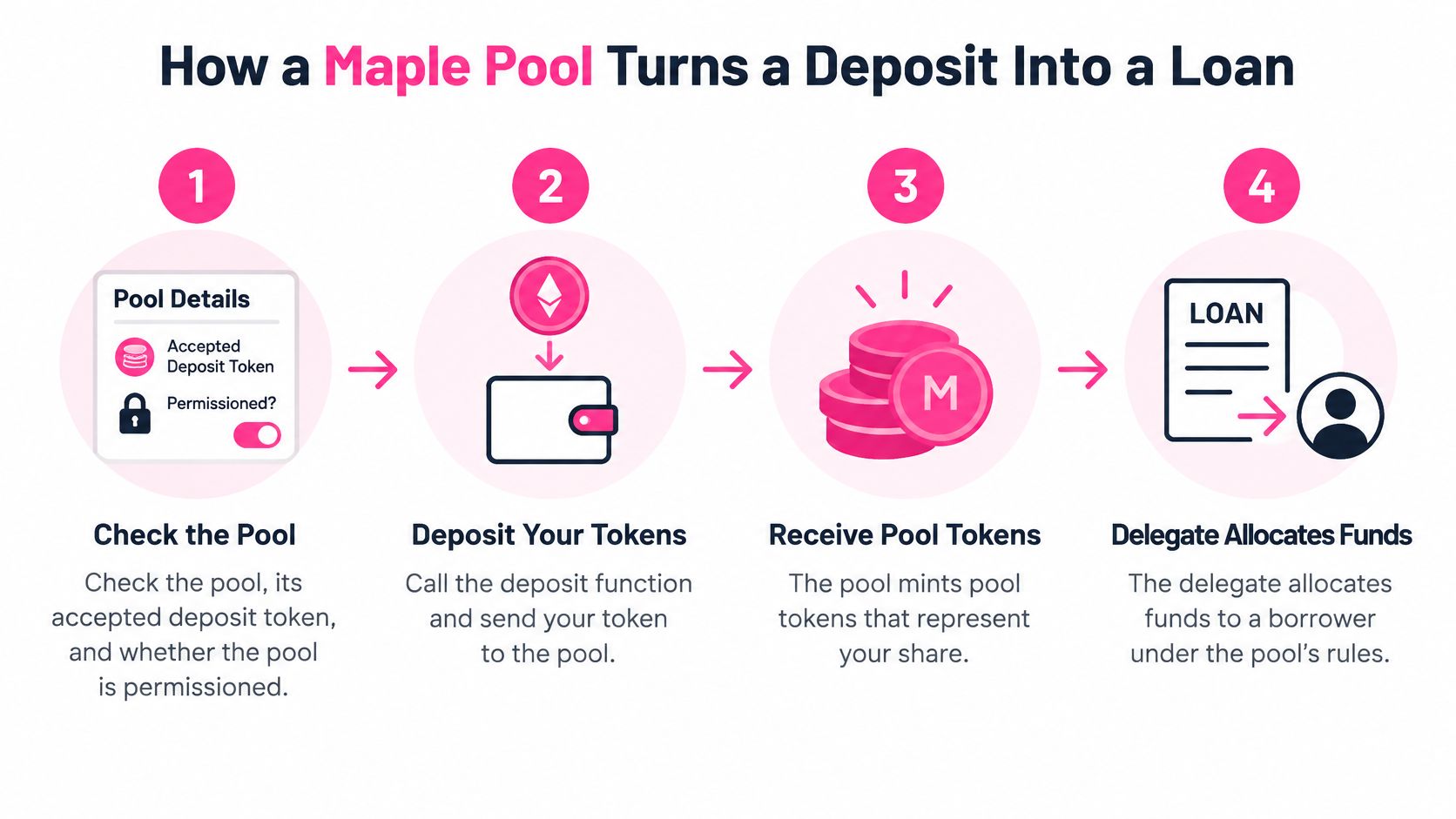
Following one deposit from wallet to borrower shows exactly where credit and technical responsibilities sit at each step.
- Verify pool eligibility and deposit token. Confirm the exact pool name, its accepted liquidity asset (such as USDC or wrapped ETH), and whether the pool requires permissioned onboarding before approving any contract call, because sending funds to the wrong pool or chain can lock or misroute capital.
- Call the pool contract's Deposit function. From a self-custody wallet, the lender calls
Depositto transfer tokens into the pool smart contract, which mints pool LP tokens back to the wallet. - Receive an ERC-4626 proportional claim. An ERC-4626 receipt isn't a fixed IOU promising the exact number of deposited tokens back; it represents a proportional share of the pool's total net assets, so its redemption value rises or falls alongside the loan book.
- Underwrite borrowers and encode loan rules. The Pool Delegate vets institutional borrowers and sets loan parameters, while an Open Term Loan Manager tracks outstanding loan accounting and a MapleLoan contract encodes the specific lender-borrower agreement.
- Draw capital and pay interest. Approved borrowers draw liquidity from the pool and make interest payments denominated in the pool's deposit asset back into the vault.
- Reflect accruals or booked losses in receipt value. As performing borrowers pay interest, each receipt token represents a larger claim on the pool's underlying asset; if a default forces a write-down, that claim shrinks proportionally.
Comparing this flow with open lending markets highlights an important distinction. In an automated market governed by a DeFi utilization rate, interest adjusts algorithmically as pool supply and demand shift. In a Maple pool, a depositor carries three layered exposures at once: smart contract code, delegate underwriting judgment, and individual borrower solvency.
Pre-Deposit Verification Checklist
Before signing an approval transaction, run through five quick checks on the live pool interface:
- Pool name and address: Match the contract address on-chain against Maple's official documentation so you don't interact with a spoofed vault.
- Accepted deposit token: Confirm whether the pool takes USDC, USDT, or wrapped ETH, and verify the token's native chain.
- Receipt token minted: Verify the exact receipt token returned to your wallet (such as syrupUSDC) and confirm it's a vault share rather than a governance asset.
- Permission status: Check whether the pool is open or requires identity verification, accredited-investor status, or allowlisting.
- Displayed APY composition: Look past the headline number to confirm how much comes from borrower interest versus temporary incentives.
Where Maple Yield Comes From and Why It Varies
A Maple pool's headline APY is a moving average across its active loan book and strategies, not a locked-in rate. Two pools accepting the exact same stablecoin can produce sharply different returns over the same quarter. As explained in Maple's smart contract architecture documentation, each pool aggregates lender capital while preserving loan-specific agreements, meaning realized yield depends on the underlying loan book, repayment performance, liquidity terms, and manager-controlled credit configuration rather than a homogeneous money-market rate.
| Yield source | Who pays | How durable it is | What to check |
|---|---|---|---|
| Borrower interest on institutional loans | Institutional borrowers repaying pool loans | Lasts while loans perform and repay | Loan book size, defaults, borrower concentration, maturities |
| Treasury bill and repo income (Cash Management Pool) | Borrowers investing proceeds in U.S. Treasury bills and fully collateralized T-bill repos | Variable, tied to SOFR | Current SOFR, the 0.50% fixed fee, permission status |
| Supplementary yield strategies | Strategy revenue after costs, as described in Maple docs | Tied to the named strategy's performance | Which strategy, its counterparties and its costs |
| Token incentives (if any) | Protocol or partner token emissions | Can fade when campaigns end | Reward share of total APY and the reward token price |
Breaking Down Each Yield Payer
Not all yield dollars carry the same staying power or downside. Reading each row by its payer reveals what has to go right for the return to continue, a core principle covered in how stablecoin yields are generated across DeFi.
Borrower interest on institutional loans comes directly from trading firms, market makers, or corporate borrowers paying to use pool liquidity. That cash flow stays steady only while borrowers remain profitable, keep paying interest, and refinance or repay principal at maturity.
Treasury bill and repo income powers Maple's Cash Management Pool, where proceeds go strictly into U.S. Treasury bills and fully collateralized Treasury reverse repurchase agreements. The yield moves up or down with the Secured Overnight Financing Rate (SOFR) and is reduced by Maple's fixed 0.50% annualized fee.
Supplementary yield strategies appear in Maple's vault descriptions alongside core lending. Because those returns rely on external venues or secondary deployments, lenders need to verify the exact named strategy, every counterparty involved, and the operating fees subtracted before returns reach the vault.
Token incentives are protocol or partner rewards layered on top of organic interest. Base means the organic or base yield component before token incentives. Incentives can inflate a pool's headline percentage during a growth push, then drop to zero the day a reward campaign ends or the reward token loses market value.
Consider a hypothetical incentive-decay example. Suppose a lender holds a $10,000 position in a pool where 3 percentage points of the displayed APY come from token rewards. While that campaign runs at constant token prices, those rewards represent $300 per year; once the campaign stops, only the base yield remains, and gas spent chasing the temporary boost can't be recovered.
Yield reality check: A high APY on a stablecoin lending pool isn't a free lunch. Higher rates compensate lenders for accepting credit risk, delegate discretion, or slower exit liquidity rather than signaling a low-risk cash equivalent.
Reviewing Yield.ly's guide on where stablecoin yield comes from alongside live peer rates on the stablecoin yields page helps place any Maple pool's base return in context against broader on-chain lending markets.
Calculating Net Return on a Hypothetical Maple Deposit
Headline percentages hide fees, transaction costs, and holding-period math. Working through a single hypothetical deposit in dollars makes the gap between a quoted rate and actual take-home return obvious. Every figure in the calculation below is strictly hypothetical and illustrative, not a live quoted rate or forecast, because market rates move constantly.
According to Maple's Cash Management Pool documentation, borrowers in that pool may invest proceeds only in U.S. Treasury bills and reverse repurchase agreements fully collateralized by U.S. Treasury bills, with a variable APY tied to SOFR minus fixed annualized fees of 50 basis points (0.50%). The same page notes that access is permissioned, requiring USDC lenders to verify accredited-investor status and pass anti-money-laundering (AML) checks.
Assume a hypothetical $10,000 USDC deposit into a Cash Management Pool structure earning an assumed 5.00% gross SOFR-based return for a full year, paired with Maple's stated 0.50% fixed fee:
- Gross annual return (hypothetical):
$10,000 x 5.00% = $500.00. - Protocol and borrower fee (stated rule):
$10,000 x 0.50% = -$50.00. - Net return before transaction costs:
$500.00 - $50.00 = $450.00, or 4.50%. - Assumed gas costs: Deposit at
$5.00plus direct withdrawal at$5.00equals-$10.00total. - Net return on direct redemption (one-year hold):
$450.00 - $10.00 = $440.00, or 4.40%. - Prorated 30-day direct-redemption result:
$440.00 x (30 / 365) = $36.16. - Alternative secondary-market exit (one-year hold): Subtract an assumed 0.30% exit slippage (
-$30.00) from the$440.00direct net, leaving $410.00, or 4.10%.
| Line item | Rate or assumption | Dollar amount on $10,000 | Note |
|---|---|---|---|
| Gross SOFR-based return (hypothetical) | 5.00% per year | $500.00 | Assumed, not a quoted rate |
| Maple fixed fee for the pool | 0.50% per year | -$50.00 | Stated in Maple docs |
| Net return before costs | 4.50% per year | $450.00 | Before taxes and wallet costs |
| Gas for deposit and withdrawal (assumed) | $5 per transaction (2 transactions) | -$10.00 | Changes with network congestion and gas prices |
| Net, direct redemption (hypothetical) | 4.40% per year | $440.00 | Assumes redemption with no slippage |
| Net, 30-day hold on direct redemption (hypothetical) | 30 / 365 of annual net | $36.16 | Prorated, not a forecast |
| Secondary-market sale slippage (assumed) | 0.30% exit slippage | -$30.00 | Illustrative exit route only |
| Net, secondary-market exit (hypothetical) | 4.10% per year | $410.00 | Assumes a one-year hold |
Testing a Lower-Rate Scenario and Excluded Costs
Because SOFR floats with macroeconomic policy, fixed fees take a larger bite when base rates drop. Run the same hypothetical $10,000 deposit at an assumed 3.00% gross SOFR-based return instead of 5.00%: gross yield falls to $300.00, Maple's fixed 0.50% fee still deducts $50.00 (leaving $250.00), and $10.00 in assumed gas trims a direct one-year exit to $240.00, or 2.40%. On a shorter 30-day stay, gas alone consumes a noticeable chunk of the roughly $19.73 prorated return.
Even the table above leaves out real-world frictions that differ by user: income or capital-gains taxes, wallet or custodian charges, cross-chain bridge fees if funds start on another network, and opportunity cost during any lockup or redemption queue delay. Understanding what APY actually measures in crypto prevents confusing annualized compounding projections with guaranteed short-term cash.
Net return equals gross yield minus protocol and borrower fees, minus entry and exit costs, minus expected credit losses, all adjusted for the actual holding period.
Credit Losses, Borrower Concentration and Collateral Limits
A Maple lender's primary risk isn't whether the smart contract can calculate interest; it's whether the institutional borrower can pay back the loan. Repayment hinges on borrower solvency, balance-sheet transparency, and Pool Delegate underwriting, none of which on-chain settlement can enforce on its own.
Undercollateralized lending puts that risk front and center because posted collateral covers only a fraction of the borrowed principal, leaving lenders exposed to unbacked corporate debt. Overcollateralized lending lowers day-to-day credit exposure by requiring borrowers to pledge assets worth more than the loan. Even after Maple shifted toward overcollateralized institutional structures, collateral ratios don't eliminate default risk.
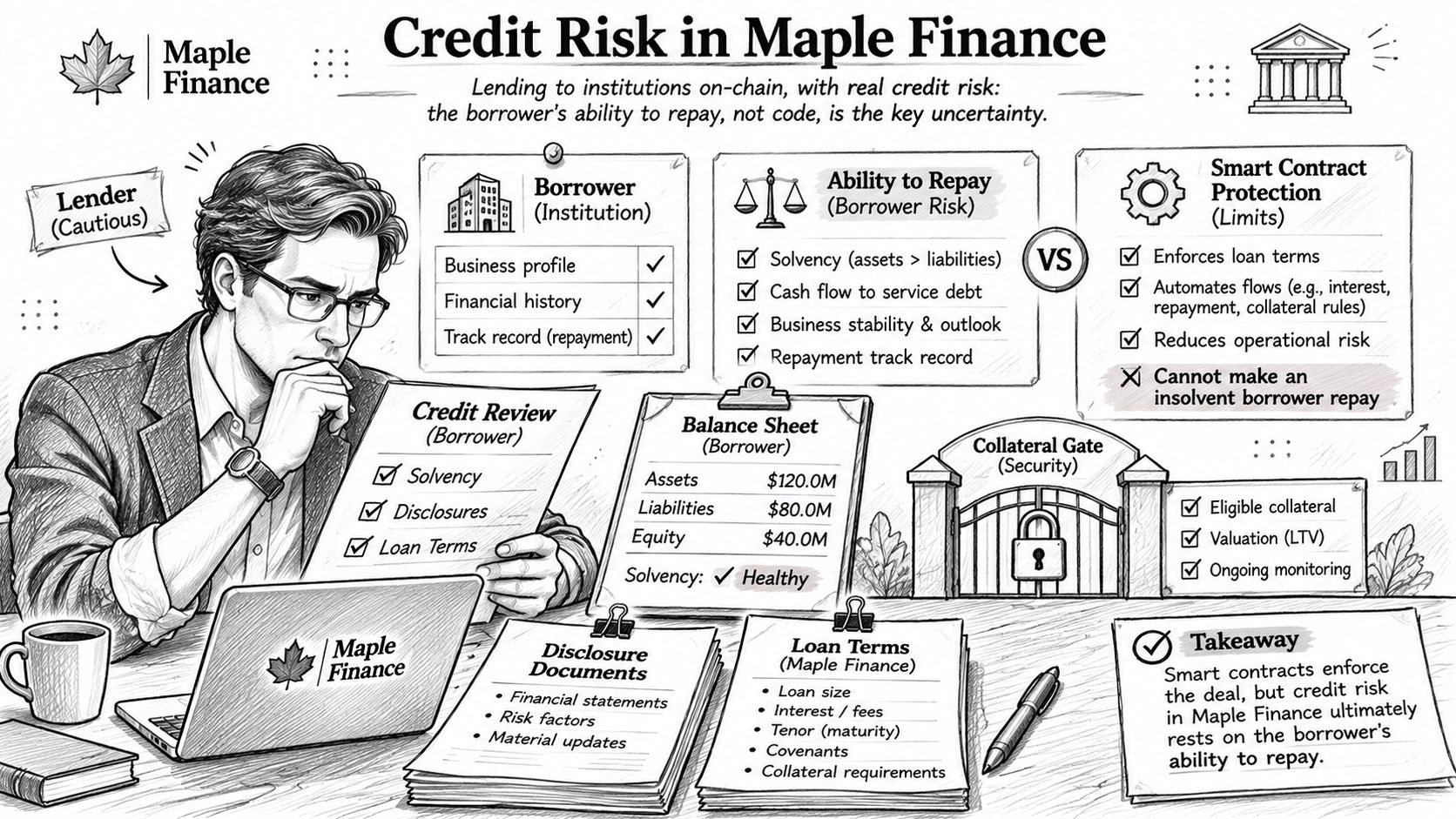
When an institutional borrower defaults, the pool's net asset value drops by the unpaid principal while the Pool Delegate moves to liquidate posted collateral. Unlike instantaneous DeFi liquidations on decentralized exchanges, institutional collateral resolution can take hours or days. During sharp market gaps, collateral value can drop below the unpaid loan balance before liquidation finishes, locking in a permanent principal loss for pool token holders.
The 2022 crypto-credit downturn delivered an enduring lesson on borrower concentration. Across on-chain institutional credit markets, a protocol can look diversified across several pools while a single trading firm accounts for an overwhelming majority of active loans inside one specific pool. When an off-chain counterparty becomes insolvent or misrepresents its financial position, depositors inside that concentrated pool absorb severe drawdowns even if other pools on the same platform stay intact.
Why Correlated Collateral Can Fail During Sell-Offs
Many crypto holders assume that an overcollateralized loan backed by BTC or ETH is safe because the collateral exceeds 100% of the loan at origination. That assumption breaks down during a correlated crypto sell-off.
When borrowers are crypto trading firms whose strategies rely on digital-asset liquidity, the exact market crash that triggers borrower distress also drives down the price of their BTC or ETH collateral. Liquidity thins out across exchanges right as multiple borrowers face margin calls and scramble to refinance simultaneously. A collateral ratio that looked comfortable in calm markets can turn insufficient within hours.
Evaluating how credit exposure stacks up against other DeFi protocols requires looking at observed evidence, a process outlined in Yield.ly's risk methodology. Before trusting any institutional lending pool, verify six concrete credit parameters:
- Borrower concentration: Check what percentage of the pool's active loans sits with the single largest borrower and the top three borrowers combined.
- Collateral type and haircut: Identify whether collateral is volatile crypto (BTC, ETH) or cash-like Treasuries, and check the initial loan-to-value haircut.
- Margin-call and grace-period rules: Confirm how quickly a borrower must top up collateral when prices fall, and how many hours or days pass before liquidation triggers.
- Liquidation venue: Verify where seized collateral gets sold and whether that venue has enough depth during market stress.
- Delegate track record: Review the Pool Delegate's historical default rate, underwriting disclosures, and loan-monitoring process.
- First-loss protection: Determine whether the delegate or borrower posts junior capital that absorbs initial losses before senior lenders take a hit.
Smart Contract, Depeg and Issuer Risks
Passing a borrower credit check still leaves five technical and structural risks that can cut into a Maple deposit's dollar value. Each one requires its own independent check, separate from evaluating borrowers or Pool Delegates.
Smart contract risk covers software bugs, logic flaws, or malicious exploits across the vault contract, Open Term Loan Manager, and MapleLoan modules. Standardized ERC-4626 interfaces simplify integrations with wallets and aggregators, yet they don't guarantee bug-free code. Before depositing, locate the audit reports listed in Maple's official documentation and check the audit dates to confirm they cover the current contract version rather than legacy code.
Depeg risk hits whenever the underlying stablecoin trades below $1.00. Because a syrupUSDC or syrupUSDT receipt tracks the pool's underlying token, a stablecoin depeg shrinks your dollar balance immediately, even if every single institutional borrower pays on schedule.
Issuer risk sits behind the stablecoins themselves. Both USDC and USDT rely on centralized issuers maintaining reserves and honoring redemptions; freezing powers, banking disruptions, or reserve shortfalls at the issuer level affect every DeFi pool holding that token. Review each issuer's own official reserve attestations rather than relying on social-media summaries.
Oracle and bridge risk enter the picture whenever collateral valuation depends on external price feeds or when a lender bridges tokens across networks. A stale oracle price can delay margin calls or cause mispriced liquidations, while a compromised cross-chain bridge can freeze bridged receipts indefinitely.
Incentive decay affects pools supplemented by token emissions. If reward programs shrink or end while your capital sits inside a withdrawal queue, realized returns drop abruptly even though your exposure to smart contracts and borrowers stays open.
What a Small Depeg Does to Dollar Value
Look at a simple hypothetical check to see how quickly a stablecoin move outweighs months of interest. Suppose a lender holds a $10,000 USDC position, and market stress pushes USDC down to $0.98 on secondary venues. In dollar terms, the deposit drops to $9,800, an immediate 2.00% paper loss before any yield accrues, which takes roughly five to six months of a hypothetical 4.40% net annual return just to break even if the peg doesn't recover.
Before moving funds, run a compact non-credit check alongside borrower due diligence: confirm current contract audits and dates, review the stablecoin issuer's latest reserve attestation, verify whether your deposit uses native or bridged tokens, and check how collateral price feeds work.
Withdrawal Queues, Liquidity and Exit Costs
Holding a liquid-looking ERC-4626 receipt token in a wallet doesn't mean you can redeem it for stablecoins on demand. A pool can only process direct redemptions up to the cash it holds on hand, so exit timing depends on available liquidity rather than the balance displayed in a portfolio tracker.
Three numbers that sound similar in protocol dashboards mean very different things for your exit:
- Deposited assets: Total capital supplied by lenders into the pool (often rolled into headline TVL or AUM figures).
- Active loans: The portion of deposited capital currently lent out to institutional borrowers and earning interest.
- Available cash: Unlent stablecoin reserves sitting idle inside the pool contract, ready to fulfill immediate withdrawals.
Headline TVL or AUM metrics measure scale, not withdrawable liquidity. In fact, rapid lending growth can increase liquidity risk if active loans expand faster than available cash buffers.
How a Withdrawal Queue Forms Under Stress
Picture a hypothetical Maple lending pool holding $100 million in deposited assets, with $80 million deployed in active loans and $20 million sitting in available cash. During normal weeks when only a few million dollars exit, redemptions clear smoothly from the cash buffer.
Now suppose market volatility spikes and lenders submit $30 million in withdrawal requests over two days. The pool's $20 million cash reserve fills the first portion of requests, leaving $10 million sitting in a withdrawal queue. Those remaining depositors have two choices: wait for active loans to mature and repay, or sell their receipt tokens on a secondary market.
Direct redemptions depend entirely on each pool's smart contract rules. Always check Maple's official documentation and the specific live pool page for how withdrawal requests are ordered, whether a queue applies, and whether any settlement deadline exists before committing capital.
Selling a receipt token on a secondary decentralized exchange is a completely separate exit route. Unlike direct pool redemptions at net asset value, secondary-market proceeds depend on order-book or AMM depth, execution price, trading fees, and slippage. During a rush for the exits, buyers often demand a discount to face value, so assuming one-to-one liquidity can turn a liquidity crunch into a realized loss.
Never treat total value locked as a cash register. Only unlent reserves and near-term loan maturities can meet redemptions without forcing a discounted secondary sale.
Stress Questions to Answer Before Depositing
Pull the live pool metrics from Maple's official dashboard and answer four stress questions before transferring stablecoins:
- Utilization share: What percentage of deposited assets is currently deployed into active loans versus held in idle cash?
- Cash buffer size: How many dollars of immediately available cash sit in the pool right now, and how does that compare with typical daily outflows?
- Queue depth and rules: How large is the current withdrawal queue, how are requests ordered, and what is the maturity schedule of the next upcoming loan repayments?
- Redemption history: How did the pool handle prior withdrawal spikes, and how wide did secondary-market discounts get during volatile weeks?
Comparing Maple Yields and Checking Before You Move Funds
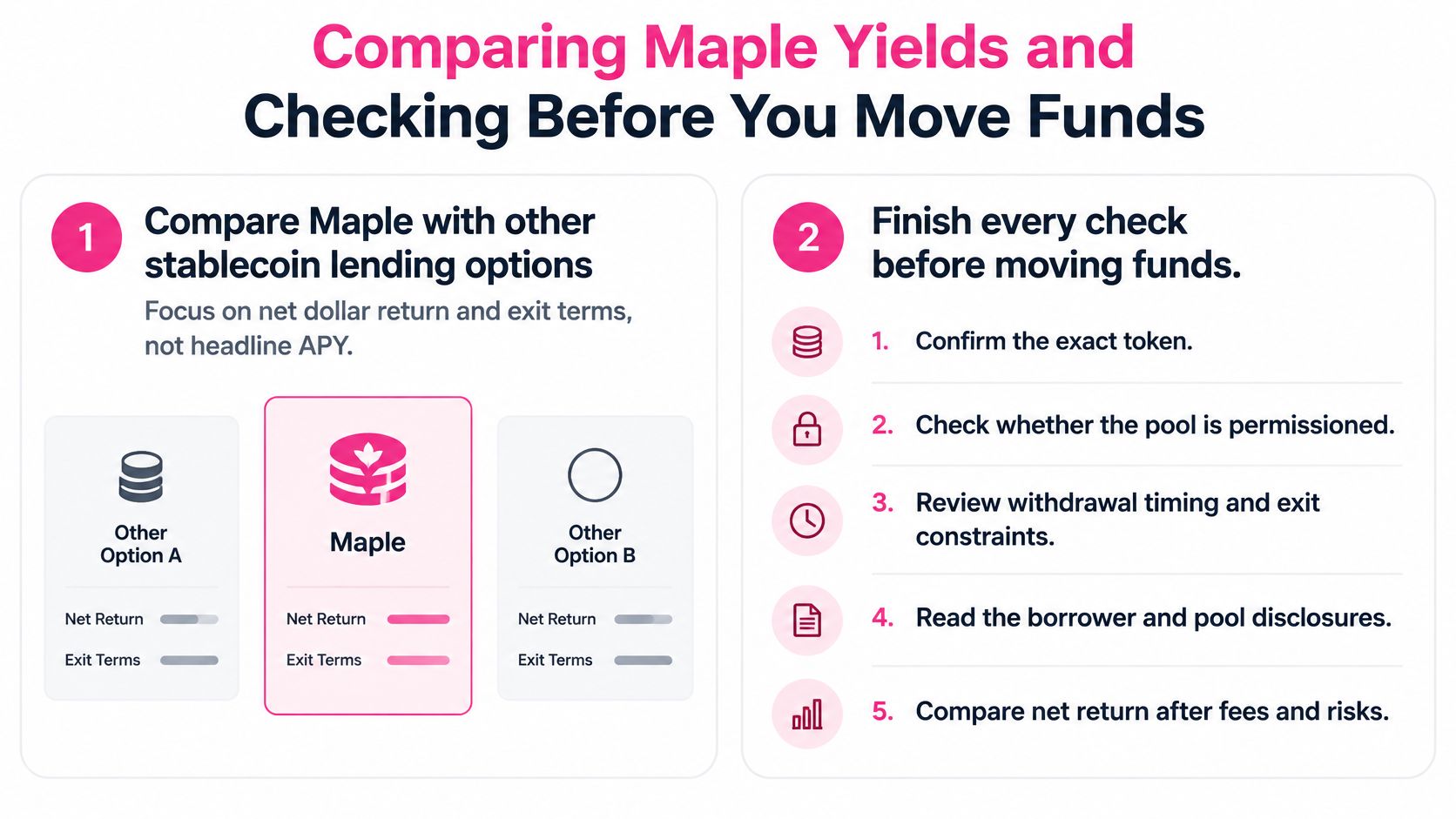
Evaluating Maple Finance crypto pools fairly means comparing them against other stablecoin lending options on net dollar return and exit terms, not on headline APY alone. A Maple pool is a loan book, so the right question is never just "what does it pay?" but "who is paying me, what do I keep after costs, and how fast could this money leave?"
Follow these seven steps in order, and write down the date next to every rate or liquidity figure you collect because yields and reserves change daily.
- Confirm the exact token, contract, and network. Verify whether you're entering syrupUSDC, syrupUSDT, or the Cash Management Pool, double-check that you aren't buying the SYRUP governance token by mistake, and confirm the exact blockchain network and contract address in Maple's official documentation.
- Split gross APY into base yield and token rewards. Record the date alongside gross APY, organic base APY, and any reward APY. Base yield is the part borrowers pay in interest, while reward APY depends on incentive programs that can shrink or end. Whenever a pool's headline rate stands far above peer stablecoin markets, review how much APY is too high in DeFi to test whether the extra spread reflects temporary incentives or higher credit risk.
- Check TVL, seven-day liquidity trends, and data freshness. Use Yield.ly's live comparison board to compare qualified opportunities by asset, return, liquidity, and observed risk with no account or wallet required. Check the seven-day TVL change and timestamp to spot sudden outflows, and compare Maple's USDC pools against alternatives on the USDC yields view.
- Inspect observed risk and ranking criteria. Review how each opportunity scores on liquidity and risk evidence by reading the Yield.ly ranking methodology, which weighs yield quality, liquidity, observed risk, and data confidence instead of sorting by headline APY alone. If any term like base APY or TVL change feels unfamiliar, check the Yield.ly Learn hub. Keep in mind that Yield.ly doesn't hold funds or execute trades, a listing isn't an endorsement, and Yield.ly and Yield Alpha are research tools, not financial advice.
- Compare withdrawal terms side by side. Put Maple's queue mechanics and loan maturities next to the exit terms of open lending protocols so you know which position can return cash on short notice and which one requires waiting or accepting secondary-market slippage.
- Run your own net-return math. Plug your real deposit size, realistic holding period, gas estimates, protocol fees, and potential exit slippage into the net-return formula to see whether switching yields puts more dollars in your wallet. A one-point APY advantage on a short holding period can disappear entirely once gas and slippage are subtracted.
- Verify eligibility and downside tolerance. Confirm whether accredited-investor verification or AML checks apply, inspect the pool's borrower concentration and available cash, and decide upfront what percentage of principal loss you could absorb if a borrower defaults before approving a single token transfer.
For education only, not financial or investment advice. Rates move and yield is never guaranteed; DeFi deposits can lose value.
Yield.ly is free, requires no account or wallet connection, and lets stablecoin holders compare Maple pools against other qualified DeFi lending markets by yield quality, base versus reward APY, liquidity, observed risk, and data confidence. To check whether switching into or out of a pool pays off after gas and friction, run Find My Yield Alpha, where Yield Alpha ranks MOVE, STAY, or WATCH moves in dollars after switching costs. To understand exactly how those classifications are built and how past calls performed, read the Yield Alpha methodology alongside the track record of settled calls before acting on any signal.
Yield.ly
Check today's rates before you move
Yield.ly ranks live DeFi yields with base and reward APY split out, TVL, and data freshness on every row. Free, no wallet needed.
Open the yield boardKeep reading
Best Crypto Liquidity Pools in 2026: 7 Options Compared Nov 26, 2026 · 12 min read
Best Crypto Liquidity Pools in 2026: 7 Options Compared
Compare the best crypto liquidity pools by fee yield, reward yield, TVL, volume and impermanent loss exposure, with a step-by-step checklist.
CLARITY Act Stablecoin Yield: What Changes for DeFi Users Nov 25, 2026 · 15 min read
CLARITY Act Stablecoin Yield: What Changes for DeFi Users
CLARITY Act stablecoin yield explained: which rewards draft text targets, what GENIUS already bans, and how to check a yield source before you deposit.

Base APY vs Reward APY: The Difference That Changes How You Read DeFi Yield Aug 25, 2026 · 18 min read
Base APY vs Reward APY: The Difference That Changes How You Read DeFi Yield
Base APY comes from a protocol's underlying activity. Reward APY comes from additional token incentives. Learn how to separate durable yield from temporary rewards.
Informational disclaimer
This guide is for research and education. Yield rates change, smart-contract risk is real, and nothing here is investment advice. Rates shown on Yield.ly are observed readings, not guarantees.
About the blog
Blog articles explain DeFi yield concepts. For live rates, qualification, and risk readings, use the Yield.ly dashboard and the methodology. Sponsored placements never change qualification or ranking logic. See commercial independence.