
On this page
Ask ten people for the best passive income crypto strategy and you'll get ten answers ranked by annual percentage yield, which is the least informative number on the page. Take two hypothetical stablecoin pools, one quoting 11% and one quoting 4%. Both numbers can be reported accurately. The difference is what pays you, and whether that payer is still there next quarter.
Every yield has a payer. A borrower pays for your dollars because they want to borrow more. A network issues new tokens because it needs validators to stay honest. A trader pays a swap fee because they want to move size now. A protocol sends you its own token because that's cheaper than buying liquidity outright. Four different businesses with four different lifespans.
The rankings that dominate search results rarely make that distinction. They compare headline APY, ignore how much of it is emissions, and leave you holding a position whose yield evaporates the week the incentive program ends. A better method is to dissect each opportunity by its return source, then decide whether that source is one you want to underwrite.
The nine methods below cover commonly used approaches, from stablecoin lending to restaking and yield tokenization. Each one gets the same treatment: what pays, why the payer keeps paying, where the yield disappears, and the practical steps that separate a position you can hold from one you can't exit.
For education only, not financial or investment advice. Rates move and yield is never guaranteed; DeFi deposits can lose value.
Table of Contents
- 1. Stablecoin Lending on DeFi Money Markets
- 2. Liquid Staking for ETH and SOL
- 3. Native Staking via Validators
- 4. Liquidity Provision on Automated Market Makers
- 5. Yield Vaults and Automated Strategy Aggregators
- 6. Restaking for Additional Security Yield
- 7. Tokenized Treasuries and Real-World Asset Yield
- 8. Delta-Neutral Yield from Stablecoin Strategies
- 9. Fixed and Principal-Based Yield via Yield Tokenization
- 9 Passive Income Crypto Strategies at a Glance
- Choosing Your Yield and Matching It to the Risk You Can Hold
1. Stablecoin Lending on DeFi Money Markets
Return source: borrower interest, sometimes topped up with token incentives.
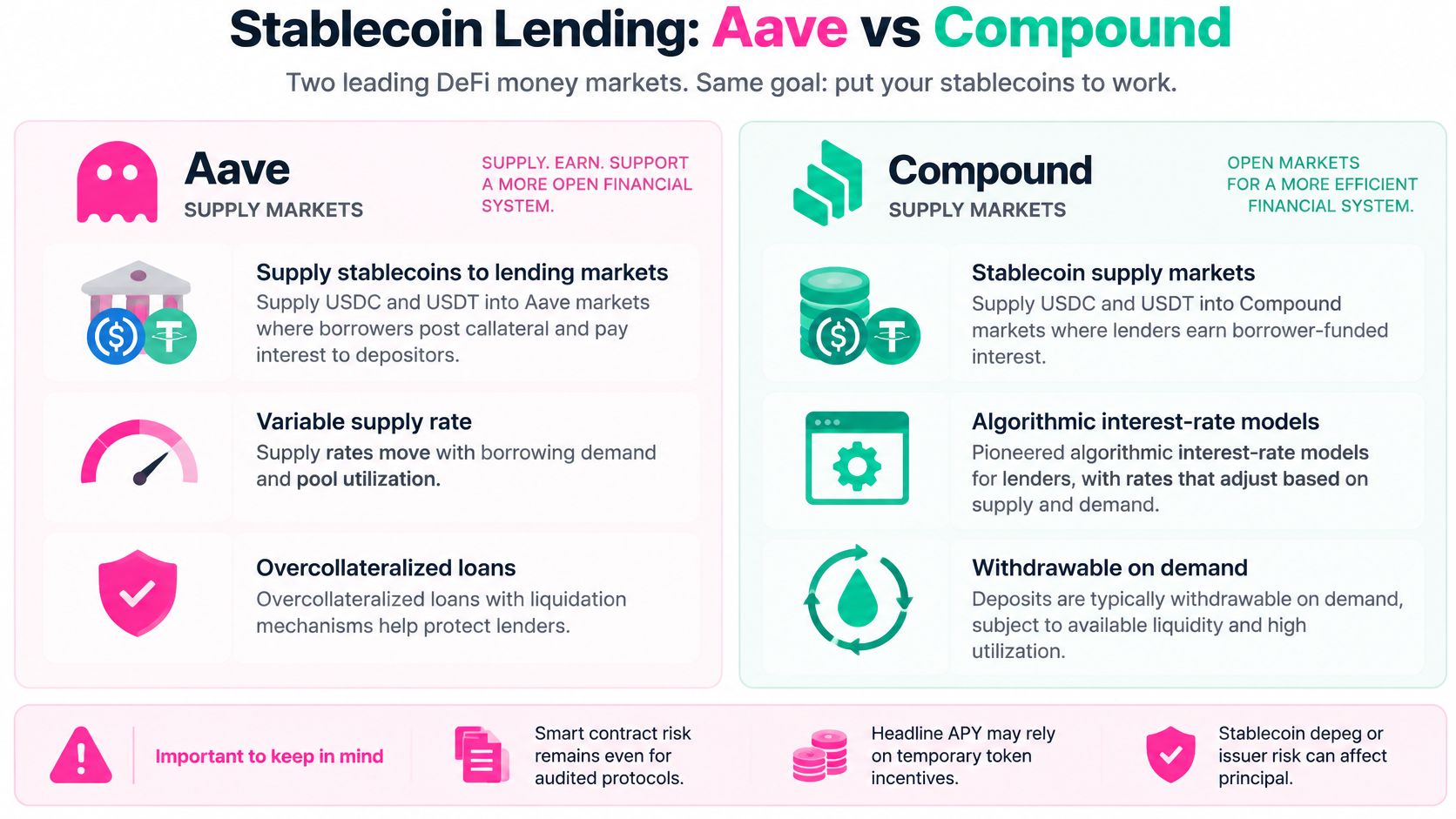
Lending markets such as Aave and Compound take your USDC, USDT, or DAI and lend it to borrowers who post collateral worth more than the loan. The interest those borrowers pay flows to depositors, minus a reserve factor the protocol keeps. That's the entire engine. When borrowing demand falls, your rate falls with it.
What moves the rate
Rates track utilization, the share of a pool that's been borrowed. High utilization means borrowers compete for scarce liquidity and the supply rate climbs, and it also means you may not be able to withdraw until someone repays.
Galaxy Research recorded the weighted average stablecoin borrow rate rising from 4.23% on June 30, 2025 to 4.83% on October 31, 2025, a reminder that these markets reprice with borrowing appetite rather than central-bank decisions (Galaxy Research).
Practical rule: if a stablecoin market quotes more than twice the going borrowing rate, look for an incentive program before you look for a strategy.
The risk the APY hides
A dollar peg is a promise, not a fact. Federal Reserve analysis of the March 2023 banking stress showed USDC's market capitalization falling by about $9.7 billion between March 1 and April 1 while USDT's rose roughly $8.8 billion, exactly as depositors were deciding which issuer they trusted (Federal Reserve FEDS Notes). The same dataset shows ownership concentration, with the top 10 Ethereum addresses holding 28.07% of DAI as of July 2023. Your exit depends on those holders not moving first.
Hypothetical example: you're placing $10,000 across two USDC markets, one quoting 9% and one quoting 4%. The higher one is usually at high utilization with an emissions tail, so compare base supply rates separately from rewards, which is exactly what this breakdown of where stablecoin yield comes from separates out.
2. Liquid Staking for ETH and SOL
Return source: network issuance, paid to validators and passed through minus commission.
Liquid staking solves the lockup problem. You deposit ETH through Lido and receive stETH, or SOL through Marinade and receive mSOL, and the protocol runs validators on the pooled balance. The receipt token represents your staked principal plus accrued rewards and can be held, traded, or reused as collateral while the underlying asset keeps earning.
Two ways a receipt token pays
Rebasing tokens like stETH increase your token balance daily, so your accounting has to handle a changing unit count. Exchange-rate tokens like rETH keep a fixed balance and appreciate against ETH instead, which is simpler to track but easier to misprice when you compare it to the market. Know which model you hold before you calculate a return.

The check that matters is net yield after commission. Lido and Rocket Pool both take a cut of rewards, so the gross network rate on a staking dashboard isn't what lands in your position. Comparing ETH yields net of fees is the only comparison worth running.
Watch the receipt token's market price against its redemption value. A 2% discount looks like free money until you remember the unstaking queue runs for days and the discount appeared because large holders are leaving.
Hypothetical example: you hold 10 ETH and might need the money in six weeks. Native staking locks it. stETH lets you sell into a pool, at whatever price buyers offer during a selloff. Liquid isn't the same as liquid at par.
3. Native Staking via Validators
Return source: protocol issuance plus transaction fees, paid directly by the network.
This is the cleanest yield in crypto. You lock the chain's own token to secure it, either by running a validator at 32 ETH on Ethereum or by delegating to one, and the protocol pays newly issued tokens plus a share of fees. No borrower, no counterparty balance sheet, no incentive program to expire. The trade-off is that you're paid in the asset you already hold.
Institutional money is moving here for that reason. An EY-Parthenon survey of more than 350 institutional investors, run with Coinbase, found 24% already engaged with DeFi and another 50% of nonparticipants planning to within two years, with staking cited by 38% of users and prospects as a leading use case (EY).
What to check before you delegate
- Validator commission and uptime: a 10% commission is a real haircut, and a validator that misses attestations earns under the headline rate.
- Concentration: picking the largest operator because it's convenient is how a network ends up with a handful of signers.
- Unbonding period: Ethereum's exit queue isn't instant, so plan around staked ETH being illiquid.
Solana works the same way with different economics, where delegation earns inflation rewards plus a share of priority fees. Running 32 ETH yourself needs hardware, monitoring, and a backup power plan, which is why most holders delegate and accept the commission.
The number to ignore is total return that folds in price appreciation. Staking yield is a token-denominated rate, and it doesn't rescue you from a 40% drawdown.
4. Liquidity Provision on Automated Market Makers
Return source: swap fees paid by traders, split pro rata across the pool.
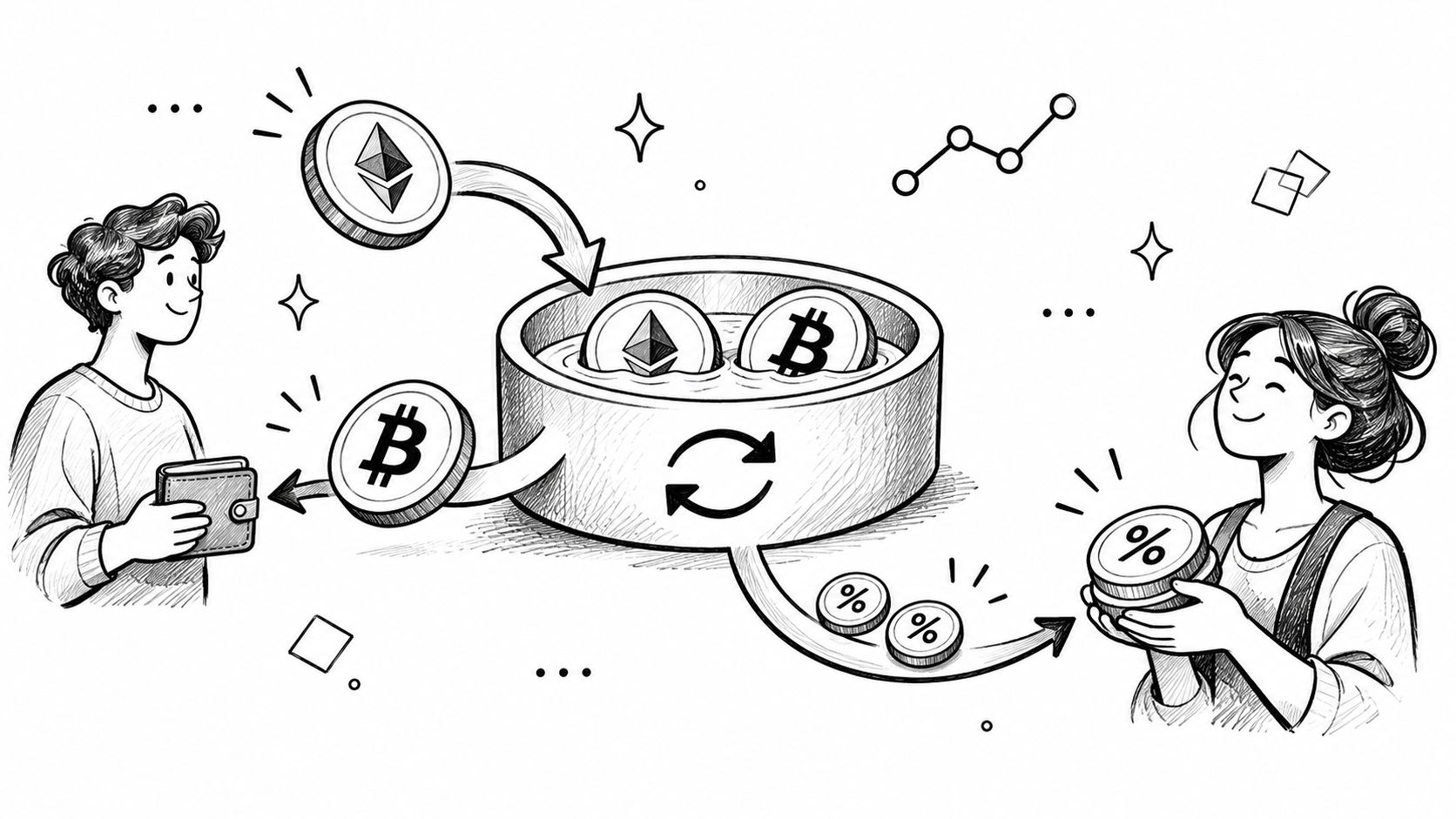
You deposit two assets in equal value into a pool on Uniswap or Curve. Traders pay a fee on every swap against that pool, and the fee accrues to liquidity providers. Nothing is lent and nothing is issued. Your return is a function of volume, fee tier, and how much capital competes for the same flow.
Impermanent loss is the cost of the fee
If ETH rises against USDC, arbitrageurs buy the cheap ETH out of your pool until the ratio matches the market, leaving you with less ETH and more USDC than you deposited. That divergence loss is permanent once realized and usually larger than the fees on a volatile pair during a big move. Model a plus or minus 50% move before you commit capital.
Chain choice changes your exit as much as your yield. When the same asset pays more on a Layer 2 than on Ethereum mainnet, check whether the extra rate is compensating for thinner liquidity before treating it as free return.
The question that outranks APY
Can you exit at the quoted value during a 20% market drop? Pool depth answers that. A shallow pool with a high fee rate looks excellent in a dashboard and slips badly when you withdraw size, and bridge dependencies add a failure point between the chain where you earn and the chain where you settle.
Start with stablecoin pairs if this is your first pool. Curve's pegged-asset pools exist because low divergence risk plus high volume beats a high fee tier on volatile pairs for most providers.
5. Yield Vaults and Automated Strategy Aggregators
Return source: whatever the underlying strategy earns, minus the operator's cut.
A vault pools deposits and runs a strategy on your behalf, lending, staking, or rotating between the two. Yearn Finance vaults move stablecoins across lending markets; Beefy Finance auto-compounds rewards on several chains. You hold vault shares, the operator harvests and rebalances, and fees come out of your return.
The convenience is real. Someone else watches utilization and moves capital when a market dries up. What you've added is a second layer of risk on top of the first, because the vault contract, the strategy logic, and the operator's judgment all sit between you and the underlying protocol.
Concentration is the thing to measure
Lending is a concentrated business. DeFiLlama's State of DeFi 2025 report recorded lending TVL rising from $48.15 billion at the start of 2025 to $64.06 billion, a 33.0% year-to-date increase, while the ten largest lending protocols held $57.00 billion, or 89.0% of total lending TVL (DeFiLlama). A vault spread across five markets may still be exposed to one or two of them in practice.
Read the strategy page before the APY. If you can't explain in one sentence what the vault does with your money and what happens when its best market closes, you're not buying yield, you're buying a description.
More capital chasing the same strategies tends to compress returns, so net APY after fees is the only figure worth comparing.
6. Restaking for Additional Security Yield
Return source: payments from new services that rent Ethereum's security.
Restaking takes staked ETH, or a liquid staking token representing it, and reuses that capital to secure additional protocols, usually called actively validated services. EigenLayer pioneered the model. Operators run the extra software, stakers supply the capital, and the services pay for the protection.
The economics work from the demand side. A new network needs credible security and doesn't want to bootstrap its own validator set from nothing. Renting Ethereum's is cheaper. From your side, the same ETH earns base staking yield plus whatever the services pay, which is why restaking APYs looked spectacular at launch.
Why the extra yield isn't free
Slashing conditions stack. One piece of capital now answers to several sets of rules, and a fault in any of them can cut the underlying stake. That's a different risk shape from lending, where the worst case is usually a bad-debt event confined to one market.
Separate the layers: base staking yield, service payments in tokens, and points programs. Only the first is durable, the same base versus reward split explained in the Yield.ly methodology. If, hypothetically, two thirds of a quoted restaking APY arrives as an unlisted token or a points allocation, you're being paid in expectations.
Hypothetical example: you restake 10 ETH through a liquid restaking token, then deposit that token as collateral elsewhere. You've now taken on slashing risk, receipt-token depeg risk, and another protocol's liquidation rules on a single position.
Apply the same suspicion you'd apply to any emissions-heavy pool, and check what portion of the reward is denominated in the asset you want to hold.
7. Tokenized Treasuries and Real-World Asset Yield
Return source: coupon income from short-term government debt or money market instruments.
Tokenized treasury products put a claim on actual bills on a blockchain. BlackRock's BUIDL fund holds short-term U.S. Treasuries and cash equivalents; Ondo Finance offers comparable exposure. The yield is the yield of the underlying paper, distributed as accruing token value or periodic payouts, and it doesn't depend on a borrower's appetite for risk or a protocol's emissions schedule.

A benchmark for everything else
This product earns its place in a comparison as a reference point. The BIS Annual Economic Report 2026 finds that stablecoin yields from DeFi lending pools have stayed largely disconnected from US interest rates, vary widely across pools, and are driven mostly by protocol-specific factors and crypto events such as USDC's March 2023 depeg (BIS). A treasury-backed yield gives you a policy-rate anchor to measure a DeFi rate against, so a pool advertising, say, 19% has to explain the gap.
The trade-offs differ from DeFi-native risk. You're relying on an issuer, a custodian, a legal wrapper, and a redemption process that runs through banking hours. Permissioned products may not be available in your jurisdiction at all, and a token trading at a premium or discount to net asset value can turn an illustrative 4% yield into a loss on entry.
Check redemption terms before the yield. If you can only redeem through a registered broker in one country, an illustrative 4.5% on the page isn't available to you.
A typical all-weather allocation parks part of a stablecoin balance here and keeps the rest in lending markets, shifting between the two as spreads widen.
8. Delta-Neutral Yield from Stablecoin Strategies
Return source: perpetual funding rates, futures basis, and staking yield, with directional exposure hedged out.
Delta-neutral strategies hold spot crypto and an offsetting short in derivatives so the net position barely moves with price. Ethena's USDe is the best-known packaged version: staked ETH collateral plus short perpetual futures, with income from staking rewards and the funding those shorts collect. Funds run the same trade manually, capturing futures-versus-spot spreads.
The yield exists because perpetual markets need someone to take the short side. When longs are crowded, funding turns positive and shorts get paid. When sentiment flips, funding goes negative and the same position pays to stay open. That's the whole cycle, and it's the number to watch.
Questions worth asking before allocating
- What share of yield comes from funding? If it's most of it, your return is a bet on traders with borrowed positions staying optimistic.
- Where does the collateral sit? Custody and counterparty arrangements matter more than the advertised rate once derivatives are involved.
- How does the peg hold in stress? A synthetic dollar is only as stable as its hedging execution during a liquidation cascade.
Size it like a trade, not a savings account. Funding conditions can turn in days, and a strategy that paid double digits for a quarter can pay nothing the next.
Hypothetical example: you hold 20,000 USDe expecting a steady return. If funding compresses, the yield falls toward the staking component alone, and if the peg slips during market-wide deleveraging, your exit price matters far more than any APY you collected.
9. Fixed and Principal-Based Yield via Yield Tokenization
Return source: another holder's future yield, bought at a discount.
Yield tokenization splits an interest-bearing asset into a principal token, which redeems for the underlying at maturity, and a yield token, which captures the variable return until then. Pendle runs the largest market for this on assets like stETH and stablecoin lending positions. Buying the principal token at a discount locks a fixed rate; selling your yield token converts a variable stream into cash today.
The math is simple enough to do by hand. In an illustrative case, a principal token trading at 0.96 with six months to maturity implies roughly 8.3% annualized (simple, not compounded), because you pay 96, receive 100, and earn about 4.2% over half a year. Set that implied rate against what the variable market pays and you can read whether traders expect yields to fall.
Where it gets complicated
Fixed rates in DeFi aren't fixed like a bond coupon. They're fixed only if you hold to maturity and the underlying protocol behaves. Liquidity thins near maturity dates, and a principal token with a wide spread erases the advantage over a variable position the moment you need out early.
Buying a discounted principal token is a credit decision on the underlying protocol, not a guaranteed deposit. You're lending to the mechanism.
Hypothetical example: you hold a variable stablecoin position and expect rates to fall. Buying principal tokens locks today's rate for the term. If rates rise instead, you've capped your upside by exactly that difference. That trade-off is the point, and why DeFi APY changes covers the forces you are betting against when you lock in.
9 Passive Income Crypto Strategies at a Glance
| Strategy | Primary Yield Source | Principal Exposure | Key Risk | Best For |
|---|---|---|---|---|
| Stablecoin Lending on DeFi Money Markets | Borrower interest and possible token incentives | Dollar-pegged stablecoins | Smart contract risk, depegs, or limited withdrawal liquidity | Straightforward variable yield with lower direct price volatility |
| Liquid Staking for ETH and SOL | Network staking rewards and transaction fees or MEV | Staked ETH or SOL represented by a receipt token | Receipt-token discounts, slashing, and layered contract risk | Earning staking rewards while keeping capital usable in DeFi |
| Native Staking via Validators | Network-issued rewards and transaction fees | Native proof-of-stake tokens | Unbonding delays, validator penalties, and token price volatility | Direct participation in network staking economics |
| Liquidity Provision on Automated Market Makers | Trading fees and possible incentives | Two pooled assets, often held in changing proportions | Impermanent loss, volatile fees, and smart contract risk | Earning fees from trading activity, especially in stablecoin pairs |
| Yield Vaults and Automated Strategy Aggregators | Returns from underlying lending, staking, or liquidity strategies | Vault shares backed by pooled assets | Strategy, contract, fee, and underlying liquidity risks | Automated compounding and multi-protocol exposure |
| Restaking for Additional Security Yield | Base staking rewards plus rewards from secured services | Staked assets or liquid staking tokens | Additional slashing exposure and uncertain incentives | Seeking layered yield while supporting additional services |
| Tokenized Treasuries and Real-World Asset Yield | Income from government debt, money market funds, or other traditional assets | Tokenized claims on off-chain assets | Issuer, custodian, legal, and redemption risks | Blockchain access to traditional lower-volatility yield |
| Delta-Neutral Yield from Stablecoin Strategies | Funding rates, staking rewards, and basis spreads | Hedged collateral and derivatives positions | Negative funding, counterparty risk, or imperfect hedging | Seeking yield less dependent on market direction |
| Fixed and Principal-Based Yield via Yield Tokenization | Future yield separated and traded through yield tokens | Principal and yield claims on an underlying asset | Pricing, maturity liquidity, and underlying asset risks | Locking in a rate or trading future yield expectations |
Choosing Your Yield and Matching It to the Risk You Can Hold
Rank these nine by the risk you can monitor, not by the return you'd like.
Tier one, lowest operational load: tokenized treasuries and stablecoin lending in deep markets. You check a rate, a utilization figure, and an issuer's terms. Nothing needs watching daily.
Tier two, needs a schedule: liquid staking, native staking, and fixed-rate principal tokens. These carry queues, maturities, and commissions that reward a monthly review rather than constant attention.
Tier three, needs active attention: liquidity provision, restaking, delta-neutral strategies, and vaults built on top of all three. Here the yield moves for reasons you have to track, and a position left alone for a quarter can become a different trade.
Then run the stress tests in order. Ask what funds the return and whether that source has an expiry date. Ask what happens to your exit during a 20% market drop. Ask how much of the headline number survives after emissions stop, fees are deducted, and the reward token falls, say, 30%.
For education only, not financial or investment advice. Rates move and yield is never guaranteed; DeFi deposits can lose value. The honest framing is that you're underwriting a mechanism, whether that's a borrower's borrowing capacity, a network's security budget, a trader's need for liquidity, or a protocol's marketing spend. Only the first three have a reason to keep paying after the incentive budget runs dry.
Comparison gets easier with the right inputs in one place. Yield.ly is a free crypto yield intelligence platform that lists opportunities by asset, return, liquidity, and observed risk without an account or wallet connection, and it separates base yield from token incentives where the data allows. It doesn't execute transactions, custody assets, or offer personalized advice. It shows you the composition of a yield so you can judge it yourself, which is why the base-versus-incentive split and the seven-day liquidity change are the two fields worth checking before you commit capital.
A sensible starting point is one position, the smallest one you can measure properly, and add complexity only when you can explain out loud where every percentage point of that yield comes from. If you can't name the payer, you're the payer. The Yield.ly Learn guides walk through each of these checks in more depth.
The gap between a headline APY and what lands in your wallet is the whole game. If you already hold a yield position, Find My Yield Alpha. It's free, with no account or wallet needed, and it ranks possible moves as MOVE, STAY or WATCH in dollars after switching costs. To scan the wider market, the Yield.ly board shows total and base APY, TVL, seven-day liquidity change, observed risk and data freshness for stablecoins, ETH, BTC, SOL and other majors. Rates move, so check the live numbers before you act, and bring questions to the community Discord that Yield.ly shares with thrive.fi.