
On this page
Type "is staking crypto worth it" into a search bar and most results hand you a rate. The advice runs: find the highest APY, delegate to a validator or a pool, and let the rewards compound. That advice starts one step too late, because a rate on its own tells you nothing about whether the trade makes sense.
Staking pays you more of the coin you already hold. It doesn't pay a dollar yield, it doesn't remove price risk, and it doesn't shorten the time it takes to get your coins back. Those three facts decide the outcome far more than the gap between 3% and 5%.
So is staking crypto worth it? For a holder who planned to keep the coin for years, can wait out the documented exit, and can absorb a price drop bigger than a full year of rewards, it usually deserves a closer look. For someone who needs cash within a month, wants stablecoin-like income, or is drawn only by a headline rate padded with token incentives, it usually doesn't.
Everything else is arithmetic. What the reward pays, who takes a cut, how long the exit takes, and how far the price has to fall before the reward stops mattering.
Table of Contents
- When Staking Crypto Is Worth It
- Where ETH and SOL Staking Rewards Come From
- A Hypothetical Net Staking Calculation
- Exit Queues Versus Other Crypto Yield
- Losses That Can Erase Years of Rewards
- Checks Before You Commit Capital
- Decide Whether to Stake or Stay Liquid
When Staking Crypto Is Worth It
Staking earns its place under three conditions, and the order matters. You already planned to hold that exact coin for longer than the exit path takes. The reward you're paid is mostly protocol yield rather than token incentives that can be switched off. And a price decline larger than a full year of rewards wouldn't change your plan.
Miss any one and the trade worsens. A holder who needs dollars in three weeks carries price risk on an asset they can't sell yet, whatever the quoted rate.
Staking changes how many coins you hold. The market still decides what they're worth.
The rate isn't a constant either. More than 27.9% of ETH supply was staked in 2024, with over $49 billion staked through liquid-staking solutions, according to Liquid Collective's 2024 year in review. Rewards are shared across that participating capital, so every new validator spreads the same issuance over a larger base. A percentage captured in a screenshot was a reading taken at one moment in that balance.
| Situation | Staking fit | Main reason |
|---|---|---|
| Already plan to hold the same coin for years | Often a fit | Rewards add tokens you meant to keep |
| Need dollars within days or weeks | Usually a poor fit | Exit queues and price swings can block a clean sale |
| Want stablecoin-like income | Poor fit | The payout is more of a volatile coin, not cash |
| Comparing with lending or vaults | Only after costs | A higher APY may only pay for lockup and extra risk |
| Headline rate is mostly token rewards | Extra scrutiny | Incentives can end and the quote can shrink |
The awkward case is sitting in the first and fourth rows at once.
A long-term holder clears the fit test, then breaks it by comparing the staking rate against a lending yield that returns a different asset with different liquidity. That comparison only holds after costs. A validator commission shaves the reward before it reaches you, the exit queue decides whether you can react to a price move at all, issuance of new coins offsets part of the nominal rate, and tax takes a cut of whatever arrives. A 4% quote can become a much smaller number.
Route choice sits on top of all of this. Native, pooled and custodial staking carry different counterparties even when all three quote the same headline number, so comparing ways to find the best staking strategy belongs in the process before capital moves.
That is why a positive APY can still lose to holding. The break-even against doing nothing comes first, priced in dollars. The protocol pick comes second.
For education only, not financial or investment advice. Rates move and yield is never guaranteed; DeFi deposits can lose value.
Where ETH and SOL Staking Rewards Come From
Two things happen when you stake. You make coins available so the network can select validators, and the protocol pays the participants doing that work. The payment comes from new issuance and a share of transaction fees, and then a validator or pool keeps a commission before the remainder reaches you.
That sequence is worth holding in your head, because each step is a place where the number on a dashboard can shrink.
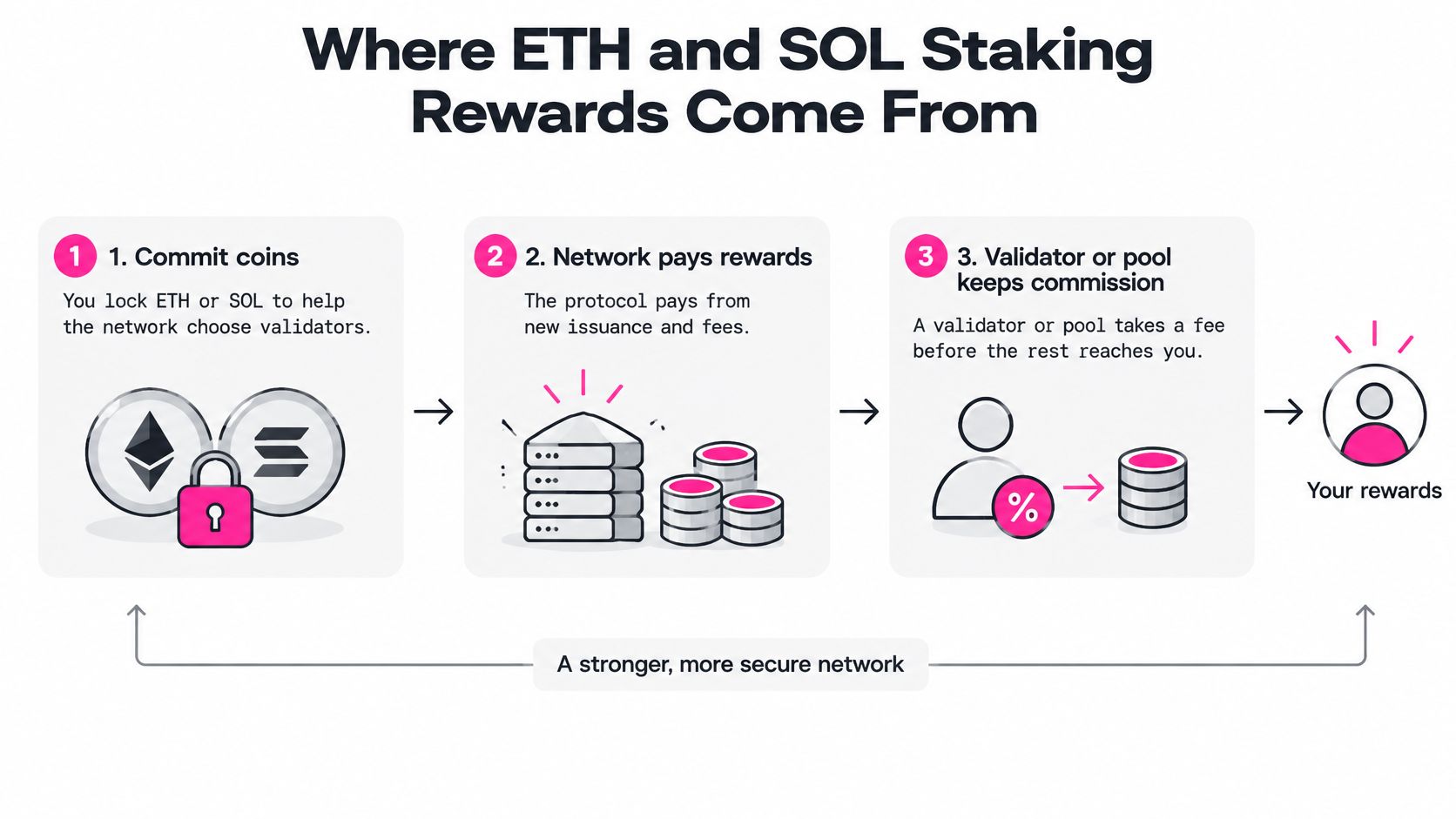
The schedule Solana publishes
Solana is the clearest published example, because its documentation states rules instead of a headline rate. The official Solana staking FAQ, checked at the time of writing, describes returns as variable rather than a fixed contractual rate: the payout depends on the network's current inflation rate, the total amount of SOL staked, and the selected validator's uptime and commission.
The schedule itself is explicit. Solana began with an 8% annual inflation rate, which decreases by 15% year over year until it reaches a long-term fixed rate of 1.5% annually. Rewards are paid roughly every two to three days and compound automatically when left staked. Unstaking is a wallet request plus a cooldown of about two to three days before the SOL can be withdrawn.
Same engine, different plumbing on Ethereum
Ethereum pays on the same principle. Rewards reach validators from issuance and fees, the annualized rate floats with participation and network activity, and an operator or pool takes its cut first. The ethereum.org staking documentation describes that flow and the duties attached to it, which is why any ETH percentage is a snapshot rather than a rate you locked in.
If a pool advertises extra tokens on top of staking, that extra layer is an incentive rather than a base reward. It comes from a treasury or an emissions schedule and it can be reduced or stopped. Why DeFi APY changes walks through the mechanics, and the Yield.ly Learn index covers the vocabulary if base yield, incentives and TVL are new terms. For the plumbing underneath, a plain-language explanation of how crypto records stay secure fills in what validators are being paid to do.
Splitting base from rewards is where most comparisons go wrong. A side-by-side ETH staking comparison is only useful when those two components are shown apart, because one is protocol yield and the other is a marketing layer that may not survive the next governance vote.
A reward is only useful if it can leave. Whether it can, and how fast, is a separate question from the rate.
A Hypothetical Net Staking Calculation
A positive staking APY can still leave you worse off than holding. Price changes can outweigh rewards, so start by finding the break-even price before choosing a protocol.
Take a holder with 4 ETH at an assumed $2,500, or $10,000 of exposure, earning an illustrative 4% gross reward over one year. The inputs are hypothetical, not a market quote.
1. Gross reward. 4 × 0.04 = 0.16 ETH. At $2,500 per ETH, that is about $400, assuming the price stays flat.
2. Commission. At an illustrative 10% of rewards, the operator keeps 0.16 × 0.10 = 0.016 ETH. The holder receives 0.144 ETH, worth about $360 at the same price.
3. Network inflation is separate. On networks with declining issuance, some rewards offset dilution of coins that are not staked. This is not another fee, so do not subtract it a second time.
| Line | Calculation and result |
|---|---|
| Starting position | 4 ETH at an assumed $2,500, or $10,000 of exposure |
| Gross reward at 4 percent | 4 × 0.04 = 0.16 ETH, about $400 if the price stays flat |
| Commission at 10 percent | 0.16 × 0.10 = 0.016 ETH, leaving 0.144 ETH, about $360 at $2,500 |
| Network inflation | Separate line, offsets dilution on networks with declining issuance, not a second fee |
| Staked after 10 percent drop | 4.144 × $2,250 = $9,324 |
| Unstaked after 10 percent drop | 4 × $2,250 = $9,000 |
| Break-even price before tax | 4.144 × P = $10,000, so P is about $2,413, a drop of about 3.5 percent |
| Illustrative tax at 24 percent | 24 percent of about $360 is about $86, lifting break-even to about $2,434, a drop of about 2.6 percent |
4. Price risk dominates. If ETH falls 10% to $2,250, the staked balance is 4.144 ETH, worth $9,324. The unstaked 4 ETH is worth $9,000. Staking cushions $324 of the $1,000 loss, but both positions are below the original $10,000.
5. Break-even before tax. Solve 4.144 × P = $10,000. The break-even price is about $2,413, a decline of about 3.5%. A larger drop leaves the staker with less than the original value.
6. Tax. At an illustrative 24% rate on $360 of rewards, about $86 goes to tax. Actual tax treatment varies by country. After that bill, break-even rises to about $2,434, a decline of about 2.6%.
7. Opportunity cost. The comparison is staking versus another use for the same money, not staking versus doing nothing. This example assumes a liquid alternative earns zero, so its break-even point is only a starting line.
A 4% reward changes your coin count. A 4% price move changes the value of your whole position.
ETH price moves have historically been much larger than annual staking rewards, so the reward rate alone cannot show whether staking paid off. Ethereum moved from proof-of-work to proof-of-stake in September 2022, after staking had launched in December 2020. The system has a track record, but the rate is not fixed.
If a quote combines protocol yield with token incentives, compare the components separately using this guide to base APY versus reward APY. A headline APY can include rewards that may change, while base yield refers to the organic yield before token incentives.
Exit Queues Versus Other Crypto Yield
An APY describes what happens while you're in. It says nothing about how you get out, and on Ethereum getting out is a protocol process rather than a button press.
Validators with Type 1 withdrawal credentials have rewards above 32 ETH swept automatically to the withdrawal address, while Type 2 credentials introduced by Pectra can compound rewards up to 2,048 ETH. A full exit is rate-limited. The exit epoch must be at least four epochs after the request, and until that epoch arrives the validator stays active, keeps earning, and remains subject to slashing rules, as the ethereum.org withdrawal documentation sets out.
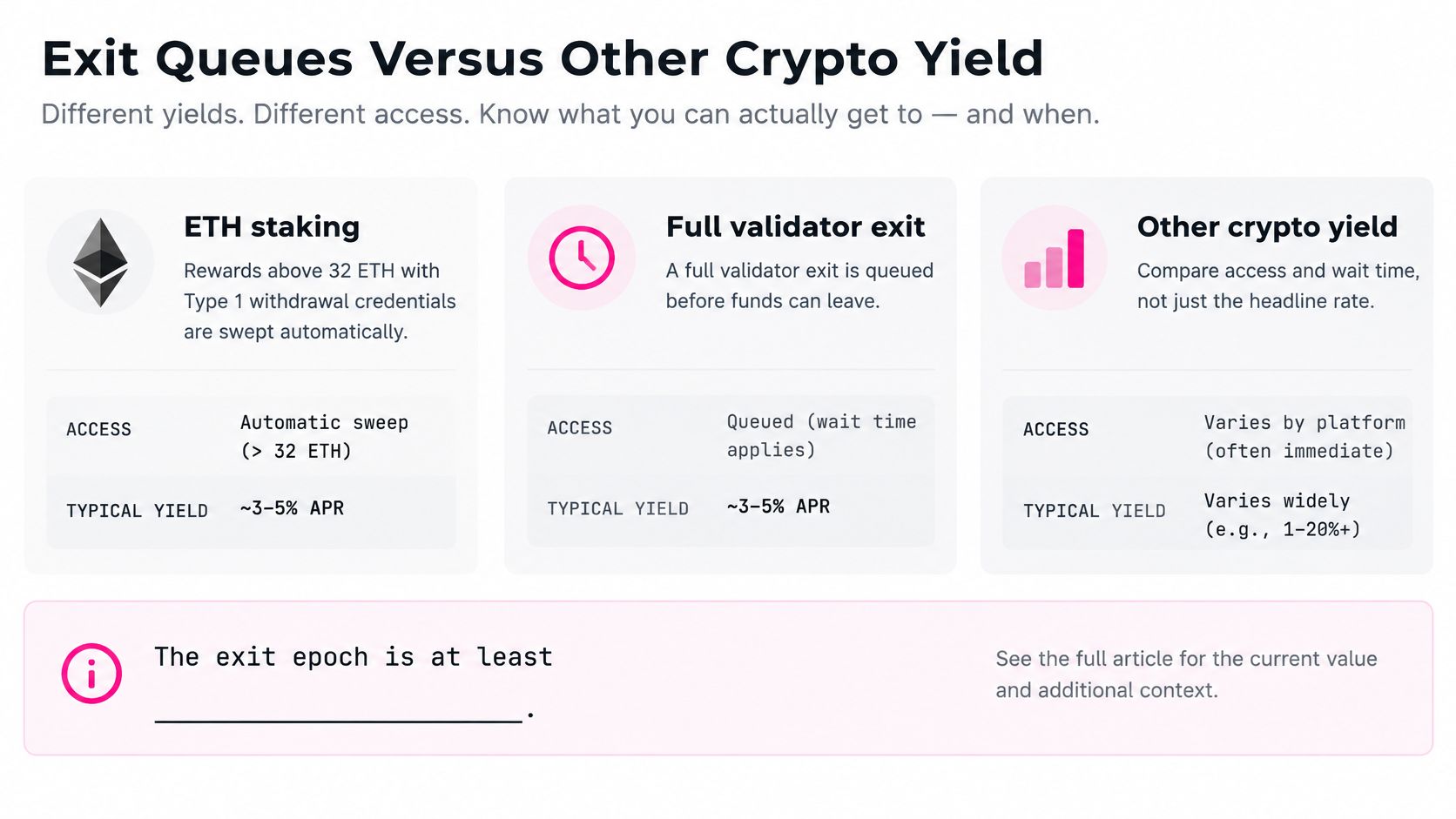
Queues aren't theoretical. A snapshot compiled by Datawallet's Ethereum staking statistics put the exit queue near 786,000 ETH, with an approximately 14-day wait followed by about a week for the withdrawal sweep. Unstake doesn't mean sell today.
Pooled and liquid staking don't bypass the process. As ethereum.org's staking pools documentation explains, redemption speed depends on both the pool's available liquidity and the consensus-layer exit queue, so a receipt token can trade below the coin it represents while the underlying exit is congested.
| Route | What you receive | Access to capital | Main extra risk |
|---|---|---|---|
| Native ETH staking | More ETH from protocol rewards | Exit queue, not an instant button | Downtime, slashing, commission |
| Native SOL staking | More SOL, often auto compounded | About a two to three day cooldown | Validator uptime and commission |
| Liquid staking | A receipt token plus staking exposure | Market sale can be faster than full redemption | Depeg, smart contract, pool liquidity |
| Stablecoin lending | More stablecoins from borrower interest | Withdrawal if pool liquidity remains | Bad debt, depeg, high utilization |
| Incentive vault or pool | Base yield plus reward tokens | Depends on pool liquidity | Incentive decay and impermanent loss in two asset pools |
The percentage is the easy part to check. Yield.ly is a free tool that ranks qualified DeFi yield opportunities by yield quality, liquidity, observed risk and data confidence rather than headline APY, splits base APY from token reward APY, and shows TVL, seven-day TVL change and data freshness. No account and no wallet connection are needed, and it doesn't hold funds or execute trades. ETH rows sit on ETH yields, stablecoin rows on stablecoin yields, and a quote far above its own history is worth testing against how much APY is too high. The ranking rules live in the methodology, and observed risk is evidence-based rather than a safety guarantee.
Two-token pools deserve a separate look, because single-sided staking versus liquidity pools is where impermanent loss enters a comparison that started out as a staking question.
Losses That Can Erase Years of Rewards
The APY line has no column for the two ways an ETH validator loses money quickly. Ethereum treats them as separate events, and both are documented.
A validator that goes offline misses rewards and collects small inactivity penalties. Provable misconduct, such as signing two conflicting blocks, triggers slashing and forced removal. Ethereum's documented initial slashing penalty is 0.0078125 ETH for a validator with a 32 ETH effective balance at the time of that documentation, followed by a 36-day removal period. A correlation penalty applies around day 18 and grows when more validators are slashed in the surrounding window. The documented maximum can reach the validator's full effective balance in a severe correlated event, as the ethereum.org rewards and penalties reference states.
What a pool user inherits
Skipping the hardware doesn't skip the exposure. A pooled or liquid staking holder inherits operator uptime, key handling, and the provider's policy on who absorbs penalties. On top of that comes smart contract risk on the receipt token, and the chance that the token trades below the coin it claims while redemptions are slow.
Routes that touch other machinery carry their own failures. A pool crossing chains adds bridge risk, a lending market adds oracle risk where collateral pricing depends on feeds, and custodial exchange staking adds solvency and private key exposure that self-custody doesn't have.
One slashing cluster, one token bug, or one deep price decline can outweigh several years of a low single digit reward.
That is the scale problem in one sentence. A single digit annual reward accumulates slowly, while the failure events arrive at once and settle in days.
Before committing, read three things in the official documentation: the penalty terms, who pays them, and whether an exit is still available after an incident. If a provider's terms are silent on penalty pass-through, that silence is your answer about who carries the loss.
Checks Before You Commit Capital
A quote hands you one number. It says nothing about the price decline, exit delay or failure that would make staking worse than holding the coin. An independent legal analysis of staking services puts the same framing at the center of the decision, and notes that liquid staking adds tradability and capital efficiency while introducing depegging, governance and smart-contract risk, plus information asymmetry between the holder and the intermediary.
Nine checks turn any quote into an answer you can defend.
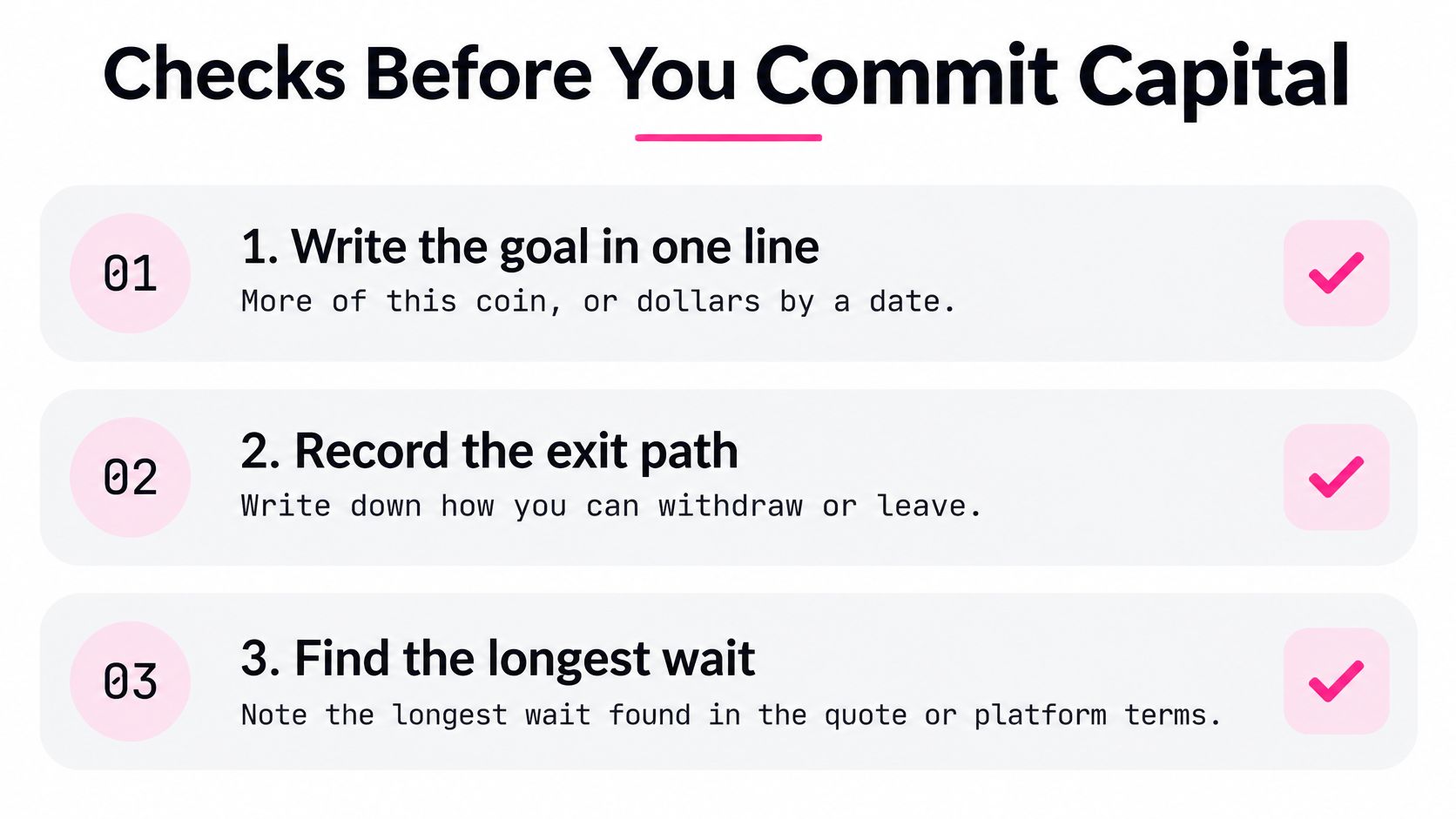
1. Write the goal in one line. Either "more of this coin" or "dollars by a date." The two goals produce different answers, and mixing them is how people end up staking money they needed in cash. A holder stacking coins can tolerate a queue; a holder chasing dollars cannot.
2. Record the exit path. Read the withdrawal rules, not the label on the button. Write down what has to happen before the coins can move, in order: request, queue, any conversion back to the underlying asset if a receipt token sits in between.
3. Find the longest wait. Take the worst case from official docs or platform terms, including pool liquidity and any queue behind it. A wait measured in weeks changes what position size is sensible, so test your plan against that wait rather than the advertised one.
4. Split base from incentives. If the quote doesn't show the split, pause. A number that's mostly token rewards is a bet on a treasury decision, not on a network paying for validation.
5. Note commission, uptime rules and who absorbs penalties. Commission is skimmed before rewards reach you, so a modest-looking percentage can eat a large share of a small yield. The penalty terms decide whether a bad month lands on your balance or stops at the provider.
6. Rerun the waterfall at your own size. Add gas, swap and bridge costs if coins have to move chains, since those are real dollars subtracted from a small percentage. The guide to DeFi yield after gas fees shows where those costs usually land hardest.
7. Name the decline that would wipe the net reward. Using the earlier method, one year of a mid single digit reward was erased by roughly a 3% price move. Write your own break-even number down before you deposit. If it feels uncomfortable, size down or stay liquid.
8. Check how rewards are taxed where you live. Confirm treatment at receipt and again at sale with a local adviser or the revenue authority's guidance. Assume nothing, and don't treat a generic illustration as your bill.
9. Keep it in the maybe pile only if you'd still hold at zero yield. That single test removes most of the temptation created by a high number on a screen.
The list runs on one assumption. A positive APY can still lose to holding once exit delay, commission, dilution from newly issued rewards, tax and a price decline are counted, or when a depeg on a receipt token and a fiat result matter more to you than extra coins. Smart contract, counterparty and issuer risk are not separate chapters of the analysis. They are ticks on specific rows above, and they get resolved before you compare a single provider.
Decide Whether to Stake or Stay Liquid
Two outcomes settle most of these decisions.
If you already hold the coin, can wait out the documented exit, and the net token gain still holds after commission and a decline you find acceptable, staking stays worth more research. That conclusion names no protocol and no deposit size, because the right route depends on how much operational risk you want to carry yourself.
If you need cash soon, measure results in dollars, or the quote is mostly incentives, staying liquid is the more honest position. Comparing a liquid alternative after costs, rather than a locked position before costs, gives you a number you can act on. The notes on crypto passive income explain why a reward rate and a spendable return get confused so often.
Yield.ly is free, with no account or wallet needed. Find My Yield Alpha to see MOVE, STAY or WATCH calls ranked in dollars after switching costs: a MOVE clears the dollar floor, STAY means the alternative doesn't beat the current position after costs, and WATCH means the edge is too thin, too new or too far above its own history to act on. Readers comparing notes can join the Yield.ly Discord.
The eight checks take minutes when the data sits in one place. Yield.ly compares qualified yield opportunities by asset, return, liquidity and observed risk, shows base APY separately from token rewards, and needs no account or wallet, so a quote can be tested against its liquidity and its own history before any coins move. Nothing listed there is a promise of yield, and a positive APY still has to clear the exit queue, the tax bill and the price move you're accepting.