
On this page
Staking means locking tokens inside a proof-of-stake blockchain so that validators can check transactions, propose new blocks and keep the network secure, and the network pays you in its own token for doing it correctly. On Ethereum, running a validator directly takes a 32 ETH deposit, while pools and staking services let smaller balances take part indirectly.
So why can a stake advertised at 5% leave someone holding fewer dollars a year later? Because that percentage isn't a payment anyone hands you. It's a rate applied to a token whose price moves, then reduced by commission, exit delays, downtime and sometimes penalties. The rate on the label answers a much narrower question than it first appears: how much of the network's token does this position earn, before everything else happens to it.
Table of Contents
- What Staking Means in Plain English
- Who Pays Staking Rewards and Why They Change
- Four Staking Methods Compared Side by Side
- How Long Unstaking Takes and Why It Varies
- Slashing, Penalties and Other Staking Risks
- Why Headline APY Is Not Your Real Return
- Staking Versus Stablecoin and Bitcoin Yield
- Confirm the Staking Terms Before You Commit
What Staking Means in Plain English
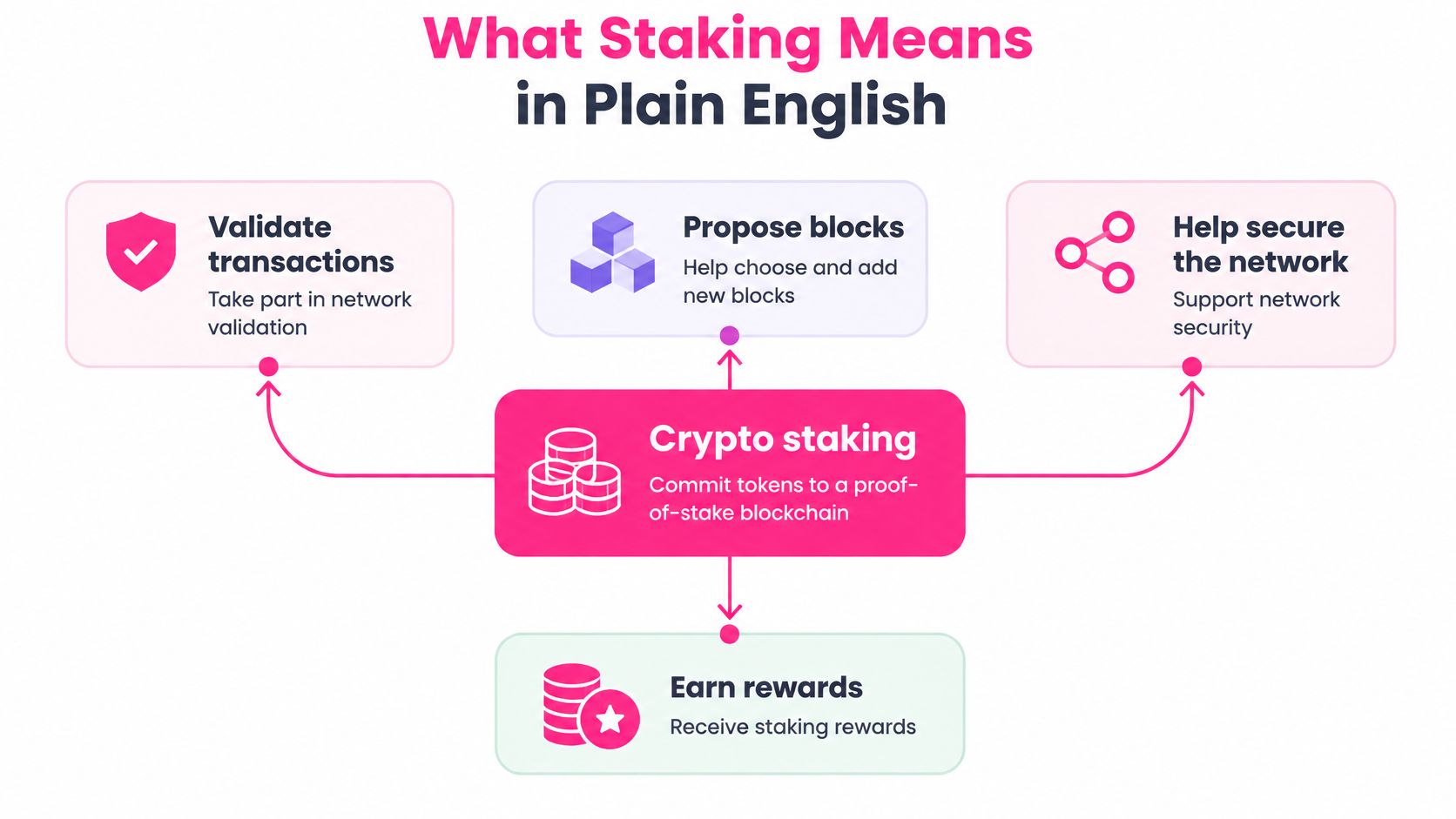
What does staking ask of you? In plain English, it requires two things at once: capital that can be penalized, and work that must be performed. Crypto staking means committing tokens to a proof-of-stake blockchain so validators can check transactions, propose blocks, and keep consensus honest. The Ethereum staking launchpad frames the deposit as the thing that gives a validator something real to lose, which is the cleanest way to understand the design.
A staking deposit works like a caretaker's security deposit. The caretaker gets keys, does the rounds, keeps the building safe, and gets paid for reliability. If the job is done badly or the rules are broken, part of that deposit can be taken. Staked tokens play the same role: they sit locked as collateral while the network pays for correct behavior and prices in the risk of mistakes.
The scarce resource also changes. Proof-of-work mining spends hardware and electricity to compete for the right to add blocks. Proof-of-stake assigns those duties to validators according to committed stake and performance, so the participant carries market risk, operational risk and protocol-rule risk rather than a power bill.
Ethereum shows the shift clearly. The Beacon Chain launched in December 2020 and let staking run before the main network changed. The Merge was completed on September 15, 2022, formally replacing proof-of-work with proof-of-stake. Security stopped being a contest of machines and became a bonded job: put capital at risk, keep validator software reliable, follow the protocol, earn the network's token.
That last part is easy to misread. The advertised rate is only the token-side rate before real life touches it. Commission can skim it, downtime can reduce it, an exit queue can delay it, slashing can cut the principal, and a falling token price can overwhelm a decent yield. Staking is paid capital plus duty, measured in dollars only after every cost and delay has had its say.
Hold three pieces as the rest of the article gets more specific:
- What you lock: a balance the protocol holds in place, either as a validator's own deposit or through an operator you delegate to.
- What you help secure: transaction validation and block production, the actual work being paid for.
- What you earn: newly issued tokens plus a share of fees, shaped by protocol rules rather than a fixed bank coupon.
Who Pays Staking Rewards and Why They Change
A blockchain has no borrowers paying interest out of loan margins. Staking rewards come from the protocol's own issuance rules, from fees users pay to transact, and sometimes from a provider's marketing budget. Those three sources behave very differently when conditions change.
| Reward source | Who pays it | What moves it |
|---|---|---|
| Protocol issuance | The network mints new tokens for validators | Total amount staked, validator performance, protocol rules |
| Transaction fees and tips | Users sending transactions | Network activity |
| Validator commission | Delegators, as a share of their rewards | Operator setting, varies by validator |
| Token incentives | Protocol or provider campaign budget | Campaign rules, can end without notice |
Commission appears in that table because it's the line that most often gets skipped. It doesn't add to the reward pool; it takes a cut of what would otherwise reach you.
The Solana example, with the math shown
Solana's yield isn't a fixed coupon either. Solana's staking documentation states that returns depend on the network's current inflation rate, the total amount of SOL staked, and the chosen validator's uptime and commission. Its published inflation schedule began at 8% annually, declines by 15% year over year, and targets a long-term rate of 1.5% annually.
Commission is where two validators on the same network produce different results. If a validator earns 7 SOL in gross rewards for a delegation and charges 8% commission, the delegator receives 6.44 SOL before wallet, custody or other costs. Solana's docs also note that unstaking means requesting an exit, waiting through a cooldown of about two to three days, then withdrawing.
Two checks catch most of the confusion. First, ask whether the advertised reward is protocol issuance or a temporary campaign that can end without improving the underlying consensus return. Second, read the commission and what it's taken from. Rates also shift as staked balances and activity change, which is normal rather than a malfunction; why DeFi APY changes walks through the moving parts.
Four Staking Methods Compared Side by Side
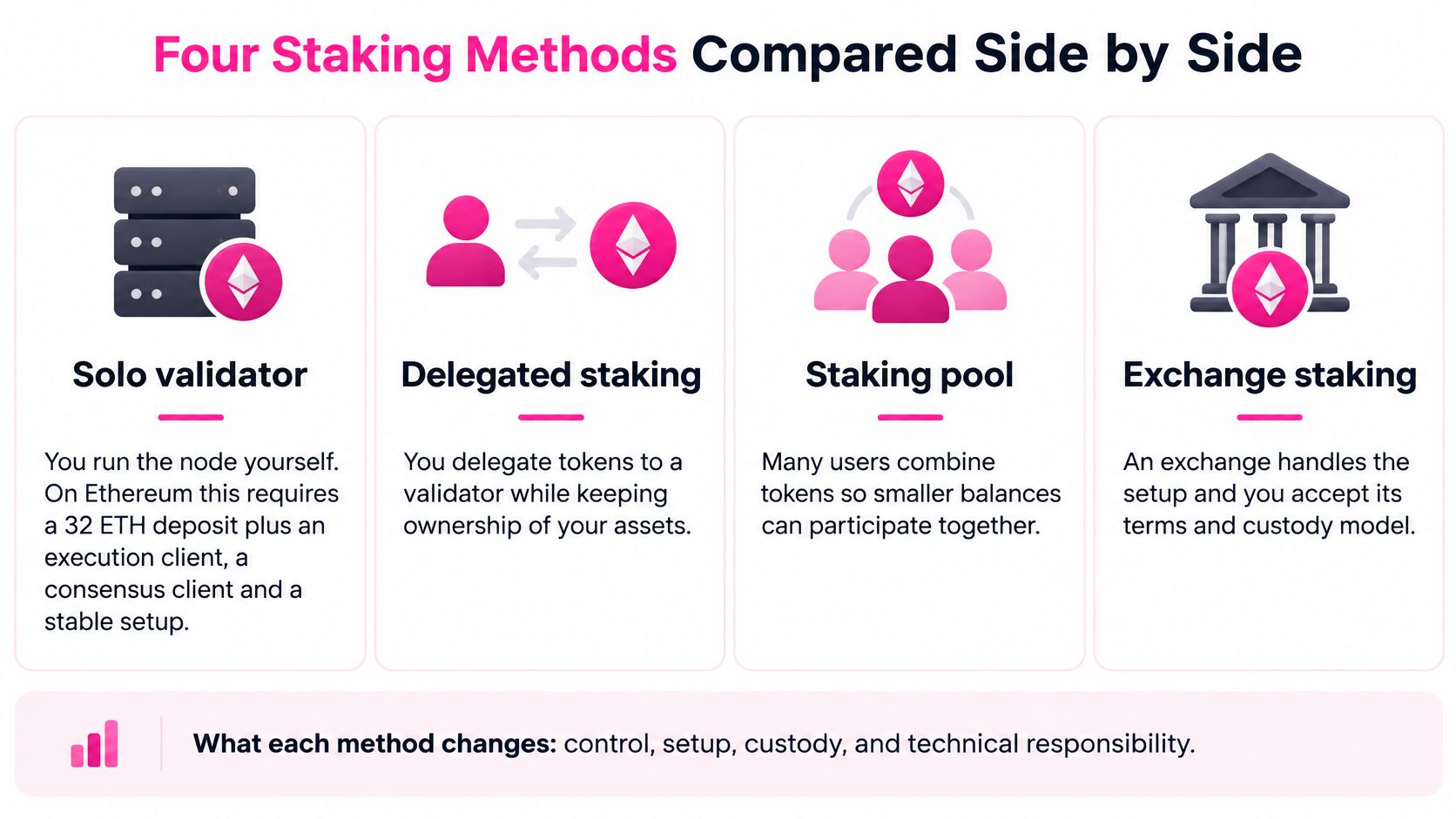
Every staking route answers the same three questions: who holds the keys, who runs the node, and can you sell or transfer your claim today. The method you choose changes the answer, and with it the risk you're taking.
| Method | Who runs the node | Minimum | Can you sell the position? | Added risk |
|---|---|---|---|---|
| Solo validator | You | 32 ETH on Ethereum | Only after the exit process finishes | Operational penalties and slashing |
| Delegated staking | Validator operator | Set by network rules | After unbonding or cooldown | Operator commission and uptime |
| Exchange or custodial | Platform | Set by platform | Per platform terms | Counterparty and custody |
| Liquid staking token | Protocol and node operators | Varies by protocol | Yes, on markets at market price | Smart-contract risk and price divergence |
Solo validation means running the machine yourself. On Ethereum that requires the 32 ETH deposit plus an execution client, a consensus client and a validator client, as Ethereum's proof-of-stake documentation sets out. You keep full control and take full operational responsibility. An offline validator doesn't get slashed automatically; it accrues inactivity penalties while its rewards stop, which is a slow leak rather than a sudden loss.
Delegated staking hands block production to an operator while you keep ownership of the assets. You pay a commission and you inherit the operator's uptime record. The advantage is that someone with monitoring, redundant power and alerting is doing the work. The trade-off is that your return now depends on a third party's discipline.
Exchange and custodial staking moves custody to a platform. That removes setup entirely and adds counterparty risk: solvency, terms of service, withdrawal limits and account access all sit between you and the network.
Liquid staking issues a transferable token representing the staked position. It's the only row where the answer to "can I sell today?" is usually yes, and the price you get can diverge from the underlying staked asset during withdrawal queues or market stress.
Practical rule: a liquid staking token adds flexibility, not safety. The protocol risk stays in every row of that table, and the token adds smart-contract risk on top.
Mixing staking with liquidity provision is a separate activity with a different risk profile, and single-sided staking versus liquidity pools covers where that line sits.
How Long Unstaking Takes and Why It Varies
"Liquid" and "withdrawable" are different words, and the gap between them is where staking surprises happen. Stake is paid capital with an operational duty: it earns for helping the network, and the network controls how quickly that duty can end. A position can be worth money on a screen and still take time to become spendable tokens.
| Exit route | Typical timing | Price you receive | Main constraint |
|---|---|---|---|
| Accrued rewards withdrawal | Protocol sweep or withdrawal request | Same token | Processing delay and gas |
| Ethereum full validator exit | Queue; congestion can stretch it | Staked balance plus rewards | Up to 16 withdrawals per block |
| Solana unstake | Cooldown, then withdrawal | SOL at withdrawal | Cooldown must finish first |
| Liquid staking token redemption | Depends on the redemption queue | Underlying value minus any discount | Queue length and redemption route |
| Sell liquid staking token on market | Immediate if there is a buyer | Market price | Can sit below underlying value |
Ethereum's queue is not a provider policy you can negotiate around. Ethereum's withdrawals documentation describes a limit of up to 16 withdrawals per block, about 115,200 per day under ideal conditions, and an exit queue that peaked near 46 days in September 2025. Partial reward withdrawals can be swept automatically. A full validator exit has to pass through that limit.
Why the queue exists at all
Exit capacity is tied to the active validator set, so the protocol caps how much stake can leave in a given period. It works like a crowded venue with only one open door: people can leave, just not all at the same instant. If everyone could exit together, the security guarantee would weaken exactly when it was needed most.
Paying a higher transaction fee does not buy a place ahead in a protocol exit queue. Fees affect how fast your transaction is included, not how fast the protocol releases stake.
The practical test is dollar based. If you might need the money within a week, ask whether the route can deliver it and at what price: rewards may be swept, principal may queue, a redemption route may lag, and a market sale can price below underlying value. Compare that exit path before comparing headline rates.
Slashing, Penalties and Other Staking Risks
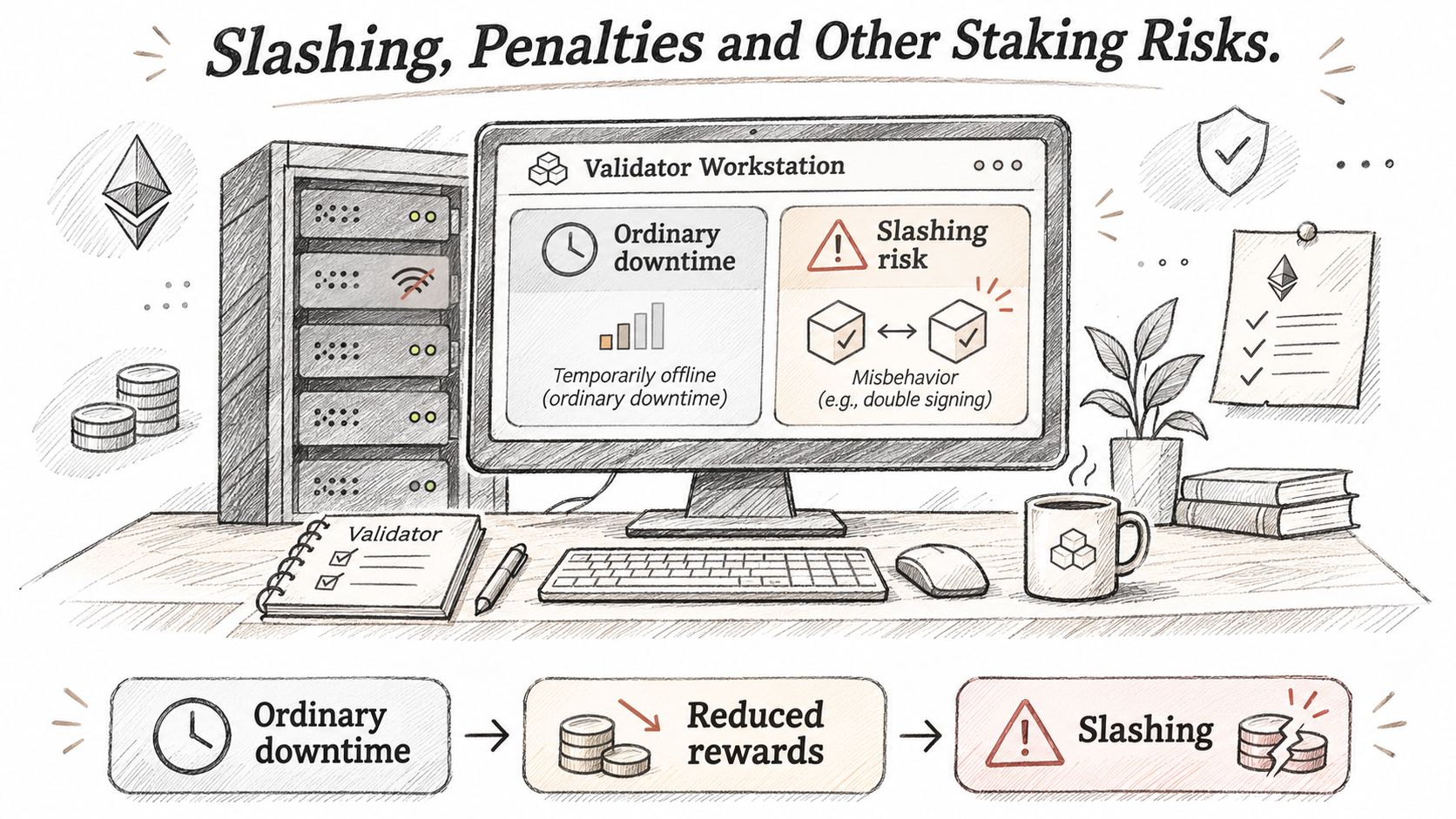
The mildest loss in staking isn't a crash. It's a validator that drops offline for a few hours and stops earning while inactivity penalties trim the balance.
Slashing is the severe end of the same fault model, and Ethereum spells out what triggers it: signing two blocks for one slot, double-voting, or making surrounding attestations. A 32 ETH validator receives an immediate penalty of 0.0078125 ETH, followed by a removal process lasting about 36 days, as Ethereum's rewards and penalties documentation explains.
When one mistake becomes a group loss
The correlation penalty scales with the number of validators slashed at the same time. For an isolated event it can be less than 0.1%; in a mass-slashing scenario it can reach as much as 100%. That range is the single most important fact about infrastructure design, because a redundant signing setup built badly can itself produce the contradictory messages that get validators slashed.
Redundancy protects you only when the backup knows the primary is down. Two machines that both believe they're in charge are worse than one.
Outside the protocol, other losses accumulate. Custodial and pooled services add counterparty, access and smart-contract risk on top of validator risk, and not every proof-of-stake network enables slashing at all, so on some chains the worst case is lost rewards and a cooldown.
Then there's price. Rewards are paid in the network's own token, so a nominal percentage return can be outweighed by a decline in that token's market value.
Crypto assets and DeFi protocols involve substantial risk of loss. Protocol, smart-contract, asset, liquidity, market and platform risks apply to yields shown on Yield.ly, and the risk methodology explains how that assessment is put together and where it stops.
Why Headline APY Is Not Your Real Return
A quoted APY is only the first line of the math. Follow one rate all the way to a wallet balance with round, hypothetical numbers: a staker puts up 10,000 USD at a quoted 5% APY.
| Step | Calculation |
|---|---|
| Gross reward at 5% APY | 10,000 USD x 0.05 = 500 USD |
| Less gas and fees (hypothetical) | 30 USD |
| Net token yield | 470 USD, or 4.7% before commission |
Next comes the validator's cut. A hypothetical 10% commission on the 500 USD reward removes 50 USD, leaving 420 USD, a 4.2% net token yield. Then apply price. If the token falls 20% over the year, the position is worth roughly 8,336 USD (10,420 x 0.80), which is 1,664 USD below the original deposit even though the token balance grew.
Compounding helps, but less than the headline suggests. In one arXiv study of Ethereum staking yields, compounding validators received a median consensus-layer APR of 2.525% versus 2.249% for non-compounding validators over a single 30-day window after the Pectra upgrade. That is one snapshot, and the gap it shows is modest beside the price move in the example above. Retrieving compounded rewards can also require explicit withdrawal requests, gas and queue delays.
Separate the base from the incentive
Only part of a quoted rate is durable. Base APY is the organic yield component before token incentives; the rest may be a campaign that ends without improving the underlying consensus return. Yield.ly's definitions page sets out how those terms are used, and its listings keep base APY and token reward APY apart where those figures are available, so a rate that depends on incentives is easy to spot. Base APY versus reward APY walks through how the two components are separated.
The question that replaces "what's the APY?": what portion is durable, what costs or risks produce it, and what remains after your actual exit, custody and price exposure?
Staking Versus Stablecoin and Bitcoin Yield
Native staking works only on proof-of-stake networks such as Ethereum and Solana. Bitcoin secures its chain with proof-of-work mining, so BTC can't be natively staked on its base chain. Any BTC yield offered elsewhere is a separate product, usually lending or a wrapped-asset strategy, and it carries its own issuer, custody and smart-contract risks. Judge it on those terms rather than calling it staking.
Stablecoin yield is a different mechanism again. The return generally comes from borrowers, liquidity incentives, or both, not from securing a network. A hypothetical 12% APY on a 10,000 USD stablecoin deposit might split into 3% paid in the deposited stablecoin (300 USD) plus 9% in a volatile governance token (900 USD nominal). If that governance token halves, the dollar result falls to roughly 750 USD, or 7.5%, even though the advertised rate was fully paid.
Checks that belong to lending, not staking
Each of these questions has a primary source: protocol documentation, such as Aave's documentation, or live protocol data.
- Available liquidity: can you withdraw at the size you deposited without waiting for borrowers to repay?
- Utilization: when borrow demand approaches the supply cap, withdrawal liquidity can tighten quickly.
- Collateral and oracle design: a thin or manipulable price feed is how liquidations go wrong.
- Redemption mechanics: whether the stablecoin itself can be redeemed at par by whoever issues it.
- Depeg risk: a stablecoin trading below its dollar target cuts the dollar result even when the stated APY is paid.
Where stablecoin yield comes from walks through the mechanics, and live stablecoin listings sit at stablecoin yields. Rates move.
Confirm the Staking Terms Before You Commit
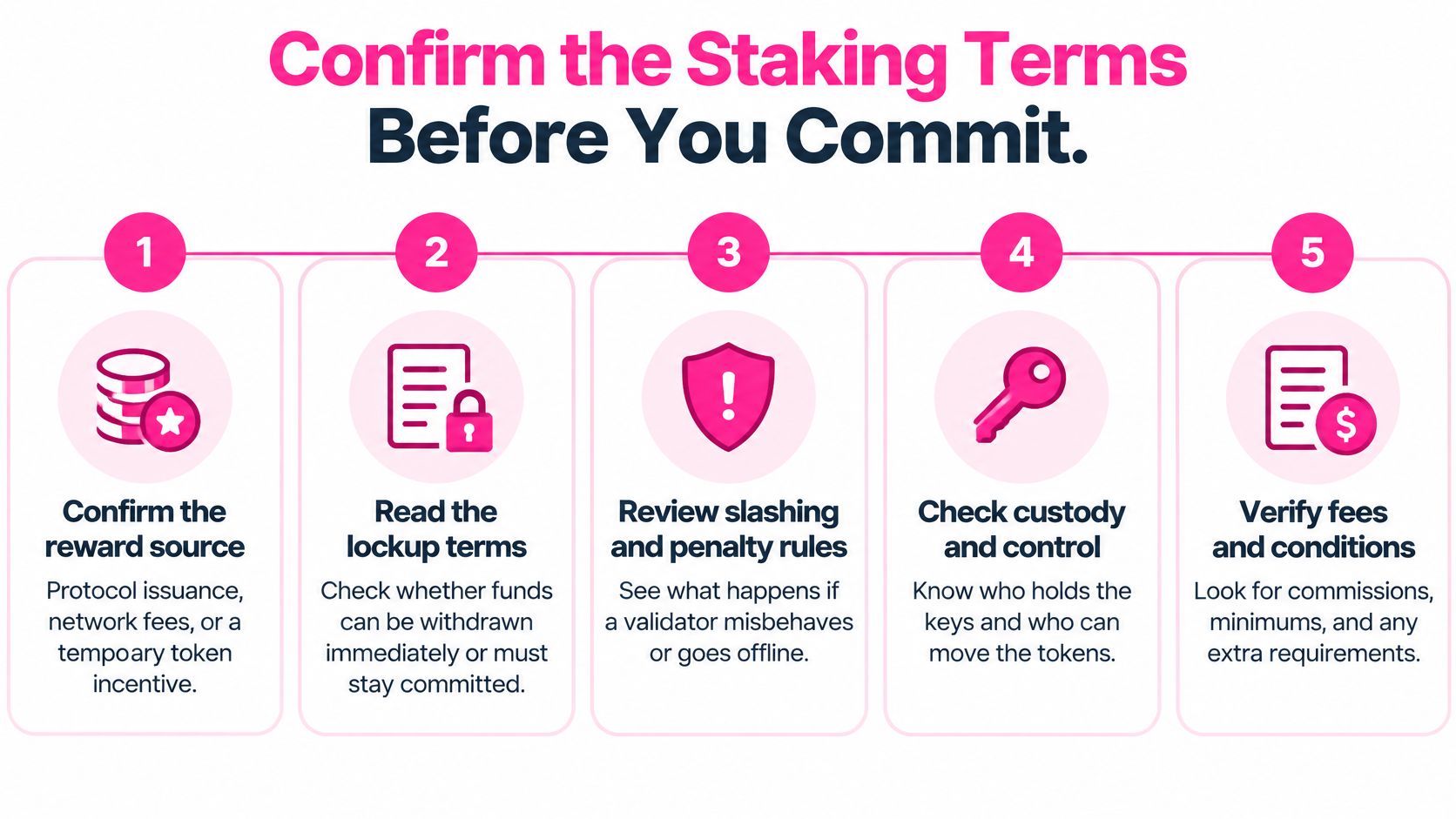
A staking position is paid capital plus an operational duty someone has to perform. Before any tokens move, run these eight checks in order; each one maps to a specific way the position can go wrong.
- Confirm the reward source. Rewards come from protocol issuance, network fees, or a temporary token incentive. If the answer is the third, the rate can vanish without warning.
- Read the commission and what it is taken from. A fee charged on rewards and a fee charged on principal are different costs; the second drains you even in a year when the rewards disappoint.
- Check the validator's uptime history and whether slashing applies on that network. Uptime is the boring metric that decides most of your realized return, since a validator that misses blocks earns less for everyone delegating to it.
- Map the exit route and its timing. Check the actual unbonding queue, not the marketing description of it, so you know how many days stand between a decision to leave and tokens back in your wallet.
- Identify the custody model. Know who can freeze, delay or lose access to the assets, whether that is the protocol, an exchange or your own keys.
- Note the reward currency. A rate paid in a volatile token is a position in that token, not a fixed payment.
- Add every cost. Gas, bridge fees, swap slippage, withdrawal fees and tax treatment all come out of the gross figure before you see a dollar.
- Compare base APY and reward APY separately. Blended rates hide how much of the return depends on incentives.
Yield.ly helps with steps 1 and 8 in particular. It compares qualified crypto yield opportunities by asset, return, liquidity and observed risk, ranks them on yield quality, liquidity, observed risk and data confidence rather than headline APY alone, splits base APY from token reward APY, and shows TVL, seven-day TVL change and data freshness. No account and no wallet connection are needed. ETH listings are at ETH yields, the scoring logic is in the methodology, and beginner explanations sit in the Learn hub. Rates move without notice, and using Yield.ly doesn't transfer responsibility: you're still the one verifying contract addresses, terms, eligibility, tax treatment and counterparty risk before acting.
For education only, not financial or investment advice. Rates move and yield is never guaranteed; DeFi deposits can lose value.
Yield Alpha is Yield.ly's free decision layer: it labels a possible move MOVE, STAY or WATCH, then ranks those moves in dollars after switching costs, so an extra percentage point on a headline rate only counts if it survives gas, bridge and withdrawal fees. Yield.ly needs no account and no wallet connection, holds no funds and executes no trades. Run your own numbers through Find My Yield Alpha before anything moves.